Our Services
Others
- DFPP
- Shockwave
- IV Drip

Degenerative disc disease is one of the most common structural explanations behind chronic neck pain, low back pain, stiffness, and nerve-related symptoms. However, the term can be misleading. It does not describe a single disease that progresses the same way in every patient. Instead, it refers to a complex biological and mechanical breakdown of the intervertebral disc, involving dehydration, extracellular matrix loss, inflammation, annular damage, endplate changes, altered loading, and sometimes nerve irritation.
The intervertebral disc is designed to absorb pressure and allow controlled spinal movement. When the disc begins to lose its normal structure, the spine may become less stable, less flexible, and more vulnerable to pain. In some patients, disc degeneration remains visible on MRI but causes few symptoms. In others, even moderate degeneration may produce persistent pain, muscle guarding, reduced mobility, or radiating symptoms into the arms or legs.
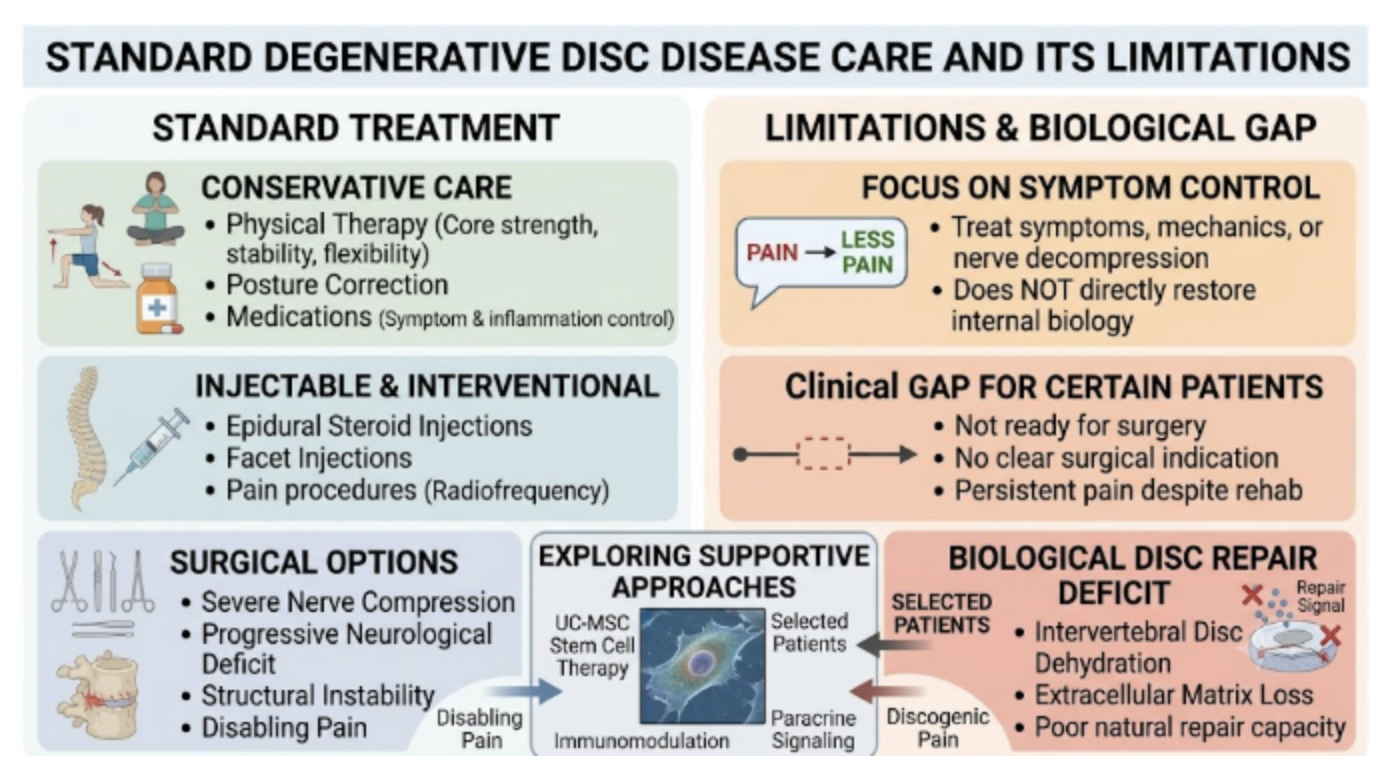
Traditional care for degenerative disc disease usually focuses on symptom control and function. Physical therapy, posture correction, anti-inflammatory medication, pain procedures, lifestyle changes, and surgery may be appropriate depending on the case. However, these approaches do not directly restore the internal biology of the damaged disc. This limitation has increased interest in regenerative medicine, including therapy using umbilical cord–derived mesenchymal stem cells therapy in Thailand (UC-MSCs).
UC-MSC stem cells therapy in Thailand should not be described as a guaranteed cure for degenerative disc disease. A more accurate medical framework is that UC-MSC stem cells therapy in Thailand may support the disc microenvironment through paracrine signaling, inflammation modulation, extracellular matrix support, and tissue repair communication. Current scientific reviews describe disc degeneration as a process involving extracellular matrix disruption, cellular senescence, oxidative stress, and chronic inflammation, which makes biological support an important area of research.
Understanding the Intervertebral Disc
Each intervertebral disc has three major structural components: the nucleus pulposus, the annulus fibrosus, and the cartilaginous endplates. The nucleus pulposus is the soft, gel-like center that helps absorb compression. The annulus fibrosus is the outer fibrous ring that contains the nucleus and resists tension. The endplates connect the disc to the vertebral bones and help regulate nutrient exchange.
Unlike many other tissues, the adult intervertebral disc has limited blood supply. Disc cells depend heavily on diffusion through the endplates for oxygen, glucose, and waste removal. This low-nutrient environment makes disc repair difficult. Once degeneration begins, the disc may struggle to restore its normal balance of hydration, collagen, proteoglycans, and cellular activity.
Healthy discs contain proteoglycans that attract water and help maintain disc height. As degeneration progresses, proteoglycan content decreases, hydration drops, and the nucleus becomes less able to absorb pressure. The annulus may develop fissures, and the endplates may become calcified or inflamed. These changes can increase mechanical stress and may contribute to discogenic pain.

Why Disc Degeneration Becomes Painful
Disc degeneration does not always cause pain. Many people have MRI findings such as disc dehydration, bulging, or height loss without significant symptoms. Pain usually becomes more likely when structural changes interact with inflammation, nerve sensitization, mechanical overload, or instability.
A degenerated disc can release inflammatory mediators that irritate nearby nerve endings. Annular tears may allow inflammatory molecules from the nucleus pulposus to reach pain-sensitive tissues. Reduced disc height may increase stress on facet joints, ligaments, and muscles. In some patients, disc bulging or herniation may compress nerve roots, causing sciatica, numbness, tingling, or weakness.
This is why accurate diagnosis is essential. A patient with isolated discogenic low back pain is different from a patient with severe spinal stenosis, unstable spondylolisthesis, advanced facet arthritis, or progressive nerve compression. Regenerative therapy should only be discussed after the pain generator is carefully evaluated.
Standard Treatment and Its Limitations
Standard treatment for degenerative disc disease usually begins conservatively. Physical therapy may help improve core strength, movement control, spinal stability, and flexibility. Medication may reduce pain and inflammation. Epidural steroid injections, facet injections, or radiofrequency procedures may be considered when specific pain generators are identified. Surgery may be appropriate when there is severe nerve compression, progressive neurological deficit, structural instability, or disabling pain that does not respond to conservative care.
These treatments can be valuable, but they often focus on symptoms, mechanics, or nerve decompression rather than biological disc repair. The American Academy of Orthopaedic Surgeons describes low back pain treatment as commonly involving activity adjustment, medications, physical medicine, and surgery depending on the cause and severity.
This creates a clinical gap for patients who are not ready for surgery, do not have a clear surgical indication, or continue to experience pain despite rehabilitation. UC-MSC stem cells therapy in Thailand is being explored in this space as a supportive regenerative approach, especially for selected patients with discogenic pain, early-to-moderate degeneration, inflammatory disc changes, or poor tissue repair signaling.
What Are UC-MSC Stem Cell Therpay?
UC-MSCs (umbilical cord–derived mesenchymal stem cells) are mesenchymal stem or stromal cells derived from Wharton’s jelly of the umbilical cord. This tissue is collected after healthy birth donation and processed under controlled laboratory conditions. UC-MSC stem cells therapy in Thailand are often discussed in regenerative medicine because they are young, highly active signaling cells with immunomodulatory and paracrine properties.
The modern understanding of MSC stem cells therapy in Thailand is not based mainly on the idea that injected cells permanently become new disc tissue. Instead, MSCs are studied for the biological signals they release. These may include cytokines, growth factors, extracellular vesicles, microRNAs, and proteins that communicate with immune cells, fibrocartilage-like cells, endothelial cells, and damaged tissue environments.
For degenerative disc disease, this signaling activity may be relevant because the disc microenvironment is often inflamed, acidic, low in nutrients, mechanically stressed, and depleted of normal extracellular matrix components. UC-MSC therapy may help support a more repair-oriented environment, but it cannot overcome every structural problem. A collapsed disc, severe deformity, major nerve compression, or advanced instability may require a different treatment pathway.
How UC-MSC Therapy May Support Disc Degeneration
1. Modulating Inflammation Inside the Disc Environment
Chronic inflammation is an important feature of painful disc degeneration. Inflammatory cytokines can increase pain sensitivity, accelerate matrix breakdown, and affect surrounding nerve structures. UC-MSC therapy may help regulate inflammatory signaling through immunomodulatory effects. This may be relevant for patients whose pain is driven partly by inflammatory disc changes rather than only mechanical compression.
2. Supporting Extracellular Matrix Balance
The disc depends on extracellular matrix components such as collagen and proteoglycans. In degeneration, matrix breakdown can exceed matrix repair. MSC-derived signals are being studied for their ability to influence matrix production, reduce catabolic enzyme activity, and support a healthier balance between breakdown and rebuilding. Reviews of stem cells therapy in Thailand for degenerative disc disease describe the field as promising, but still clinically developing.
3. Protecting Native Disc Cells
Disc cells can undergo senescence, apoptosis, and functional decline in response to inflammation, oxidative stress, acidity, and nutrient limitation. UC-MSC paracrine signaling may support cell survival pathways and reduce stress-related injury in experimental settings. The clinical goal is not to create a completely new disc overnight, but to help preserve remaining disc cell function where possible.
4. Extracellular Vesicle Communication
MSC-derived extracellular vesicles are small biological particles that carry proteins, lipids, and nucleic acids. They are being studied because they may deliver repair-supportive signals to damaged tissues. In disc degeneration research, extracellular vesicles are of interest for inflammation regulation, matrix remodeling, and cell-to-cell communication.
5. Supporting Discogenic Pain Management
Pain in degenerative disc disease may come from inflammatory mediators, annular fissures, nerve ingrowth, mechanical stress, and muscle guarding. By supporting inflammation balance and tissue signaling, UC-MSC stem cells therapy in Thailand may help some patients experience improved pain and function. However, pain improvement should not be interpreted as proof of full structural disc regeneration.
Route of Administration and Image-Guided Planning
In spine-focused regenerative medicine, local delivery is often discussed because the intervertebral disc is a specific anatomical target. Intradiscal injection may be performed using fluoroscopy or other image guidance to improve placement accuracy. In some cases, treatment may target related structures such as facet joints, sacroiliac joints, ligaments, or paraspinal tissues depending on the pain generator.
Image-guided planning is important because back pain can come from multiple sources. A patient may have disc degeneration on MRI but pain from facet arthritis, spinal stenosis, sacroiliac dysfunction, myofascial pain, or hip disease. Treating the disc without identifying the true pain source may lead to disappointing results.
A responsible program should review MRI findings, symptoms, physical examination, neurological signs, pain distribution, prior treatments, medication history, and functional limitations before deciding whether UC-MSC therapy is appropriate.

Who May Be a Suitable Candidate?
UC-MSC therapy may be considered for selected patients with chronic discogenic low back pain or neck pain, early-to-moderate disc degeneration, annular fissure-related pain, inflammatory disc changes, or persistent symptoms despite conservative care. It may also be discussed for patients seeking a non-surgical biological support option when surgery is not clearly indicated.
However, not all patients are suitable. Severe spinal canal stenosis, progressive neurological weakness, cauda equina symptoms, active infection, spinal tumor, fracture, severe instability, advanced deformity, or complete disc collapse may require urgent or specialist-directed care. Patients with uncontrolled diabetes, active cancer, systemic infection, severe immune compromise, or unstable cardiovascular disease may need additional evaluation before treatment.
The most appropriate patients are usually those whose imaging findings, symptoms, and clinical examination align with a disc-related pain generator and whose spine still has enough structural integrity to respond to biological support.
Safety, Cell Quality, and Clinical Standards
For UC-MSC stem cells therapy in Thailand, safety depends heavily on cell quality, laboratory control, physician training, and proper patient selection. Important quality factors include donor screening, sterility testing, endotoxin testing, cell identity markers, viability, culture conditions, transport timing, and documentation. Spine injections also require sterile technique and accurate anatomical delivery.
Patients should ask where the cells come from, how they are tested, whether documentation is available, how viability is confirmed, and who performs the procedure. A higher cell number alone does not guarantee better treatment. Freshness, potency-related characteristics, delivery accuracy, and the biological condition of the target tissue all matter.
Regulatory status should also be explained responsibly. In the United States, the FDA states that regenerative medicine therapies have not been approved for orthopedic conditions including disc disease, back pain, and neck pain. Regulations differ by country, but this reinforces the importance of avoiding exaggerated claims and clearly describing UC-MSC therapy as supportive or investigational rather than a proven cure.
Realistic Expectations After UC-MSC Therapy
UC-MSC stem cells therapy in Thailand should not be presented as instant disc rebuilding. Degenerative disc disease develops over years, and the disc has limited natural repair capacity. Realistic goals may include reducing inflammatory pain, improving function, supporting tissue repair signaling, improving tolerance for rehabilitation, and helping selected patients delay or avoid more invasive treatment when appropriate.
Progress should be tracked using objective and practical measures. These may include pain score, Oswestry Disability Index, walking tolerance, sitting tolerance, medication use, sleep quality, neurological symptoms, range of motion, and follow-up imaging when clinically appropriate. Some patients may improve in pain and mobility without major visible MRI changes, while others may show limited response despite technically appropriate treatment.
Long-term success also depends on rehabilitation. Core strength, hip mobility, posture, weight management, smoking cessation, ergonomic correction, and gradual load progression all influence spinal health. Biological therapy works best when it is part of a complete spine preservation plan.
Conclusion
Degenerative disc disease is more than age-related wear and tear. It is a complex biological and mechanical process involving disc dehydration, extracellular matrix loss, annular damage, endplate dysfunction, inflammation, oxidative stress, and altered spinal loading. Because the disc has limited blood supply and poor natural repair capacity, many patients struggle with chronic pain even after conventional treatment.
UC-MSC stem cells therapy in Thailand is being explored as a supportive regenerative approach for selected cases of discogenic back or neck pain. Its scientific rationale is based on paracrine signaling, immunomodulation, extracellular vesicle communication, matrix support, and improvement of the local tissue microenvironment. Early clinical research is promising, but the evidence is still developing, and earlier reviews have noted limitations such as small sample sizes, risk of bias, and the need for stronger comparative studies.
For patients considering stem cell therapy for degenerative disc disease in Thailand, the safest approach begins with accurate diagnosis, MRI review, physician-led evaluation, high-quality UC-MSC preparation, image-guided delivery when appropriate, and structured rehabilitation. The goal is not to promise a new spine. The goal is to support the biological conditions that may help reduce pain, preserve function, and improve quality of life in carefully selected patients.
FAQ
1.Can UC-MSC therapy cure degenerative disc disease?
No. UC-MSC therapy should not be described as a guaranteed cure. It may support inflammation regulation, tissue repair signaling, and the disc microenvironment in selected patients, but results vary.
2.Is stem cell therapy a replacement for spine surgery?
No. If there is severe nerve compression, progressive weakness, spinal instability, fracture, infection, or cauda equina symptoms, surgical or urgent specialist care may be required. UC-MSC therapy is best discussed as a supportive option when clinically appropriate.
3.How is UC-MSC therapy delivered for disc degeneration?
In spine cases, local image-guided injection may be discussed depending on the target area. The treatment plan should be based on MRI findings, symptoms, physical examination, and physician assessment.
4.How long does it take to see improvement?
Some patients may notice changes over weeks to months, but response varies. Degenerative disc disease is chronic, and biological repair processes are gradual.
5.Do I still need rehabilitation after stem cell therapy?
Yes. Rehabilitation is essential. Core strength, posture, movement control, weight management, and gradual activity progression are important for long-term spine health.
This article is for educational purposes and does not constitute medical advice. UC-MSC therapy for degenerative disc disease is supportive and investigational, not a guaranteed cure. Please consult a qualified physician to discuss your specific situation.