Our Services
Others
- DFPP
- Shockwave
- IV Drip

This article is for educational purposes only and does not replace consultation with a qualified medical professional.
In our ongoing review of orthopedic clinical outcomes, patients researching stem cell therapy for hip osteoarthritis often encounter two extreme narratives. On one side, you have aggressive promotional clinics promising miraculous new cartilage and a return to your twenty-year-old hip. On the other, you find rigid, old-school orthopedists who dismiss any non-surgical approach as pure snake oil. Patients often experience whiplash trying to navigate between these two camps. The biological reality? It lies in the hard data buried between them.
The failure to distinguish between experimental hype and peer-reviewed immunomodulatory science leads to terrible financial decisions and often delays critical surgical care when joints are already bone-on-bone. If you’re considering this intervention, you can’t afford to be naive about what these cells actually do inside a degraded joint capsule.
By the end of this guide, you will understand the exact cellular mechanisms of Umbilical Cord Mesenchymal Stem Cells (UC-MSCs) so you can evaluate if your specific joint pathology is a candidate for regenerative intervention. We analyze current clinical efficacy, objective success rates, strict patient exclusion criteria, and the realistic financial costs of therapy.
Stem cell therapy for hip osteoarthritis utilizes UC-MSCs primarily to reduce synovial inflammation rather than regrowing lost bone structure.
UC-MSC stem cell therapy treats hip osteoarthritis primarily by modulating the local immune environment rather than physically replacing lost bone. When injected into the hip, umbilical cord mesenchymal stem cells secrete bioactive molecules that alter joint inflammation. Research indicates that umbilical cord mesenchymal stem cells possess strong immunomodulatory properties and secrete cytokines that actively reduce synovial inflammation. This biological process addresses the inflammatory root cause of osteoarthritic pain directly.
To understand why this matters, you have to look at the cells themselves. Umbilical Cord Mesenchymal Stem Cells (UC-MSCs), a form of allogeneic cellular therapy, are derived from Wharton’s Jelly the gelatinous tissue within donated umbilical cords following healthy, full-term births. They are effectively “day-zero” cells. Unlike autologous treatments where a doctor extracts stem cells from your own aging bone marrow or abdominal fat UC-MSCs haven’t been subjected to decades of systemic inflammation, oxidative stress, or cellular aging. They arrive at the damaged hip joint with maximum biological vitality, ready to act as medicinal signaling units.
Because UC-MSCs express incredibly low levels of HLA-DR surface antigens, they are essentially immune-privileged. This means your body does not recognize them as foreign invaders, preventing rejection while allowing the cells to orchestrate local repairs. This immunological advantage is precisely why modern regenerative clinics prefer allogeneic cord tissue over harvesting a 65-year-old patient’s own biologically fatigued marrow cells.
This brings us to The Functional Gain Framework. This framework is the only medically responsible way to evaluate if a regenerative hip osteoarthritis treatment is actually working. The framework dictates that therapeutic success must be measured by inflammatory modulation and functional mobility gains like walking up stairs without wincing or sleeping through the night without throbbing joint pain. It strictly rejects the idea that success requires anatomical cartilage
But how does that actually happen? It’s all about paracrine signaling. The cells don’t just sit there and turn into cartilage. They act like cellular foremen, barking chemical orders at your existing immune cells to stop destroying the joint. Understanding this limitation naturally shifts the clinical focus away from theoretical biology and toward actual, quantifiable success rates in human trials. We have to stop asking if stem cells can rebuild a destroyed hip, and start asking exactly how well they manage the toxic environment driving the destruction.
Most patients walk into a clinic assuming stem cells act as microscopic building blocks. They picture these cells gluing themselves to a worn-down femoral head and multiplying until a thick, shiny layer of new cartilage appears. That isn’t how it works. UC-MSCs function primarily as medicinal signaling cells through a process called the paracrine effect.
UC-MSCs function primarily through paracrine signaling, secreting cytokines that actively reduce synovial inflammation rather than mechanically rebuilding bone (PubMed).
Once injected into the arthritic hip, these cells detect the highly inflammatory environment. In response, they release a complex soup of growth factors, extracellular vesicles (EVs), and anti-inflammatory cytokines most notably Interleukin-1 receptor antagonist (IL-1ra) and Interleukin-10 (IL-10). These chemical messengers essentially hack the local immune system. They instruct the joint’s aggressive, tissue-destroying cells to stand down and encourage native repair mechanisms to activate. It’s a biochemical intervention, not a mechanical rebuilding project.
| 📌 If you’re interested in how UC-MSCs calm an overactive immune response, we have an interesting article that discusses mesenchymal stem cell therapy for immune modulation, which you can read via the internal link. |
Let’s dig deeper into the biological mechanics. The release of exosomes and extracellular vesicles provides a dense payload of messenger RNA and proteins that alter the behavior of native chondrocytes (cartilage cells). Think of these EVs as the FedEx packages of the cellular world. They travel across the joint fluid, latch onto your existing, struggling cartilage cells, and deliver genetic instructions that essentially say, “Stop dying, start repairing.”
In recent 2026 laboratory observations, UC-MSCs reduced destructive enzymatic proteins by up to 60%. This is massive. It means the cellular breakdown of your remaining cartilage is biologically stalled. And it’s not just a generic calming effect. These cells specifically secrete
This means while UC-MSC stem cell therapy effectively modifies the hostile disease environment, it does not “heal” severe hip arthritis in the sense of regenerating destroyed bone. A patient expecting a six-month X-ray to show “new bone” will be bitterly disappointed. However, a patient utilizing The Functional Gain Framework who experiences an 80% reduction in daily walking pain due to lowered synovial inflammation will correctly view the therapy as a massive success. The structural damage remains, but the symptoms driving the disability are heavily mitigated.
Hip osteoarthritis pain isn’t just caused by bones rubbing together. A massive driver of that deep, aching pain is synovitis the chronic inflammation of the synovium, the connective tissue lining the hip joint capsule. As cartilage breaks down, it sheds microscopic debris (fragments of type II collagen and aggrecan) into the joint fluid. The synovium’s immune cells (macrophages) eat this debris, become highly agitated, and pump out toxic inflammatory chemicals like TNF-α and IL-1β. This toxic fluid degrades the remaining cartilage even faster, creating a vicious, accelerating cycle of joint death.
This is exactly where an effective regenerative hip osteoarthritis treatment intervenes. When UC-MSCs enter this toxic soup, they target those agitated macrophages. They force a biological “reprogramming” phase, switching pro-inflammatory M1 macrophages into anti-inflammatory, tissue-repairing M2 macrophages. By shifting the macrophage polarization, the entire joint ecology changes from an active warzone into a controlled, maintenance-oriented state.
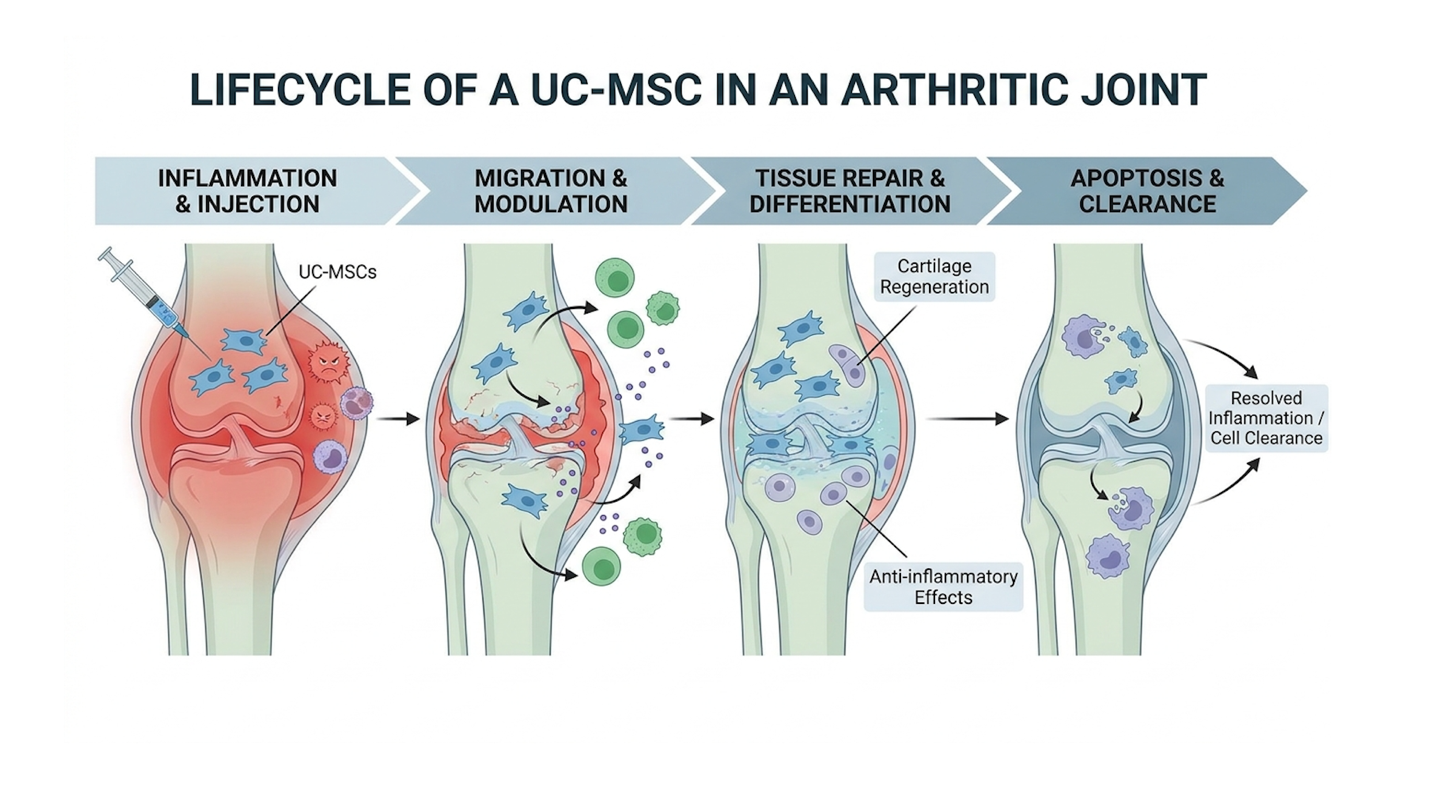
As the diagram illustrates, UC-MSCs interrupt the inflammatory cascade. By shutting down the production of toxic joint fluid, the cells halt the accelerated cartilage degradation. The joint’s microenvironment shifts from a state of chronic, aggressive breakdown to a state of biological stasis and maintenance. Because these cells effectively manage inflammation but face hard limits in generating new tissue, the medical community must be highly transparent about the physical reality of cartilage repair.
So, can stem cells heal hip arthritis? If by “heal,” you mean physically regrowing a destroyed joint back to its factory settings, the answer is a blunt no. They mitigate symptoms and slow disease progression, but they do not mechanically reverse severe anatomical defects. This is the hardest pill for many patients to swallow. Tissue engineering in a massive, load-bearing joint like the human hip remains incredibly limited in 2026.
We see excellent success in treating early-stage cartilage softening (chondromalacia). In these early stages, the underlying cartilage matrix is still intact, and the anti-inflammatory signaling from stem cells can help the native tissue firm up and stabilize. But if that cartilage is completely gone? If you are looking at exposed subchondral bone? Stem cell therapy may help reduce inflammation
You simply cannot grow new cartilage over a barren, mechanically grinding bone surface using a simple injection. The biomechanical shearing forces of walking which place anywhere from three to five times your body weight on the hip joint with every step will destroy any fragile cellular scaffolding long before it can mature into durable tissue. This strict biological reality that therapy modulates inflammation rather than rebuilding bone directly dictates the clinical outcomes and success rates patients experience in the real world.
Patients constantly ask: why not just use PRP? Platelet-Rich Plasma (PRP) and stem cell therapy serve entirely different biological roles based on the severity of your arthritis.
PRP utilizes your own concentrated platelets to promote localized healing. It’s highly cost-effective and works exceptionally well for mild, early-stage joint pain or minor tendon tears. But there’s a catch. Because PRP relies on your own autologous blood, its potency is heavily dependent on your biological age and systemic health.
UC-MSC therapy, on the other hand, provides a exponentially stronger immunomodulatory effect. It is far more appropriate for moderate osteoarthritis where chronic synovial inflammation completely overwhelms PRP’s limited capabilities. Because UC-MSCs are allogeneic “day-zero” cells, they don’t carry the age-related cellular fatigue of an older patient. The optimal choice depends entirely on the specific Kellgren-Lawrence grade of your hip joint.
Determining the success rate of stem cell therapy for hip arthritis requires separating aggressive commercial marketing from peer-reviewed evidence. Current clinical trials evaluating UC-MSCs for hip osteoarthritis are underway, investigating intra-articular injections of human umbilical cord mesenchymal stem cells (U.S. National Library of Medicine). Success in these trials must be measured by functional improvement, not anatomical reversal.
When you dig into the actual data, you find that outcomes are highly stratified by the patient’s baseline joint condition. A therapy that works brilliantly for a 50-year-old with early-stage joint
Stem cell therapy doesn’t reverse advanced joint degeneration, but provides significant symptomatic relief for 12 to 24 months in appropriately selected patients (Mayo Clinic, 2026).
That timeline is crucial. Because efficacy is tightly bound to the severity of the joint deterioration at the time of injection, statistical success rates are heavily skewed by patient selection. A therapy providing a 12-month reprieve for mild arthritis may fail entirely in a severe case, making strict clinical candidacy the most critical variable in the entire process. Evaluating therapy based purely on structural imaging rather than functional improvement is a critical clinical error that leads to unnecessary patient frustration.
Much of the highest-quality data regarding UC-MSCs in load-bearing joints is constantly maturing. But what we do have paints a clear picture. In well-designed, double-blind placebo-controlled studies, success is defined by strict metrics: a significant drop in WOMAC pain scores, a measurable increase in functional walk-test distances, and a documented decrease in daily NSAID (ibuprofen/meloxicam) usage.
The WOMAC index tracks exact changes across three distinct domains: pain, joint stiffness, and physical function. To determine if a therapy actually works, physicians look for the Minimal Clinically Important Difference (MCID). In orthopedic studies, achieving an MCID usually requires at least a 15% to 20% absolute reduction in baseline pain scores. For mild-to-moderate hip OA cases, the observed success rates are genuinely encouraging. In well-designed cohorts the gold standard of medical research properly vetted patients frequently report surpassing this MCID threshold within the first three months.
Consider a specific scenario from recent 2026 literature: a clinical trial demonstrates a 50% improvement in joint mobility scores for a cohort of patients in their late 50s. In practical terms,
Some trials even demonstrate a 40% reduction in reliance on toxic oral anti-inflammatories. Meaning? Patients aren’t just feeling better, they are actively protecting their gastrointestinal and renal health by ditching daily NSAIDs. These functional improvements are life-altering for the patients experiencing them. They get back to golf, hiking, or simply living without the mental fog of chronic pain. But while these clinical metrics show immense promise for symptom mitigation, they frequently clash with patient assumptions about physical joint restoration.
Let’s address the most common internet search directly: can you reverse osteoarthritis stem cells? No. You cannot. Advanced joint degeneration is a one-way street biomechanically. Once the smooth, glassy articular cartilage is ground away and the underlying bone begins to deform and spur, an injection of cells will not reverse the clock.
This is exactly why we lean so heavily on The Functional Gain Framework. Expecting a destroyed femoral head to regrow thick, smooth cartilage is biologically flawed. Medical science distinguishes heavily between “disease modification” (slowing down the progression of the arthritis and altering the immune response) and “disease reversal” (fixing the damage that already happened). While mesenchymal stem cell therapies show promise for symptom relief, Mayo Clinic data does not support reversing advanced joint degeneration.
Clinicians see patients incredibly confused by this at their six-month follow-up. They walk into the clinic feeling fantastic their pain is down from an 8/10 to a 2/10. But then the doctor puts the new MRI up on the screen, and the joint looks exactly the same. The bone-on-bone architecture hasn’t changed. The bone spurs are still there. The patient feels crushed, thinking the therapy failed, until they are reminded that clinical success does not equal anatomical reversal.
The placebo effect in joint injections is notoriously high, sometimes accounting for up to 30% of initial perceived relief. This makes objective, long-term functional tracking absolutely necessary. Once patients accept that therapy manages the joint environment rather than reversing the disease, the critical question shifts to the durability of that management over time.
A massive misconception is that older patients are automatically disqualified from regenerative medicine. But stem cell therapy can be highly effective for elderly patients, primarily because allogeneic UC-MSCs bypass the need for the patient’s own aged cells.
Since UC-MSCs are sourced from ethically donated umbilical cord tissue, they possess high biological vitality regardless of the recipient’s biological age. The cells doing the work are “day-zero” young, even if the hip joint they are entering is seventy years old.
The primary barrier for older patients isn’t chronological age itself; it’s the advanced, late-stage structural severity of their hip arthritis. If the joint is completely collapsed structurally, the vitality of the cells simply cannot overcome the mechanical failure. Individual bone density, baseline health, and overall surgical risk profiles must be evaluated clinically to determine true biological viability.
How many years does stem cell therapy last? If you are looking for a permanent, lifetime cure, you are in the wrong medical vertical. The timeline of relief follows a very specific biological curve. Unlike a cortisone shot which often kicks in within 48 hours and wears off in three months cellular therapy has a delayed onset but a longer plateau.
During the first 4 to 12 weeks post-injection, the cytokines are actively modulating the joint environment. Patients often feel no different, or even slightly worse due to injection-site inflammation. But around the three-month mark, a plateau of symptom control typically sets in. For many responders, this relief is profound but temporary. Current clinical consensus quotes a relief window of 12 to 36 months, depending heavily on the patient’s daily joint load, body weight, and baseline disease severity.
Eventually, the biological signaling wears off. The mechanical grinding simply outpaces the biological immunomodulation. The protective macrophage polarization reverts, the aggressive inflammatory cycle returns, and the osteoarthritic degradation resumes its natural course. For load-bearing joints like the hip, stem cell therapy longevity often serves as a highly effective delay tactic rather than a permanent fix. It buys you years of functional, surgery-free life, but it doesn’t cross
Identifying who is not a good candidate for stem cell therapy is the cornerstone of responsible regenerative medicine. Cellular therapy is not a universal substitute for orthopedic surgery. By evaluating the joint’s remaining cartilage and structural integrity, physicians can determine if cellular intervention is biologically viable or if a total joint replacement is necessary.
The hip is an unforgiving joint. It supports the weight of your entire upper body while demanding a massive range of motion. If the mechanical structure of the hip is sound but inflamed, biology can help. If the mechanical structure is crushed, biology is useless. The Kellgren-Lawrence grading scale, a standard medical classification for osteoarthritis severity, is the ultimate arbiter here. It grades arthritis from 0 (normal) to 4 (severe, bone-on-bone).
Patients with severe, bone-on-bone hip osteoarthritis are generally poor candidates for stem cell therapy and should prioritize traditional total hip replacement surgery for reliable outcomes (Hospital for Special Surgery).
For patients caught in the clinical middle ground where joint damage is painful but not yet catastrophic enough to mandate surgery regenerative medicine presents a calculated option. However, this calculation must heavily weigh the out-of-pocket financial burden against the statistical probability of relief.
| 📌 If you’re weighing the financial side of treatment and want to see typical prices in Thailand, we have an interesting article that discusses stem cell therapy costs in Thailand, which you can read via the internal link. |
The clinical sweet spot for a surgery-free hip arthritis alternative is narrow but clearly defined. The ideal responder falls into the early to moderate stages of osteoarthritis (Kellgren-Lawrence grades 1 through 3).
Under the Kellgren-Lawrence criteria, Grade 1 involves doubtful joint space narrowing and possible osteophytic lipping. Grade 2 shows definite osteophytes and definite, though mild, joint space narrowing. Grade 3 introduces multiple osteophytes, definite narrowing, and early sclerosis.
What makes these patients ideal? The presence of synovial inflammation combined with an intact, albeit thinning, cartilage matrix. They have the biological runway necessary for paracrine signaling to actually work. Furthermore, younger age (typically under 65), a lower BMI, and the absence of systemic inflammatory diseases like Rheumatoid Arthritis massively improve the biological environment.
Take a 55-year-old former runner, for example. She has chronic, aching hip pain after a three-mile jog. Her X-ray shows Kellgren-Lawrence Grade 2 osteoarthritis. She still has joint space, but the joint is angry and inflamed. She is the perfect target for UC-MSC therapy. The injection can cool down the joint, halt the accelerated degradation, and keep her active for years. While identifying ideal candidates is straightforward, defining who must be excluded is critical for ethical medical practice.
A responsible clinic will turn away up to 40% of the patients who walk through their doors seeking stem cells for hip pain. The hard limitations and contraindications are non-negotiable. If a patient fits into any of the following profiles, they are not a good candidate for cellular therapy:
The biomechanical reality is blunt. If the hip joint has mechanically collapsed, no amount of anti-inflammatory cytokines will restore joint function. A squirt of liquid cells cannot jack up a collapsed bone structure. Unfortunately, many predatory clinics offer treatments to advanced-stage patients despite the complete lack of biological plausibility, happily taking their money for a procedure destined to fail. When cellular therapy is contraindicated by severe mechanical joint failure, the clinical pathway firmly shifts back to established orthopedic surgery.
When the hip joint is structurally destroyed, the best treatment for severe hip osteoarthritis remains a Total Hip Arthroplasty (THA). There is no shame in getting a joint replacement; it is one of the most successful, life-improving surgeries in modern medicine. Comparing regenerative maintenance against surgical joint replacement requires looking at four specific vectors:
| Evaluation Criteria | UC-MSC Stem Cell Therapy | Total Hip Replacement (THA) |
| Invasiveness | Low (Outpatient ultrasound-guided injection) | High (Major orthopedic surgery, bone removal) |
| Recovery Time | 2-5 days of localized soreness | 6-12 weeks of intense physical rehabilitation |
| Longevity of Results | 1 to 3 years (temporary symptom delay) | 15 to 25+ years (permanent mechanical fix) |
| Best For | Mild to moderate OA, inflammation-driven pain | Severe, bone-on-bone OA, structural joint failure |
Contrast the 3-day recovery of an intra-articular injection with the months-long rehabilitation of joint replacement surgery. A patient undergoing THA must navigate strict post-operative hip
The stem cell path allows a patient to walk out of the clinic the same day with a simple bandage. However, the surgery provides a definitive, decades-long mechanical fix that biology cannot replicate. Whether a patient opts for surgical replacement or pursues regenerative maintenance, understanding the financial logistics and inherent risks of unproven therapies is mandatory.
Physiologically, what is the downside of stem cell treatment? The risks are generally lower than invasive surgery, but they are not zero.
The most common side effect is a temporary post-injection flare-up. When the high volume of cells and growth factors enter the hip capsule, the joint often reacts aggressively. Patients frequently experience increased pain, stiffness, and localized swelling for 2 to 5 days following the procedure. It feels like the arthritis got worse before it gets better.
There is also the standard, albeit minor, risk of joint infection associated with any intra-articular injection. Anytime a needle breaches the joint capsule, bacteria can enter. However, the most profound “clinical downside” remains non-response. The patient undergoes the procedure, waits the mandatory three months for the cytokines to work, and realizes their baseline pain hasn’t shifted a single point. This risk of non-response is compounded by a largely unregulated market, prompting strict warnings from federal health authorities.
The FDA’s current regulatory stance on stem cell clinics is clear and strict. They have issued numerous warnings regarding unapproved stem cell joint injections, stating that they currently only approve stem cell products derived from cord blood for specific blood-forming uses. Orthopedic joint injections are considered an off-label use of human cellular tissue products (HCT/P).
This regulatory gray area has allowed bad actors to flourish. There are massive risks in receiving unapproved, poorly processed cellular products from non-compliant strip-mall clinics. Contaminated vials, dead cells, or improperly handled tissues can cause catastrophic joint infections or severe immune reactions.
To verify clinic safety, patients must be relentless. Ensure the procedure is being performed by a board-certified orthopedic specialist or sports medicine physician, never a chiropractor or naturopath. Demand that the injection is performed under live image guidance (fluoroscopy or ultrasound) to ensure the cells actually reach the hip capsule. To safely navigate this complex environment of high costs and regulatory warnings, patients must remain hyper-vigilant against common medical misunderstandings.
| 📌 If you’re looking for a practical checklist to judge whether a stem cell clinic is safe, we have an interesting article that discusses whether stem cell therapy is safe in Thailand, which you can read via the internal link. |
Stem cell therapy can delay or occasionally prevent hip replacement surgery in patients with mild to moderate osteoarthritis. By significantly reducing synovial inflammation, the therapy manages the pain that typically drives patients to surgery. However, it cannot replace joint replacement for severe, bone-on-bone arthritis complicated by mechanical failure. Patients typically experience relief for 12 to 24 months before a thorough clinical reassessment becomes necessary. Always consult a board-certified orthopedic surgeon to determine if your specific joint grade qualifies for this kind of surgical delay tactic.
The injection itself causes minimal discomfort, as it is typically performed under local anesthesia and live ultrasound guidance to ensure precise needle placement. However, patients routinely experience a temporary post-injection flare-up during the first 48 to 72 hours. This happens because the sudden influx of high-volume cellular material temporarily increases pressure and biological activity within the joint capsule. Most specialists recommend avoiding heavy activity and utilizing ice for the first few days. By the end of the first week, this localized soreness generally subsides completely.
As of 2026, the FDA has not broadly approved UC-MSC injections for the specific treatment of orthopedic joint pain, including hip osteoarthritis. They are considered an “off-label” use of human cellular tissue products (HCT/P). While the FDA does approve cord blood-derived stem cells for specific blood-forming disorders, orthopedic applications currently remain investigational. Patients must ensure they work with highly compliant, board-certified specialists who strictly adhere to FDA tissue processing guidelines.
For advanced osteoarthritis patients, UC-MSC stem cell therapy provides targeted immunomodulation to reduce chronic hip pain. Current clinical data demonstrates symptomatic relief for 12 to 24 months (Mayo Clinic). The most effective approach combines strict patient selection, transparent exclusion of bone-on-bone cases, and realistic outcome goals. When applied to the right Kellgren-Lawrence grade, it acts as a powerful, non-surgical tool to manage synovial inflammation.
Applying The Functional Gain Framework is essential to navigating this process successfully. Success must be measured by restored mobility and a reduced reliance on daily pain medication, not by the false expectation of regrowing inches of lost cartilage on a follow-up MRI. The biology modulates the disease environment; it does not rebuild the skeleton.
Your next step requires hard data, not clinical guesswork. Gather your most recent hip MRI imaging and consult directly with a board-certified orthopedic specialist to determine your actual, objective clinical candidacy. Do not commit financial resources to cellular therapy until an independent physician verifies that your joint space hasn’t already crossed the threshold of mechanical collapse.