Our Services
Others
- DFPP
- Shockwave
- IV Drip

When researching non-surgical options for thinning hair, patients often search for what are the benefits of stem cell therapy for hair loss while weighing the pros and cons against older methods. Because Vega Medical Services already maintains dedicated pages covering hair biological mechanisms and clinical candidates, this guide focuses entirely on what sets regenerative therapy apart: the specific clinical advantages, realistic limitations, safety profiles, and direct comparisons to traditional treatments.
The primary benefit is its ability to stimulate native follicle regeneration without surgery or lifelong chemical dependencies. By utilizing concentrated growth factors and paracrine signaling, the treatment targets miniaturized follicles at a cellular level to increase hair density, improve scalp health, and naturally restore hair thickness.
| 📌 If you’re interested in how MSCs calm overactive immune cells throughout the body, we have an interesting article that discusses mesenchymal stem cell therapy for immune modulation, which you can read via the internal link. |
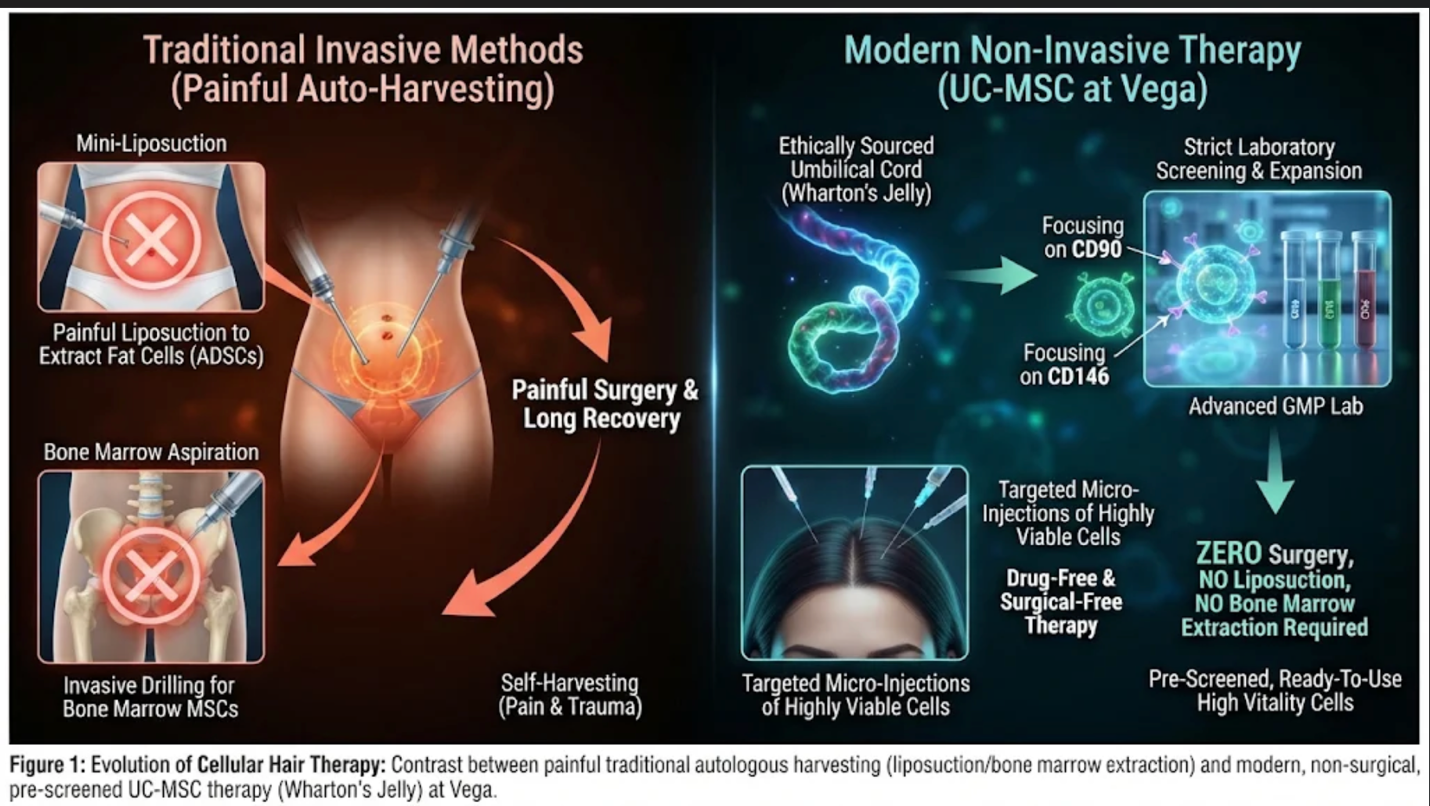
Figure 1: Comparative Hair Restoration Methodologies: A clinical visualization distinguishing between traditional surgical hair transplants and lifelong pharmaceutical maintenance (left) and modern, non-surgical UC-MSC cellular therapy (right), emphasizing zero scarring, natural regeneration, and freedom from daily medication.
Understanding the benefits of stem cell hair treatment requires looking at how biological stimulation differs from surface-level management.
No, Because the procedure is performed via targeted micro-injections, there are no surgical incisions, no stitches, and does stem cell hair treatment need liposuction? Not when using pre-screened, laboratory-expanded cell lines, eliminating the trauma of autologous fat harvesting.
To provide complete transparency, evaluating the stem cell hair treatment pros and cons ensures patients have grounded expectations before beginning care.
| 📌 If you’re planning treatment in Thailand and want a practical checklist for choosing a safe clinic, we have an interesting article that discusses whether stem cell therapy is safe in Thailand, which you can read via the internal link. |
Patients frequently ask: is stem cell hair treatment better than a hair transplant? The answer depends entirely on your stage of hair loss. They are complementary rather than competing solutions.
| Comparison Factor | Stem Cell Hair Treatment | Surgical Hair Transplant (FUE/FUT) |
| Primary Goal | Revitalize, thicken, and save struggling existing follicles. | Physically relocate healthy hair follicles from a donor site to bald zones. |
| Invasiveness | Non-surgical (micro-injections; zero scars). | Surgical procedure involving harvesting and grafting (leaves donor scars). |
| Best For | Early to moderate thinning, diffuse hair loss, and preserving hair. | Advanced, localized baldness and completely dead follicular zones. |
| Can You Combine Them? | Can I combine stem cell hair treatment with a hair transplant?Yes. Many patients use stem cell therapy post-transplant to heal donor sites and support graft survival. | Often paired with regenerative therapy to optimize overall scalp density. |
When comparing stem cell vs traditional hair loss treatments like topical minoxidil or oral finasteride, the fundamental difference lies in maintenance and mechanism.
Traditional pharmaceuticals require lifelong daily adherence. If you stop taking them, the hair loss resumes. Stem cell therapy acts as a biological reset, aiming for longer-lasting structural improvements by addressing localized inflammation and follicle exhaustion.
When evaluating umbilical cord vs adipose stem cells for hair loss, source quality and patient convenience dictate the choice:
Understanding what are the risks of stem cell hair treatment ensures informed decision-making.
What are the benefits of stem cell therapy for hair loss?
The key benefits include non-surgical application, natural hair thickening via follicular reactivation, improved scalp micro-circulation, and long-lasting biological support without daily chemical maintenance.
Is stem cell hair treatment better than a hair transplant?
They serve different purposes. Stem cell therapy revitalizes existing thinning hair without surgery, whereas a hair transplant physically moves follicles into completely bald areas.They can also be combined for optimal results.
Is stem cell hair treatment better than finasteride and minoxidil?
Unlike daily pharmaceuticals that require lifelong use and can carry systemic side effects, stem cell therapy provides a targeted, biological intervention to restore follicle health from within.
Can I combine stem cell hair treatment with a hair transplant?
Yes, Combining them helps accelerate healing at the graft sites, reduces post-surgical inflammation, and supports the vitality of both transplanted and native surrounding hairs.
What is the stem cell hair treatment recovery time?
There is virtually no downtime. Patients can resume normal daily activities immediately after the micro-injection session, avoiding heavy sweating or hair washing for 24 hours.
Does stem cell hair treatment leave scars?
No, Because the procedure is administered entirely through ultra-fine needle micro-injections, it leaves zero linear or surgical scars on the scalp.
What are the risks of stem cell hair treatment?
Risks are generally minor and limited to transient localized redness,mild swelling, or tenderness at the injection sites, which typically subside within 48 hours.
Umbilical cord or fat stem cells which is better for hair loss?
Umbilical cord stem cells (UC-MSCs) are generally preferred because they offer higher cellular potency and vitality while sparing the patient from an invasive fat-harvesting surgery (liposuction).
| 📌 If you’re interested in why umbilical cord cells are often preferred over bone marrow or fat-derived cells, we have an interesting article that discusses why UC-MSCs are superior to other stem cell sources, which you can read via the internal link. |
Ready to Explore Regenerative Hair Care?
If you want to move beyond daily topicals and explore a targeted,biological solution for your thinning hair, our medical team is here to help. Send us a clear photo of your scalp via WhatsApp, email, or our secure consultation form for a free, honest medical evaluation.