Our Services
Others
- DFPP
- Shockwave
- IV Drip

Vega Stem Cell – Bangkok, Thailand | Updated 2026
Anyone researching UC-MSC stem cell therapy eventually runs into two very different narratives online: one that promises miracle results, and one buried in dense clinical jargon few patients can actually use. The truth sits in the middle. Umbilical cord–derived mesenchymal stem cells (UC-MSCs) are one of the most studied cell types in regenerative medicine today, with real, evidence-backed potential but also real limits worth understanding before you book a flight to Bangkok. This guide walks through both sides honestly, the way our clinical team explains it during an actual consultation.
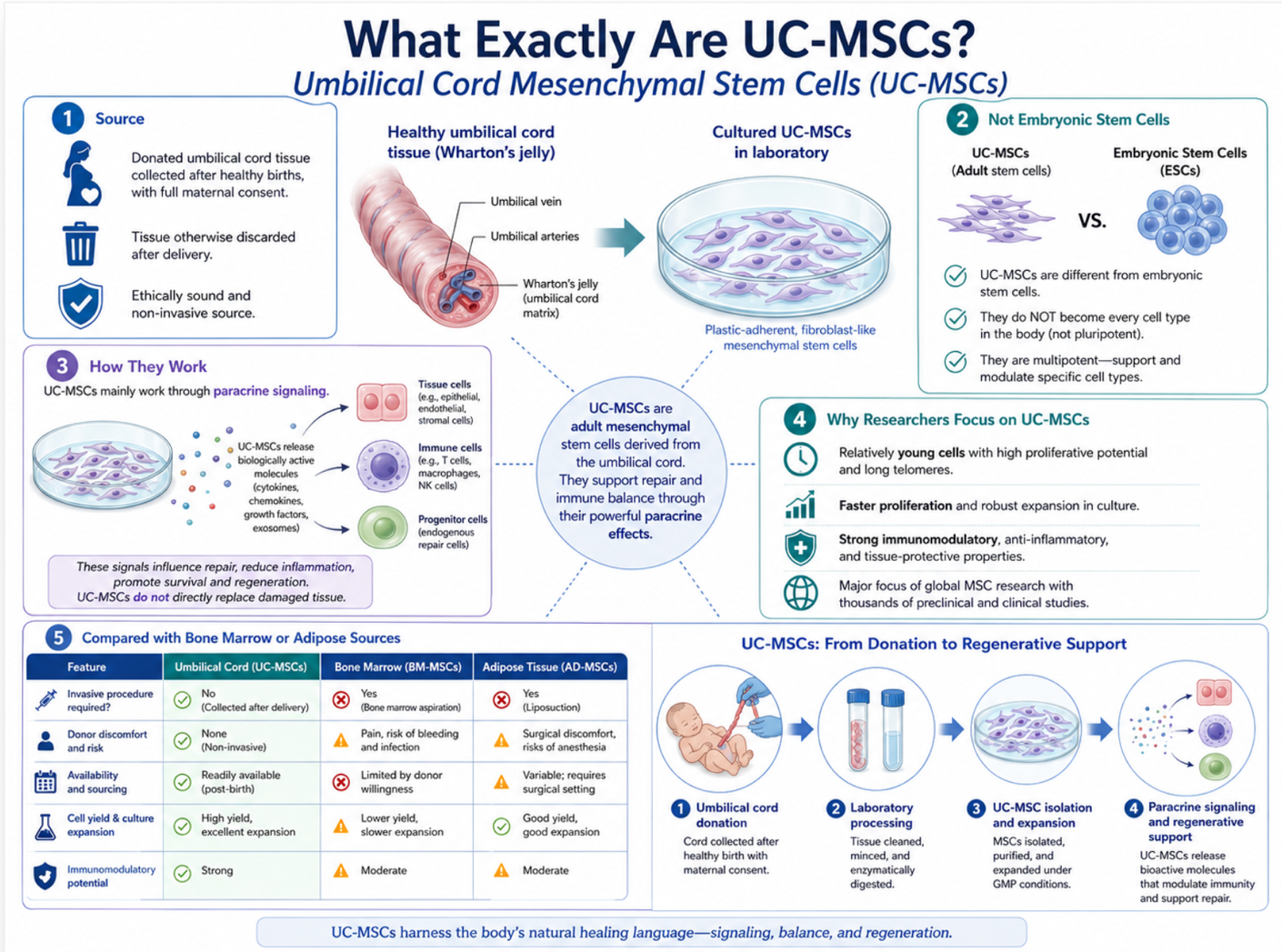
Umbilical cord mesenchymal stem cells (UC-MSCs) are multipotent stromal cells sourced from donated umbilical cord tissue collected after healthy births, with full maternal consent. Because this tissue would otherwise be discarded post-delivery, it’s widely regarded as an ethically sound and non-invasive source of regenerative cells no bone marrow extraction or liposuction required.
UC-MSCs aren’t the same as embryonic stem cells; they can’t become any cell type in the body. Their real power lies in paracrine signaling the process of releasing biologically active molecules that instruct nearby tissue and immune cells to behave differently, rather than physically replacing damaged structures outright. Compared with cells sourced from bone marrow or adipose tissue, UC-MSCs are relatively “young,” proliferate faster in laboratory culture, and carry favorable immunomodulatory properties, which is part of why they’ve become a leading focus of mesenchymal stem cell (MSC) research worldwide.
At Vega Stem Cell, every UC-MSC product used in treatment is fresh, non-frozen, and processed under laboratory conditions referencing internationally recognized standards, including ISO 9001:2015, OECD Good Laboratory Practice (GLP), and ISO/IEC 17025:2017.
A common misconception is that stem cells act like a biological patch, permanently replacing damaged tissue. That’s not how the current evidence describes it. After infusion or injection, UC-MSCs travel toward sites of inflammation or injury through a process known as homing behavior.
Once there, they release a cocktail of growth factors, cytokines, extracellular vesicles, and exosomes that help regulate local inflammation, modulate immune activity, stimulate angiogenesis (new blood vessel formation), and support the tissue’s own repair machinery.
Interestingly, the cells themselves usually don’t stick around forever most clear from the body within days to weeks. What persists is the biological cascade they trigger, which can continue producing measurable effects for months afterward. This is why UC-MSC therapy is best framed as supporting the body’s healing capacity rather than permanently rebuilding an organ, joint, or organ system.
The most consistently documented effect of UC-MSCs across studies is their ability to modulate inflammation. Persistent, low-grade inflammation underlies many degenerative and immune-mediated conditions including osteoarthritis, post-stroke recovery, and autoimmune disorders. Rather than simply suppressing immune activity, UC-MSCs appear to help restore a more balanced inflammatory response, creating conditions that favor genuine tissue repair.
By secreting growth factors, UC-MSCs support the survival of existing cells, stimulate new blood vessel growth, and activate resident cells involved in local regeneration a mechanism researchers point to when explaining UC-MSC potential across such a broad range of conditions.
Clinical studies suggest UC-MSC therapy may help reduce pain and improve physical function in carefully selected patients with knee osteoarthritis (OA). Some imaging-based studies report signs of improved cartilage quality, although structural cartilage regeneration remains an area of active research rather than a confirmed outcome. This is one of the more established applications offered through our osteoarthritis treatment program and broader joint pain therapy.
Researchers have explored UC-MSCs as a supportive therapy for conditions such as Parkinson’s disease, multiple sclerosis (MS), and amyotrophic lateral sclerosis (ALS). Evidence remains preliminary, with most studies still in early phases and larger, placebo-controlled trials needed to confirm durable functional benefit. You can review the specific conditions we work with on our Parkinson’s disease, multiple sclerosis, and ALS program pages.
UC-MSCs have also been studied in children with autism spectrum disorder. A phase I trial found that intravenous infusion of donor umbilical cord tissue–derived MSCs was safe and feasible in young children with ASD, with roughly half of treated children showing some improvement in symptoms though the study’s authors were careful to note it remains uncertain whether those improvements were directly caused by treatment. A follow-up phase I/II study of repeated UC-MSC infusions in children with ASD similarly reported no treatment-related serious adverse events, alongside some measurable shifts in inflammatory markers. Rigorous, placebo-controlled trials are still needed before firmer conclusions can be drawn. Our autism (ASD) program outlines how this research translates into our current clinical approach.
Because UC-MSCs influence inflammation and tissue repair broadly, there’s growing interest in their role in healthy aging and general wellness, an area covered on our anti-aging & wellness page though, as with other applications, this remains an evolving area of research rather than a settled clinical outcome.
Any credible regenerative medicine clinic should be just as upfront about limitations as benefits.
Age, disease severity, how long a condition has been present, underlying health status, genetics, and lifestyle all shape how a patient responds. Two people with the same diagnosis can have meaningfully different outcomes from the same UC-MSC protocol.
For most chronic conditions, UC-MSC therapy isn’t curative. Its role is to support the body’s own repair mechanisms, calm inflammation, and potentially slow progression in select conditions not to reverse disease outright. Patients should continue existing medical treatment unless a physician advises otherwise.
While evidence for knee osteoarthritis has grown fairly robust, evidence for neurological, autoimmune, and systemic conditions remains earlier-stage. Encouraging pilot results don’t always hold up once larger, controlled trials are run a pattern worth keeping in mind with any regenerative therapy.
Because UC-MSCs don’t permanently engraft in the body, their beneficial effects can fade over time. Some patients report improvements lasting several months; others may need repeat treatment depending on their condition and their physician’s assessment.
Researchers are still refining the optimal cell dose, route of administration, timing, and treatment frequency for different conditions. This variability makes direct comparisons between published studies and between clinics genuinely difficult, which is part of why an individualized medical review matters more than a standardized “package.”
The volume of clinical trials involving mesenchymal stem cells has grown substantially over the past decade. Systematic reviews generally describe a favorable safety profile paired with encouraging, if uneven, efficacy signals depending on the condition studied.
Knee osteoarthritis currently has the strongest evidence base, including multiple randomized controlled trials showing improvements in pain and function one trial specifically found that repeated UC-MSC dosing produced a superior clinical effect compared with single administration. Neurological and autoimmune applications generally rest on smaller, earlier-phase studies, meaning the science is progressing but confidence levels differ meaningfully by condition. Most researchers continue to call for larger, well-designed randomized trials before many UC-MSC applications become routine, first-line clinical practice.
Published trials generally describe a reassuring safety profile for UC-MSC therapy when cells are prepared to recognized quality standards and administered under physician supervision. The most commonly reported side effects are mild and temporary low-grade fever, fatigue, headache, or localized discomfort depending on the delivery route. Serious adverse events directly attributed to the cells themselves have been uncommon in controlled studies, though long-term monitoring remains an active area of research as the field matures.
In practice, safety depends heavily on factors patients can actually verify beforehand: proper donor screening, laboratory quality control, sterility testing, cell characterization, and physician oversight throughout the process the same standards outlined on our Center of Excellence page.
UC-MSC therapy may be appropriate for carefully selected patients where current evidence supports a potential role as an adjunctive treatment including certain orthopedic, neurological, or inflammatory conditions, following a full medical evaluation. Not everyone qualifies: active infection, uncontrolled malignancy, severe medical instability, or unrealistic treatment expectations can all affect eligibility.
At Vega Stem Cell, every candidacy decision starts with a review of medical history, diagnosis, recent test results, current medications, and relevant imaging. From there, our medical team can advise whether UC-MSC therapy is a reasonable option and outline what a personalized treatment plan including cell dose and delivery method would involve. You can see the full range of conditions we work with on our stem cell therapy page, or read real patient outcomes and reviews.
Yes, stem cell–related treatments in Thailand fall under medical and regulatory oversight, and reputable clinics operate within frameworks recognized by local authorities and ethics committees. Vega Stem Cell follows protocols aligned with current Thai regulations and is transparent about which treatments represent established standard-of-care versus emerging regenerative options still under investigation.
Interest in regenerative medicine reflects genuine scientific progress, but it’s important to separate promise from confirmed clinical evidence. UC-MSCs offer real, biologically plausible mechanisms paracrine signaling, immunomodulation, and homing toward injured tissue that may support repair and reduce inflammation in selected patients. At the same time, they aren’t permanent tissue replacements, don’t remain indefinitely in the body, and shouldn’t be marketed as a guaranteed cure. Outcomes vary by patient, and research continues to refine who benefits most and how durable the effects tend to be.
Are umbilical cord stem cells better than other stem cell sources? Different sources bone marrow, adipose tissue, umbilical cord carry distinct biological characteristics. No single source has been established as universally superior across every condition.
How long do UC-MSCs stay in the body? Most evidence suggests MSCs don’t remain permanently after administration; their effects are believed to occur mainly through signaling molecules released in the days and weeks following treatment.
Can UC-MSC therapy cure osteoarthritis, autism, or neurological disease? No. Current evidence doesn’t support describing UC-MSC therapy as a cure for any of these conditions. It may help reduce inflammation, ease symptoms, or support tissue repair in selected patients, but it isn’t a replacement for standard medical care.
Does Vega Stem Cell treat international patients? Yes. International patients can send medical records for an initial review before traveling, allowing our team to assess suitability and help plan the treatment schedule in advance details are available on our contact page.
References
Sun JM, Dawson G, Franz L, et al. Infusion of human umbilical cord tissue mesenchymal stromal cells in children with autism spectrum disorder. Stem Cells Translational Medicine, 2020. https://stemcellsjournals.onlinelibrary.wiley.com/doi/full/10.1002/sctm.19-0434
Dmitrieva V, et al. Allogeneic Human Umbilical Cord Mesenchymal Stem Cells for the Treatment of Autism Spectrum Disorder in Children: Safety Profile and Effect on Cytokine Levels. Stem Cells Translational Medicine, 2019. https://academic.oup.com/stcltm/article/8/10/1008/6403779
Matas J, Orrego M, Amenabar D, et al. Umbilical Cord-Derived Mesenchymal Stromal Cells for Knee Osteoarthritis: Repeated Administration Exerted Superior Clinical Effect in a Phase I/II Randomized Trial. Stem Cells Translational Medicine, 2019. https://pubmed.ncbi.nlm.nih.gov/30592390/
Pittenger MF, Discher DE, Peault BM, et al. Mesenchymal stem cell perspective: cell biology to clinical progress. NPJ Regenerative Medicine, 2019. https://www.nature.com/articles/s41536-019-0083-6
Freitag J, Bates D, Boyd R, et al. Mesenchymal stem cell therapy in the treatment of osteoarthritis: Reparative pathways, safety and efficacy, A review. BMC Musculoskeletal Disorders, 2016. https://bmcmusculoskeletdisord.biomedcentral.com/articles/10.1186/s12891-016-1085-9