Our Services
Others
- DFPP
- Shockwave
- IV Drip

Most conversations about autism center on children, which leaves adults navigating ASD with a strange gap: the condition doesn’t disappear at 18, but the research, treatment options, and public understanding often act like it does. Adults with autism frequently manage sensory sensitivities, anxiety, digestive issues, immune dysfunction, and chronic fatigue a fuller picture than childhood-focused discussions usually cover. Growing interest in stem cell therapy in Thailand using umbilical cord–derived mesenchymal stem cells (UC-MSCs) reflects an attempt to address that fuller picture: not just brain function, but full-body well-being.
How Autism in Adults Differs From Childhood Presentation
Early developmental challenges remain part of the picture, but adults frequently report additional or intensified issues chronic stress, immune dysregulation, gastrointestinal problems, and sleep disorders. Many of these are linked to underlying neuroinflammation and immune imbalance rather than being unrelated, coincidental health issues.
Symptom management alone tends to lose ground over decades of accumulated stress and untreated systemic inflammation. Addressing root biological causes, rather than only managing individual symptoms as they appear, is increasingly seen as key to improving long-term quality of life for adults specifically a population that’s had more years for these systemic effects to compound.
The Mitochondrial Connection: An Overlooked Root Cause
Mitochondrial dysfunction is one of the more substantial, if underdiscussed, biological findings in autism research. A systematic review and meta-analysis found that classic mitochondrial disease occurs in roughly 5% of individuals with ASD compared to about 0.01% in the general population while abnormal mitochondrial biomarkers show up far more broadly, with research estimating that 30–80% of individuals with ASD demonstrate some degree of mitochondrial dysfunction on biochemical testing.
A 2023 study examining markers of mitochondrial function specifically in adults with autism spectrum disorder found measurable metabolic differences compared to neurotypical adults relevant because mitochondrial dysfunction is closely tied to the chronic fatigue, reduced exercise tolerance, and “finite and fragile” energy many autistic adults describe. This isn’t a separate issue from core autism symptoms; it’s increasingly understood as part of the same underlying biological picture, and it’s a symptom cluster with real relevance to daily functioning that childhood-focused treatment discussions rarely address.
High Potency
UC-MSCs are sourced from umbilical cords after healthy, full-term births, making them younger and more metabolically active than stem cells harvested from adult tissue sources like bone marrow or fat.
Low Immunogenicity
Their reduced risk of immune rejection makes them suitable for allogeneic use meaning a patient doesn’t need to undergo their own cell harvesting procedure before treatment.
Multipotency
UC-MSCs retain the ability to differentiate into multiple cell types and support tissue repair across different body systems, which is central to their relevance for whole-body symptom patterns rather than a single isolated target.
Neuroinflammation Reduction
UC-MSCs release anti-inflammatory cytokines that help calm overactive immune responses in the brain a mechanism relevant to the neuroinflammation increasingly documented in ASD research.
Neuroprotection
Growth factors including BDNF (brain-derived neurotrophic factor) help protect and repair neurons, supporting the nervous system’s underlying structural health.
Immune System Modulation
By helping restore immune balance, UC-MSC therapy is studied for its potential to reduce autoimmune-like responses that show up with some frequency in autism research.
Gut-Brain Axis Support
UC-MSCs may support gut lining repair, potentially easing digestive issues that both accompany and, through inflammatory signaling, may exacerbate other autism-related symptoms.
Mitochondrial Function Support
Given the mitochondrial research described above, UC-MSC therapy’s potential role in supporting cellular energy production is a genuinely relevant mechanism for adults specifically with plausible relevance to focus, fatigue reduction, and mood stability, though this remains an area needing dedicated study rather than settled science.
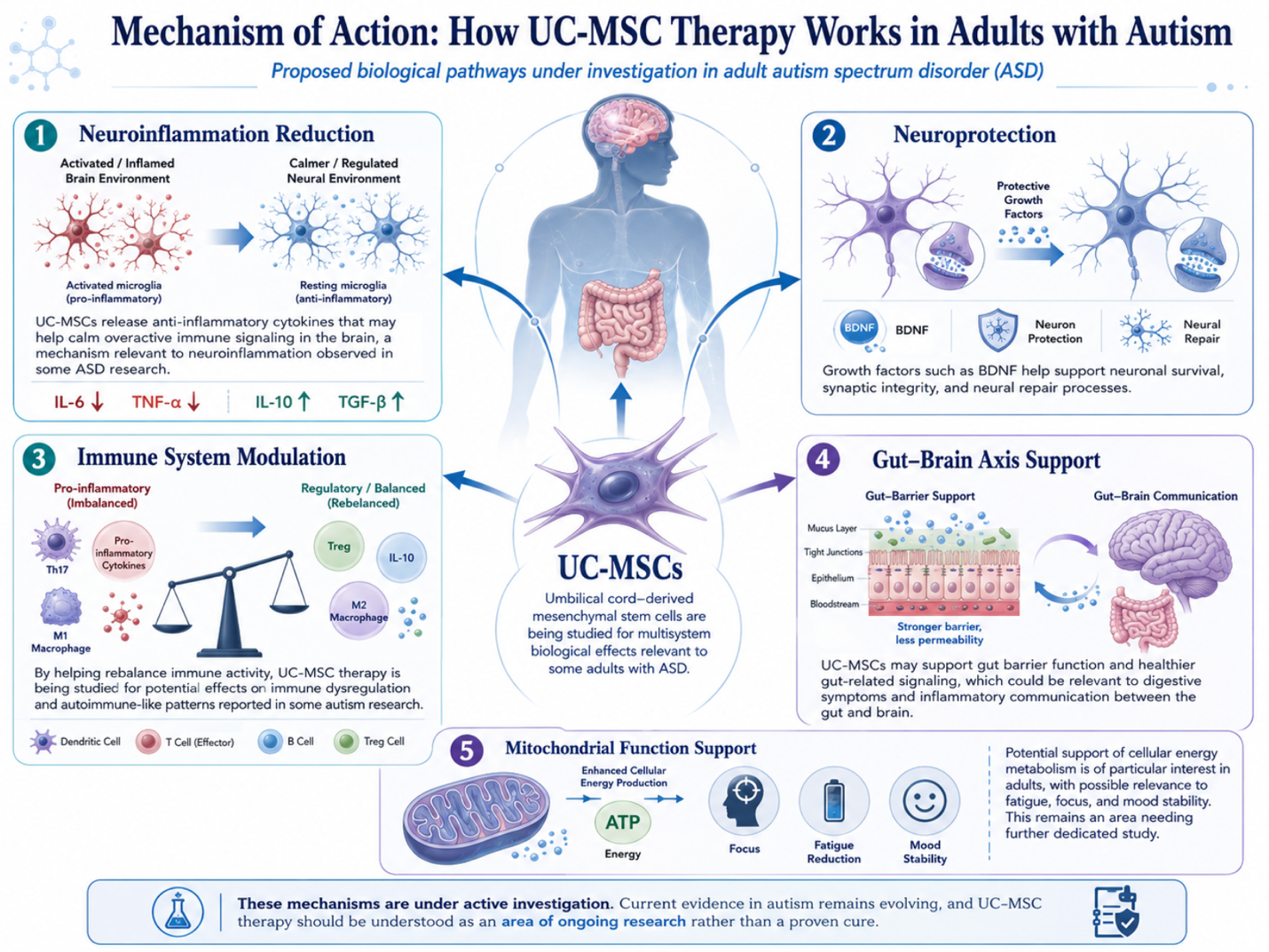
While brain function remains the primary target, UC-MSC therapy is studied for broader effects, including improved cognitive clarity and problem-solving, reduced sensory overload and better tolerance to sound, light, and texture, more stable emotional regulation with lower anxiety, improved digestive health with less bloating and food sensitivity, better sleep quality, and enhanced energy through improved mitochondrial function. These outcomes are reported across early research and clinical observation genuinely encouraging, but not yet the subject of the large-scale confirmatory trials this field still needs.
1.Intravenous Infusion
IV delivery allows stem cells to circulate systemically, targeting inflammation and immune dysregulation throughout the body rather than one isolated site relevant given how many adult ASD symptoms extend beyond the brain alone.
2.Intrathecal Injection
Some protocols use direct delivery into the cerebrospinal fluid for more targeted neurological effects, depending on the patient’s medical history, symptom profile, and treatment goals.
What the Clinical Evidence Currently Shows
A Genuine Research Gap Worth Naming
Most stem cell therapy for autism research to date has focused on children, which means adult-specific data remains more limited by comparison an honest gap, not a reason for dismissal. Emerging early-phase research and clinical observation in adult populations have reported improved social interaction and communication, reduced repetitive behaviors, improved quality-of-life scores, and improvement in co-occurring conditions like irritable bowel syndrome and chronic fatigue.
Why This Gap Matters for Decision-Making
Ongoing research continues exploring optimal dosages, treatment intervals, and long-term effects specifically in adults variables that can’t simply be assumed to transfer directly from pediatric protocols given real physiological differences between developing and mature nervous systems.
Important Considerations Before Treatment
Individual variability in response is real and expected, shaped by overall health status and autism symptom severity. Treatment cost is a genuine consideration, since stem cell therapy is an advanced intervention typically not covered by insurance. And UC-MSC therapy works best as part of a broader plan combined with nutrition support, behavioral strategies, and lifestyle adjustment rather than as a standalone intervention expected to work in isolation.
Why Thailand Supports Adult-Focused Regenerative Care
Stem cell therapy in Thailand has grown around infrastructure suited to exactly this kind of full-body, adult-focused treatment, physicians experienced in both regenerative medicine and adult neurological care, and integrated protocols addressing systemic symptoms alongside core ASD presentation. Treatment costs typically run 50–70% below equivalent care in Western countries, a meaningful factor for adults managing treatment decisions independently rather than through pediatric family care structures.
Regenerative Support at Vegastemcell
Vegastemcell’s approach to UC-MSC therapy for autism in adults begins with a comprehensive evaluation of medical history, symptom profile, and treatment goals recognizing that adult presentation differs meaningfully from childhood ASD. Physician-supervised administration, whether IV infusion or intrathecal delivery, is followed by structured follow-up tracking progress across cognitive, emotional, digestive, and energy-related outcomes, not brain function alone.
Frequently Asked Questions
Is stem cell therapy for autism only for children, or can adults benefit too?
While most research has historically focused on children, emerging studies and clinical experience suggest adults with ASD may benefit as well, particularly for whole-body symptoms like fatigue, digestive issues, and immune dysregulation that childhood-focused research rarely addresses directly.
What is the connection between mitochondrial dysfunction and autism in adults?
Research shows mitochondrial disease occurs in about 5% of individuals with ASD (versus 0.01% generally), with broader biomarker abnormalities in 30–80% of cases. A 2023 study found measurable mitochondrial differences specifically in autistic adults, relevant to the chronic fatigue many describe.
How is UC-MSC therapy administered for adults with autism?
Typically through intravenous infusion for systemic, whole-body effect, with intrathecal injection used in some protocols for more targeted neurological impact, depending on individual symptom profile and treatment goals.
What full-body benefits have been reported with UC-MSC therapy in adults?
Reported outcomes include improved cognitive clarity, reduced sensory overload, better emotional regulation, improved digestive health, better sleep quality, and increased energy alongside core symptom improvements, though large-scale confirmatory research is still needed.
For more infomation you can reach me directly on WhatsApp or Email. Here’s our official link:
WhatsApp :+66982509599
Email : vegastemcell@gmail.com