Our Services
Others
- DFPP
- Shockwave
- IV Drip

If your knees have gotten to the point where stairs feel like a negotiation, you’ve probably already typed some version of stem cell therapy for knee pain cost in Thailand” into a search bar at 11pm. You’re not alone it’s one of the most common searches among people weighing regenerative options against surgery, and Bangkok keeps coming up as the answer. This guide walks through what knee osteoarthritis treatment in Thailand actually involves, what it costs, how it compares to knee replacement, and what to actually look for in a clinic.
A huge share of the people researching this aren’t casually curious they’ve been told you’ll probably need a knee replacement eventually and are looking for literally anything else to try first. That’s the search intent behind queries like stem cell therapy vs knee replacement surgery and it’s a completely reasonable thing to want to understand before committing to an irreversible procedure.
Beyond the general appeal of medical travel, Bangkok specifically has built a dense cluster of regenerative clinics, ISO-certified laboratories, and board-certified orthopedic specialists which is why Bangkok shows up in so many of these searches rather than Thailand more broadly.
Costs vary meaningfully based on cell source, cell count, and whether one or both knees are treated. Single-knee treatment in Bangkok generally falls somewhere between roughly $2,500 and up to $10,000 depend on individual course while premium protocols including higher cell concentrations, PRP combination therapy, or multi-day packages with accommodation and full diagnostic workups can run considerably higher. For comparison, similar procedures in the US often run $14,000 to $25,000, which is the gap driving most of this search traffic in the first place.
A few factors consistently move the price: cell concentration (10 million cells versus 20 million cells per injection, for example), whether cells are umbilical cord–derived (allogeneic) or harvested from your own bone marrow or fat tissue (autologous), whether PRP is bundled in, and whether the package includes accommodation, transfers, and follow-up diagnostics or just the injection itself.
A transparent quote should spell out the consultation, diagnostic imaging review (MRI or X-ray), the cell product itself, the injection procedure, and post-treatment follow-up. If a price seems unusually low, ask directly what’s excluded that’s usually where the surprises hide.
Knee replacement physically removes and replaces damaged joint surfaces it’s definitive, but it’s major surgery with a real recovery timeline. Umbilical cord stem cell therapy for knee conditions works differently: rather than replacing the joint, UC-MSCs are injected to support the joint’s existing tissue, aiming to calm inflammation and support cartilage health in cases of mild-to-moderate degeneration.
Stem cell therapy is generally considered for patients with mild-to-moderate osteoarthritis who want to delay or potentially avoid surgery, not as a direct substitute for advanced, bone-on-bone degeneration where replacement is often the more appropriate option. This is exactly why an honest consultation reviewing your actual imaging, not just your symptoms matters more than marketing copy.
Regenerative medicine centers in Bangkok commonly report success rates in the range of 80–85% for patients with moderate knee osteoarthritis, based on clinic outcome tracking. It’s worth being precise about what that figure represents: it typically reflects patient-reported pain reduction and mobility improvement tracked by individual clinics, not a large, independent, peer-reviewed clinical trial. That doesn’t make it meaningless it’s a genuinely useful data point, but it should be read as clinic-reported outcome data, not the same evidentiary weight as a randomized controlled trial.
Most patients measure success in pain reduction, improved mobility, and reduced reliance on anti-inflammatory medication rather than complete elimination of osteoarthritis which tracks with how the treatment is designed to work.
Most patients report noticeable improvement within the first few weeks, with continued benefit building over two to three months as the cells’ repair signaling does its work. Effects commonly last from several months up to a couple of years, depending on the severity of the underlying joint degeneration, though this varies meaningfully by individual and isn’t a fixed timeline. Because MSCs don’t persist indefinitely in the body, many patients return for periodic follow-up treatment rather than expecting one injection to be permanent.
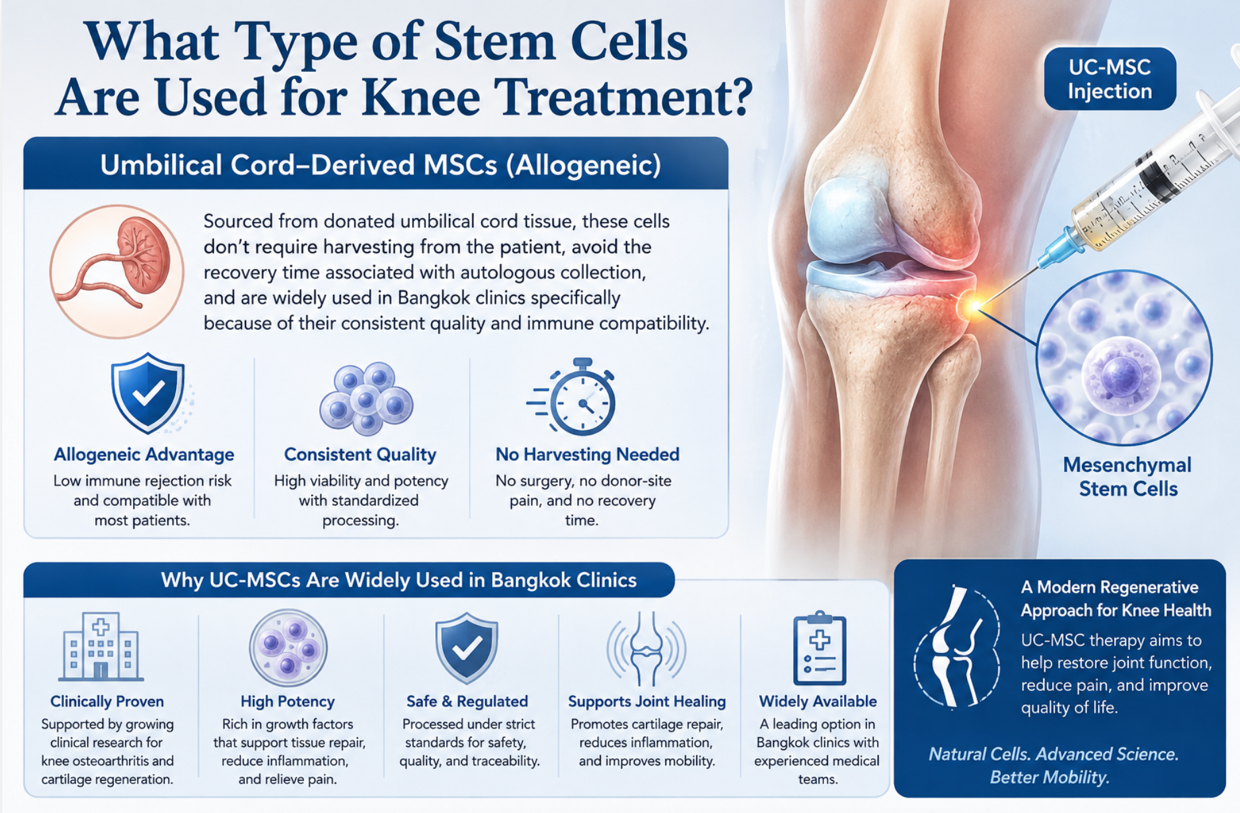
Sourced from donated umbilical cord tissue, these cells don’t require harvesting from the patient, avoid the recovery time associated with autologous collection, and are widely used in Bangkok clinics specifically because of their consistent quality and immune compatibility.
Single-knee treatment generally ranges from around $2,500 and up to $10,000 depend on individual course, , with premium multi-day programs running higher. That’s typically 60–80% less than equivalent treatment in the US.
It depends on your specific degree of joint degeneration. Stem cell therapy is generally considered for mild-to-moderate osteoarthritis, while knee replacement remains the more established option for severe, bone-on-bone cases. This should be determined from actual imaging, not preference alone.
Bangkok clinics commonly report success rates around 80–85% for moderate knee osteoarthritis, based on clinic-tracked patient outcomes a genuinely useful figure, though not equivalent to independent clinical trial data.
Many patients report benefit lasting from several months to a couple of years, with some choosing periodic follow-up treatment since MSC activity naturally tapers over time rather than persisting indefinitely.
Verify ISO/GMP laboratory certification, confirm board-certified orthopedic oversight, ask about cell freshness and sourcing, and request a full breakdown of what’s included in your quote before committing.
Whether you’re comparing stem cell therapy for knee options against surgery or just trying to understand realistic costs and outcomes, the right next step is a proper review of your actual imaging not a generic package. Book a consultation with Vega Medical Services to find out what a personalized knee treatment plan would look like for you.
For more information you can reach me directly on WhatsApp or Email. Here’s our official link:
WhatsApp: +66982509599
Email: vegastemcell@gmail.com
This article is for general informational purposes and is not medical advice. Outcomes vary by individual and severity of joint degeneration. Please consult a qualified orthopedic specialist before making treatment decisions.