Our Services
Others
- DFPP
- Shockwave
- IV Drip

For families evaluating regenerative medicine, the most critical question is rarely about the procedure itself it is about what functional changes actually follow. I see this constantly in clinical review circles. Parents are exhausted by vague marketing promises and want objective data. When researching stem cell therapy for autism results, you don’t need another basic definition of the spectrum. You need to know what behavioral, cognitive, and physical changes actually materialize.
The reality of these outcomes is heavily misunderstood. We aren’t talking about disease reversal. We are looking at specific, documented functional improvements driven by the reduction of underlying neuroinflammation. It takes time. Sometimes it doesn’t work at all.
This guide details exactly what families report post-treatment. We will break down the timeline for functional changes, explain how progress is tracked using objective measurement tools like the ATEC, and look at the physiological reasons why results vary wildly between individuals.
Stem cell therapy for autism results are typically reported as functional improvements in behavior and communication, driven by reductions in underlying neuroinflammation.
Realistic expectations of stem cell therapy for autism require distinguishing between disease reversal and functional symptom management. Clinical observations and family reports indicate that regenerative treatments target underlying neuroinflammation, which can subsequently improve an individual’s capacity to learn, communicate, and regulate emotions. It is not a cure.
Reductions in neuroinflammation do not instantly create new skills; rather, they remove physiological barriers so that behavioral therapies can take effect.
Here’s the thing most clinics won’t explicitly tell you: biological changes don’t mean instant visible results. Autism is frequently accompanied by chronic neuroinflammation specifically, the overactivation of microglial cells in the brain. Mesenchymal stem cells are hypothesized to modulate this immune response. When infused, they seek out inflammatory signaling and begin to downregulate it.
| 📌 If you’re interested in how MSCs calm overactive immune cells throughout the body, we have an interesting article that discusses mesenchymal stem cell therapy for immune modulation, which you can read via the internal link. |
According to a 2024 immunological review in PubMed, this biological shift happens relatively quickly at the cellular level. But dropping inflammation doesn’t magically teach a non-verbal child syntax. When the biological barriers are reduced, the brain is primed for neurogenesis. Learning the actual skill whether that’s expressive speech or tying a shoe still requires intensive time, repetition, and targeted behavioral therapy. Families who expect their child to wake up the next morning fundamentally changed are setting themselves up for crushing disappointment.
Because generalized “improvement” is practically impossible to quantify in a medical setting, clinicians rely on “The 5-Domain Autism Response Framework” to track specific functional changes. When you dig into clinical outcome analysis in tier-one medical journals, you won’t see words like “recovery.” You see quantifiable shifts in severity moving from Level 3 support needs to Level 2 in specific categories.
If you read autism stem cell therapy success stories online, you have to filter them through this clinical lens. A success story in the medical literature means a child who previously engaged in severe self-injurious behavior now self-regulates after a few minutes, or a teen who couldn’t sleep more than three hours a night now achieves consolidated REM cycles. We categorize these reported improvements into five distinct domains to accurately track what is actually happening post-treatment.
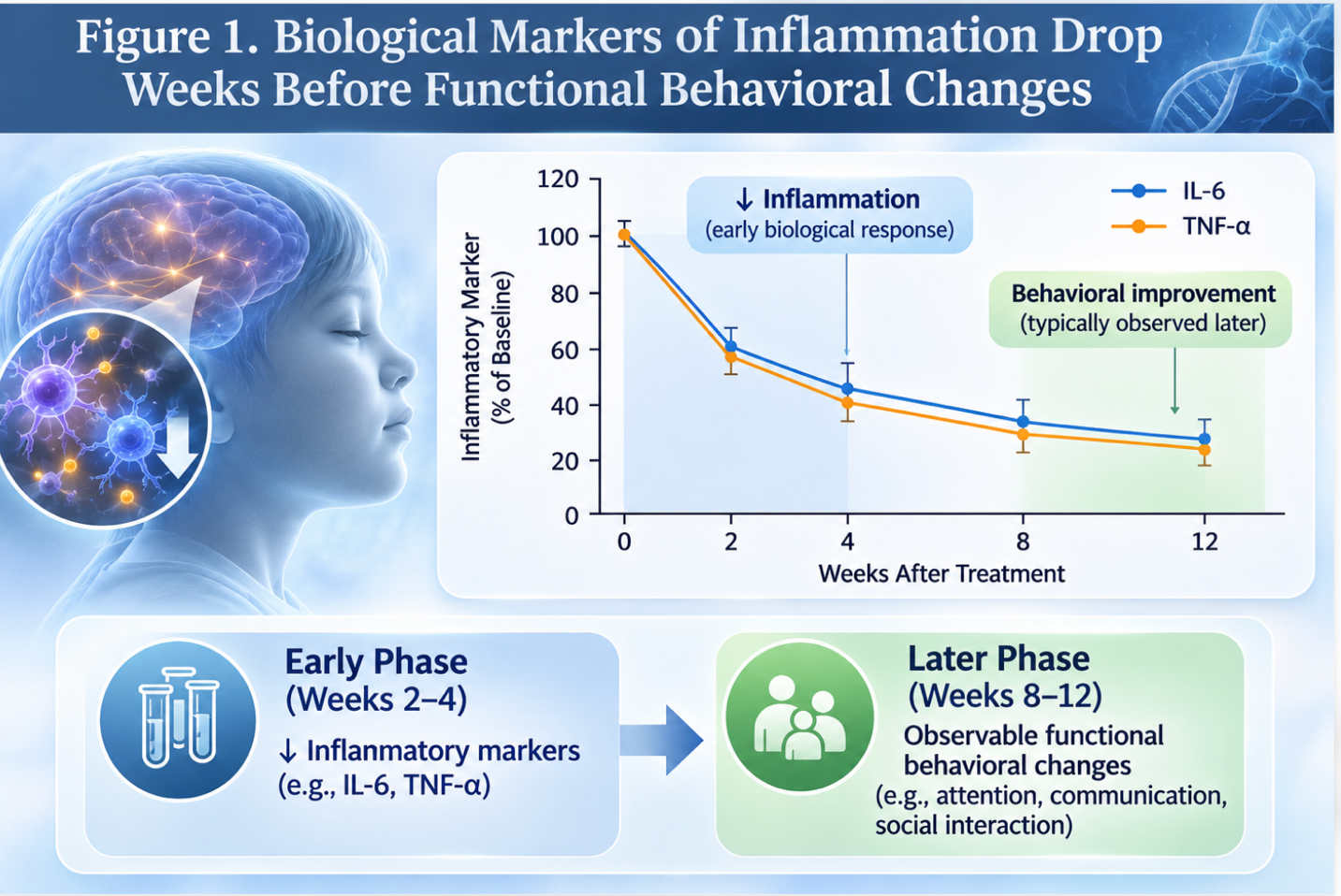
Figure 1: Biological markers of inflammation drop weeks before families notice functional behavioral changes.
When evaluating stem cell therapy for autism improvements, clinicians and researchers look beyond generalized observations to specific, measurable functional domains. Based on clinical trial data and systematic family reporting, functional gains are typically categorized into five distinct areas of daily living and cognitive processing.
The most heavily scrutinized outcomes revolve around stem cell therapy for autism eye contact and speech improvement. We have to separate receptive language (what a person understands) from expressive language (what they can say). In responder populations, parents frequently report a timeline where receptive language improves first. A child might suddenly start following two-step instructions they previously ignored.
Expressive language takes longer. ClinicalTrials.gov observations consistently log increases in spontaneous vocalizations. We see reports of individuals transitioning from echolalia (repeating words without context) to purposeful, limited verbal communication.
Social engagement heavily ties into this. Why does eye contact improve? It likely comes down to sensory processing. In an inflamed, hyper-aroused neurological state, direct eye contact feels physically threatening or intensely overwhelming. As neuroinflammation drops, sensory overload decreases. A 2023 study on sensory processing suggests that lowering this physiological distress allows the individual to tolerate social stimuli. Families report prolonged eye contact, faster responses to their own name, and a shift from isolated play to parallel or joint play.
Parents constantly ask: can stem cell therapy reduce repetitive behaviors in autism? The clinical answer is yes, but with massive caveats. Stimming (self-stimulatory behavior) and tunneling (hyper-focusing on a single input, like spinning a wheel) are coping mechanisms. They are how an overwhelmed nervous system regulates itself.
Families report a distinct decrease in the intensity and frequency of these behaviors, rather than total elimination. If a child previously spent six hours a day engaged in rigid routines and experienced violent meltdowns when interrupted, parents often note the duration drops to manageable intervals. Self-injurious behaviors head-banging, biting are frequently the first to diminish. The individual still stims when stressed, but the baseline level of stress is fundamentally lower, requiring less intense physical regulation.
You can’t overstate the impact of sleep. And yes, parents aggressively research can stem cell therapy improve sleep in autistic children because severe insomnia fractures the entire family dynamic. There is a deep, established physiological link between the gut-brain axis, systemic inflammation, and sleep architecture.
Autistic individuals frequently struggle with melatonin dysregulation and disrupted circadian rhythms. When cellular therapy targets the central nervous system’s inflammatory load, one of the earliest reported functional changes is sleep stabilization. Pediatric neurology reports document parental observations of faster sleep onset and a drastic reduction in night wakings. When a child finally gets sustained REM sleep, their cognitive baseline for therapies the next day improves exponentially.
This is the blind spot in almost all regenerative medicine literature. Everyone talks about toddlers, ignoring stem cell therapy for autism in adults. While early intervention capitalizes on maximum neuroplasticity, older individuals still report profound outcomes.
The focus just shifts. For an autistic teenager or adult, the primary therapeutic goals are rarely about foundational speech acquisition. Instead, adult patients and their families report changes in severe anxiety, emotional regulation, and executive functioning. We see older patients reporting an increased ability to handle transitions in daily tasks moving from the house to the car without a panic response. Occupational therapy retention improves. It’s about securing independence and quality of life, proving that neuroplasticity doesn’t simply shut off at age seven.
Families need to brace for a marathon, not a sprint. Setting a chronological timeline is the only way to manage the brutal waiting game that follows a medical intervention.
Functional improvements following cellular therapy are most consistently reported in expressive language, social engagement, and sleep architecture.
So, exactly how long does it take to see results from stem cell therapy for autism? The timeline is split into two distinct physiological phases.
During Weeks 1 through 4, we are looking strictly at acute biological shifts. Families often report early changes in sleep regulation and digestion. This happens as the acute inflammatory cytokine storm begins to settle. It’s the “quieting down” phase of the nervous system.
The heavy lifting happens between Months 3 and 6. This is the delayed functional improvement window. Cognitive and behavioral shifts like spontaneous speech, sustained eye contact, and the capacity to learn new routines take months to solidify because synaptogenesis (the forming of new neural pathways) is biologically slow. If you expect a massive behavioral shift in week two, you are ignoring basic neurology.
This is the ultimate question: do the results of stem cell therapy for autism last? The clinical consensus is nuanced. When an individual acquires a functional skill say, learning to speak a new sentence or mastering a complex occupational therapy task that skill is retained. It is a permanently learned neural pathway. Longitudinal follow-up studies confirm that once a child learns to tolerate eye contact, they don’t suddenly forget how to do it.
However, biological regression can occur. Autism involves complex immune and environmental interactions. If an underlying autoimmune trigger flares up two years later, neuroinflammation can spike again. The resulting sensory overload might mask the skills the patient learned, mimicking a regression. This is why neuroplasticity research emphasizes that cellular therapy is not a one-and-done miracle; it requires ongoing clinical monitoring and relentless behavioral support to lock in the gains.
| 📌 If you’re interested in whether a second dose can extend the benefits of the first, we have an interesting article that discusses why double-dose UC-MSC therapy may offer greater benefits than a single dose, which you can read via the internal link. |
Determining how to measure progress after stem cell therapy for autism requires moving past subjective family impressions to validated clinical instruments. The medical community relies on standardized scoring systems to quantify changes across the 5-Domain Framework accurately over time. If a clinic isn’t tracking data this way, walk away.
The Autism Treatment Evaluation Checklist (ATEC) was developed by the Autism Research Institute and remains the gold standard for tracking treatment efficacy. It divides autism presentation into four clinical subscales: Speech/Language, Sociability, Sensory/Cognitive, and Health/Physical/Behavior.
When evaluating an ATEC score after stem cell therapy, the math is simple: lower scores indicate fewer severe symptoms. A score dropping from 90 to 65 is a massive, life-altering functional shift. Clinics utilizing Autism Research Institute standards will mandate a baseline ATEC test before you even step foot in the facility. They then compare that baseline against 3-month, 6-month, and 12-month post-treatment scores to plot a mathematical trajectory of the 5-Domain improvements. It removes parental bias and gives clinicians cold, hard data.
While ATEC is parent-driven, the Childhood Autism Rating Scale (CARS) is a secondary clinical tool utilized directly by medical professionals. It validates the parent-reported data with structured clinical observation.
But the most advanced clinics don’t stop at behavioral questionnaires. They track the biology. They monitor inflammatory biomarkers specifically inflammatory cytokines and CD47 markers through sequential blood panels. By correlating biological shifts with functional CARS improvements, clinicians can mathematically prove the therapy is working at a cellular level. According to recent cytokine biomarker tracking, when a patient’s inflammatory markers drop 40%, we typically see a corresponding 15-20% improvement in their behavioral rating scales three months later.
We have to address the elephant in the room. Despite rigorous measurement and optimized protocols, data shows that not every patient achieves significant score reductions. The therapy simply does not work for everyone.
Parents are desperate to know: why does stem cell therapy work for some autistic children and not others? It comes down to the fundamental heterogeneity of the autism spectrum. Autism isn’t a single biological mechanism; it is a clinical umbrella covering hundreds of different physiological states.
Cellular therapies primarily target immune dysregulation. Therefore, patients whose autism profile is heavily driven by neuro-immune factors identifiable via specific laboratory findings, GI issues, or clinical history are overwhelmingly more likely to be “responders.” If the patient has rampant, chronic brain inflammation, the stem cells have a clear biological target to act upon. Current immunological profiling in autism clearly dictates that neuro-immune subgroups are the ideal candidates for this specific intervention.
This brings us to a harsh but necessary clinical reality: treatment suitability requires individual clinical assessment. A proper medical consultation isn’t a sales pitch. It involves a grueling review of medical records, genetic panels, previous pharmacological interventions, and inflammatory markers to determine if the patient is a viable candidate before pursuing treatment.
| 📌 If you’re planning treatment in Thailand and want a practical checklist for choosing a safe clinic, we have an interesting article that discusses whether stem cell therapy is safe in Thailand, which you can read via the internal link. |
If an individual’s autism is strictly genetic or structural lacking any systemic inflammatory component they are highly likely to be a non-responder. The cells have no inflammation to quiet down. This is why patient selection criteria is the single most important factor in determining outcomes. Lack of response is a highly realistic outcome if the underlying biology of the patient doesn’t match the mechanism of the treatment.
Parents most frequently observe functional improvements in expressive speech, sustained eye contact, and emotional regulation. These observations are often accompanied by more normalized sleep patterns and a reduction in severe repetitive behaviors or self-injury. Standardized tools like the ATEC track these changes systematically. They show progress typically within 3 to 6 months post-treatment. Individual results vary heavily based on the child’s baseline neuroinflammatory levels.
Determining if stem cell therapy is worthwhile requires balancing potential functional gains against the investigational nature of the treatment. For candidates with identified neuro-immune dysregulation, the procedure may successfully remove biological barriers to learning and communication. However, because non-responders definitely exist, families must consult with a qualified specialist to assess individual suitability before proceeding.
Yes, a reduction in the intensity and frequency of repetitive behaviors is a commonly reported outcome following cellular therapy. By targeting central nervous system inflammation, the treatment may lower overall sensory overload. This reduces the individual’s desperate need to rely on stimming or tunneling for self-regulation. While these behaviors are rarely eliminated entirely, their decreased severity often allows for much better engagement in traditional behavioral therapies.
Mild autism does not biologically go away with age, as it is a lifelong neurodevelopmental condition. However, symptoms and diagnostic severity can shift significantly as individuals mature and acquire advanced coping mechanisms through structured behavioral intervention. While core neurological differences and processing styles remain, many adults with high-functioning autism achieve complete independence. They learn to manage sensory or social challenges effectively throughout their daily lives.
For families researching stem cell therapy for autism results, outcomes must be defined by functional gains rather than disease reversal. Clinical evidence indicates that improvements in speech, behavior, and sleep typically manifest over a delayed 3 to 6-month timeline as underlying neuroinflammation gradually decreases. The best, most realistic approach always combines cellular therapy with aggressive, continued behavioral education.
Utilizing the 5-Domain Autism Response Framework ensures that parents and clinicians can objectively measure progress without falling victim to wishful thinking. Tracking data through standardized tools like the ATEC separates realistic clinical gains from subjective observation. It provides a clear, mathematically sound picture of the therapy’s exact efficacy for the individual.
Because results vary so drastically based on individual neuro-immune profiles, the critical next step is determining actual medical eligibility. Take the next step by preparing your child’s medical records, genetic testing results, and current therapy logs to schedule a consultation with a qualified regenerative medicine specialist.