Our Services
Others
- DFPP
- Shockwave
- IV Drip

A chronic ulcer a wound that persists for 12 weeks or longer despite standard care is one of the most frustrating conditions in medicine, both for patients and physicians. These wounds commonly affect people with diabetes, venous insufficiency, poor circulation, or limited mobility, and tend to appear on the feet, legs, and toes. As conventional treatment often stalls, more clinicians in Thailand are turning to regenerative medicine, and specifically Umbilical Cord–derived Mesenchymal Stem Cell (UC-MSC) therapy, as a way to support healing where standard wound care alone hasn’t been enough. This guide explains why chronic ulcers resist healing, how UC-MSC therapy works, and what current research actually supports.
Chronic wounds don’t fail to heal randomly they get stuck due to specific, identifiable biological barriers.
Reduced blood flow prevents oxygen and nutrients from reaching damaged tissue, starving the cells that are critical for tissue regeneration.
Common among diabetic patients, neuropathy reduces sensation, allowing minor injuries to go unnoticed and progress before treatment begins and blunting the body’s normal healing responses.
Persistent bacterial colonization prolongs inflammation and interferes with the normal stages of tissue repair, keeping the wound in a destructive cycle.
Repetitive friction or sustained pressure often seen in bed-bound or wheelchair-using patients leads to continuous tissue breakdown, a major driver of pressure ulcers.
Diabetes, peripheral artery disease, and heart failure all worsen wound formation and interfere with the body’s ability to recover.
Conventional management cleaning, debridement, antibiotics, specialized dressings, and offloading (reducing pressure on the wound) focuses primarily on symptom control. These methods are genuinely important, but they often don’t correct the underlying biological causes of poor healing, such as vascular insufficiency, nerve damage, or unresolved chronic inflammation. This gap is a key reason regenerative wound therapy, including UC-MSC-based treatment, has drawn growing clinical interest.
Among the various types of stem cells studied in wound care, Mesenchymal Stem Cells (MSCs) stand out for their ability to self-renew, differentiate into multiple cell types, and secrete a wide range of bioactive signaling molecules. While MSCs can be sourced from bone marrow or adipose tissue, umbilical cord–derived MSCs (UC-MSCs) carry some distinct practical advantages: they’re collected non-invasively from umbilical cord tissue (a medical byproduct after childbirth, obtained with donor consent), and they tend to be highly proliferative, expanding efficiently in laboratory culture.
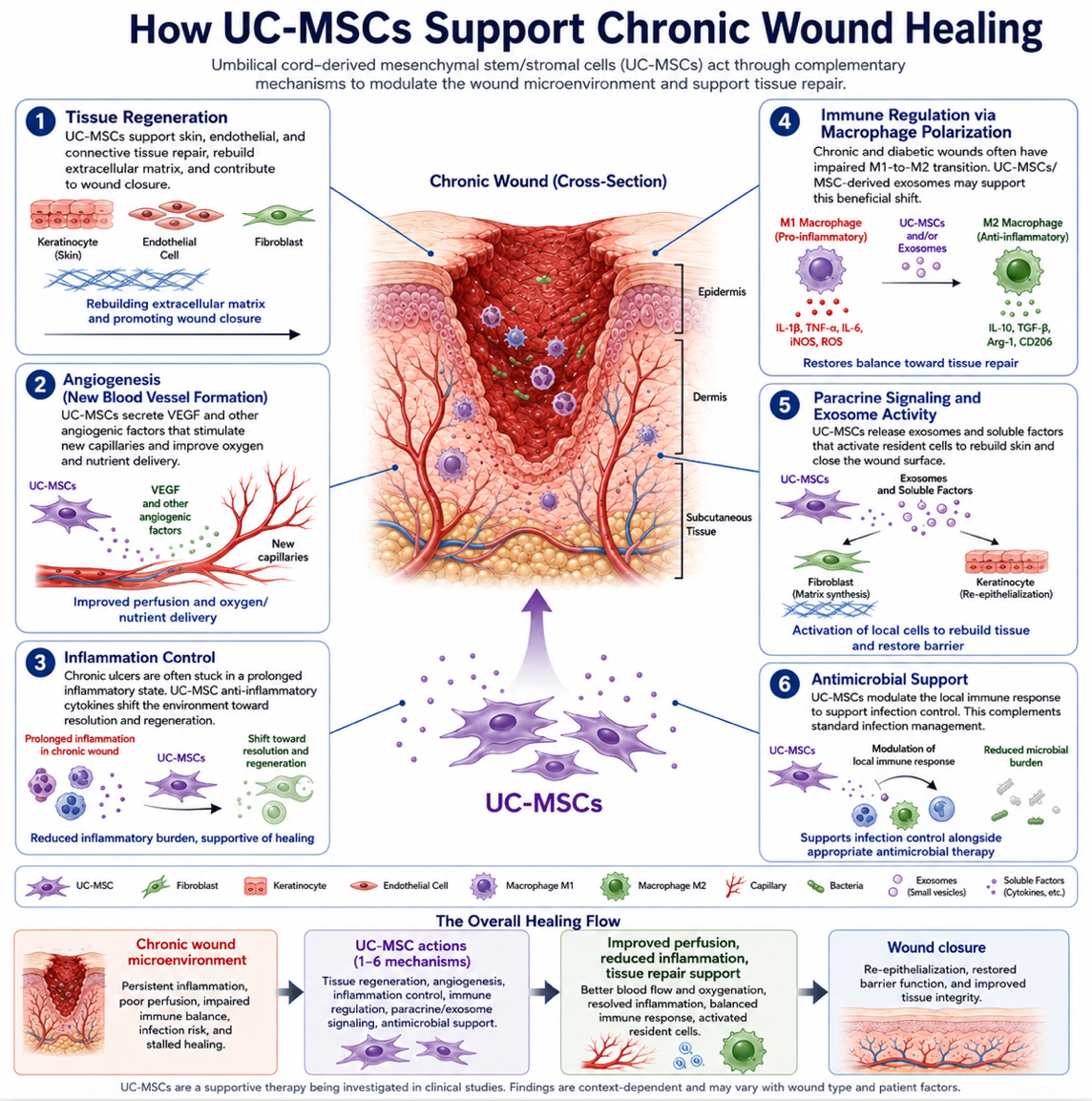
UC-MSCs can differentiate into skin, endothelial, and connective tissue cell types, allowing them to support the rebuilding of the extracellular matrix and contribute directly to wound closure, alongside the paracrine signaling described below.
UC-MSCs secrete vascular endothelial growth factor (VEGF) and related angiogenic signals that stimulate new capillary formation. Better blood flow means better delivery of the oxygen and nutrients tissue needs to repair itself.
Chronic ulcers are often locked in an extended inflammatory phase. UC-MSCs release anti-inflammatory cytokines that help calm this prolonged response, shifting the wound environment toward one that favors regeneration rather than ongoing tissue damage.
One of the more well-documented mechanisms in current research is how MSCs interact with macrophages immune cells that play a central role in wound healing. Early in a wound’s life cycle, M1 macrophages dominate, clearing debris and driving inflammation; healthy healing depends on these cells transitioning to an anti-inflammatory M2 phenotype that supports tissue repair. Multiple studies have found that MSCs and MSC-derived exosomes specifically can help drive this M1-to-M2 macrophage polarization, and that chronic and diabetic wounds often show an impaired version of this transition, which is part of why they stall.
Beyond direct differentiation, UC-MSCs release exosomes and soluble signaling factors that activate nearby skin cells and stimulate fibroblast and keratinocyte activity the cells responsible for rebuilding skin structure and closing the wound surface.
Research also points to MSCs’ ability to help modulate the local immune response in ways that support infection control at the wound site, complementing not replacing standard infection management.
UC-MSCs can be incorporated into hydrogels, creams, or advanced dressings applied directly to the wound. This approach tends to work best for shallower ulcers and supports localized regeneration.
Cells are injected around the wound edges, allowing them to migrate inward and support healing from the periphery toward the center.
Biocompatible scaffolds such as collagen or fibrin matrices loaded with UC-MSCs provide structural support, helping improve cell retention and survival at the wound site.
UC-MSCs are sometimes used alongside platelet-rich plasma (PRP), additional growth factors, or negative pressure wound therapy as part of a broader treatment plan, rather than as a stand-alone intervention.
It’s worth being precise here, since claims about stem cell therapy for wounds vary widely online. Published research on MSC-based wound therapy consistently reports:
A generally favorable safety profile, with most studies noting minimal serious adverse events directly attributed to the cells themselves
Biologically plausible mechanisms angiogenesis, macrophage polarization, paracrine signaling that are well-documented at the cellular and preclinical level
Promising, but still developing, clinical evidence, with researchers consistently calling for larger, standardized, long-term trials before UC-MSC therapy becomes routine first-line treatment across every wound type
What this means in practice: UC-MSC therapy is a scientifically grounded and increasingly studied option, not a guaranteed cure. Outcomes vary by patient, wound type, and severity, and it’s typically positioned as part of a broader treatment plan alongside continued wound care, infection control, and management of underlying conditions like diabetes rather than a complete replacement for them.
Thailand has become a recognized regional center for regenerative medicine, supported by a growing base of laboratory infrastructure and specialized clinical expertise. Cell-based therapies fall under oversight from the Thai FDA and the Ministry of Public Health, with advanced therapies such as MSCs classified and regulated according to their risk profile. Reputable clinics operate within licensed laboratories that follow quality and safety standards for cell processing patients should always confirm this directly with their provider before starting treatment.
Addresses underlying biology, not just wound symptoms targeting circulation, inflammation, and tissue regeneration directly
Supports tissue quality, with research suggesting regenerated tissue may have better structural properties than scar tissue formed through conventional healing alone
May help reduce complication risk, including infection, by supporting the body’s own repair and immune-regulating mechanisms
Generally well-tolerated, with published studies reporting a favorable safety profile in appropriately screened patients
Works across all wound layers epidermis, dermis, and underlying vasculature rather than addressing the surface alone
UC-MSC therapy is typically considered for patients whose chronic ulcers have:
Not responded to standard wound care after an appropriate trial period
Signs of poor circulation or an impaired inflammatory transition limiting natural healing
Ongoing risk of progression toward deeper tissue involvement despite conventional treatment
Candidacy always requires a full medical evaluation wound depth, infection status, vascular health, and any underlying systemic conditions all factor into whether UC-MSC therapy is an appropriate option. You can review real patient outcomes on our results page or book a consultation to discuss your specific case.
How is a chronic ulcer different from a regular wound? A wound is generally classified as chronic when it fails to heal within the expected timeframe often defined as 12 weeks or more despite appropriate standard care.
Is UC-MSC therapy proven to prevent amputation? Current research shows UC-MSCs support angiogenesis, infection defense, and tissue repair mechanisms relevant to reducing complication risk but no treatment, including UC-MSC therapy, is currently established as a guaranteed way to prevent amputation. It’s best understood as a way to support healing alongside standard wound and vascular care.
How many UC-MSC treatment sessions are typically needed? This depends on wound severity, size, and delivery method. Some protocols use a single application; others involve repeated sessions, based on individual assessment by the treating physician.
Is UC-MSC stem cell therapy legal in Thailand? Yes, cell-based therapies are regulated under Thai FDA and Ministry of Public Health oversight. Patients should confirm a clinic’s licensing and the regulatory status of the specific cell product being used.