Our Services
Others
- DFPP
- Shockwave
- IV Drip

Diabetic wounds also called diabetic foot ulcers (DFUs) are one of the most serious complications of long-term diabetes. Roughly 6.3% of people with diabetes worldwide will develop a diabetic foot ulcer at some point, and these wounds are a leading cause of lower limb amputation. When standard wound care stalls, more patients are asking about regenerative medicine, specifically mesenchymal stem cell (MSC) therapy, as a way to support healing where conventional treatment alone hasn’t been enough. This guide explains why diabetic wounds resist healing, what current stem cell research actually shows, and how treatment is approached in Thailand.
A normal wound moves predictably through inflammation, tissue formation, and remodeling. In a person with chronic hyperglycemia, that process gets stuck usually at the inflammatory stage and stalls for months or even years.
In a healthy person, an injury triggers a prompt macrophage response that clears cellular debris and moves healing forward. In diabetic wounds, the injury site instead becomes trapped in a chronic inflammatory cycle. The wound microenvironment fills with damaging inflammatory cytokines and reactive oxygen species that injure DNA and cell membranes, keeping the wound in a destructive loop rather than a repair one.
Diabetes causes changes to small blood vessels (microvascular disease), which reduces oxygen delivery to the wound site. This localized hypoxia limits the ability of fibroblasts to synthesize collagen the structural protein essential for rebuilding skin and slows every downstream stage of repair.
Because the wound stays open and poorly nourished, it becomes vulnerable to bacterial biofilm formation and infection, which further blocks the body’s own restorative signals. In this environment, cell death consistently outpaces new tissue formation the core reason diabetic wounds are so difficult to close.
Conventional diabetic wound care typically includes:
Surgical debridement : removing dead tissue to leave a clean wound bed
Moisture-retentive dressings : such as collagen or hydrocolloid dressings
Offloading : reducing pressure on the wound, especially for foot ulcers
Antibiotics : to control or prevent infection
These approaches remain the foundation of care, but they have real limitations: standard dressings don’t actively stimulate healing the way bioengineered or cell-based therapies aim to, and they don’t address the underlying cellular and metabolic dysfunction driving the wound in the first place. As a result, many patients experience prolonged periods where healing plateaus completely one of the key reasons interest has grown in regenerative therapies for diabetic wounds, including stem cell-based treatment.
Mesenchymal stem cells (MSCs) including umbilical cord–derived mesenchymal stem cells (UC-MSCs) are the most extensively studied cell-based option for chronic wound repair. Rather than physically replacing tissue, MSCs work mainly through paracrine signaling: releasing growth factors, cytokines, and extracellular vesicles (EVs) that instruct the wound environment to shift from a destructive state to a reparative one.
Research on MSC-derived extracellular vesicles shows they can help inhibit excessive inflammatory activity at the wound site, encouraging the transition out of the stalled inflammatory phase.
Because diabetic wounds suffer from poor microcirculation, restoring blood flow is critical. MSCs release vascular endothelial growth factor (VEGF) and related signals that stimulate angiogenesis, improving oxygen delivery to the wound bed.
MSC-derived signaling molecules stimulate collagen deposition and accelerate re-epithelialization the process of new skin cells covering the wound surface both essential for durable wound closure.
MSCs help regulate local immune activity, which supports better infection control and reduces the destructive inflammatory cycle characteristic of chronic diabetic ulcers.
Adipose-derived stem cells (ASCs) have shown similar mechanisms in published research, including promotion of immunomodulation, neovascularization, and fibrous tissue synthesis in diabetic wound models, reinforcing MSCs broadly not just one specific source as a promising direction for diabetic wound regeneration.
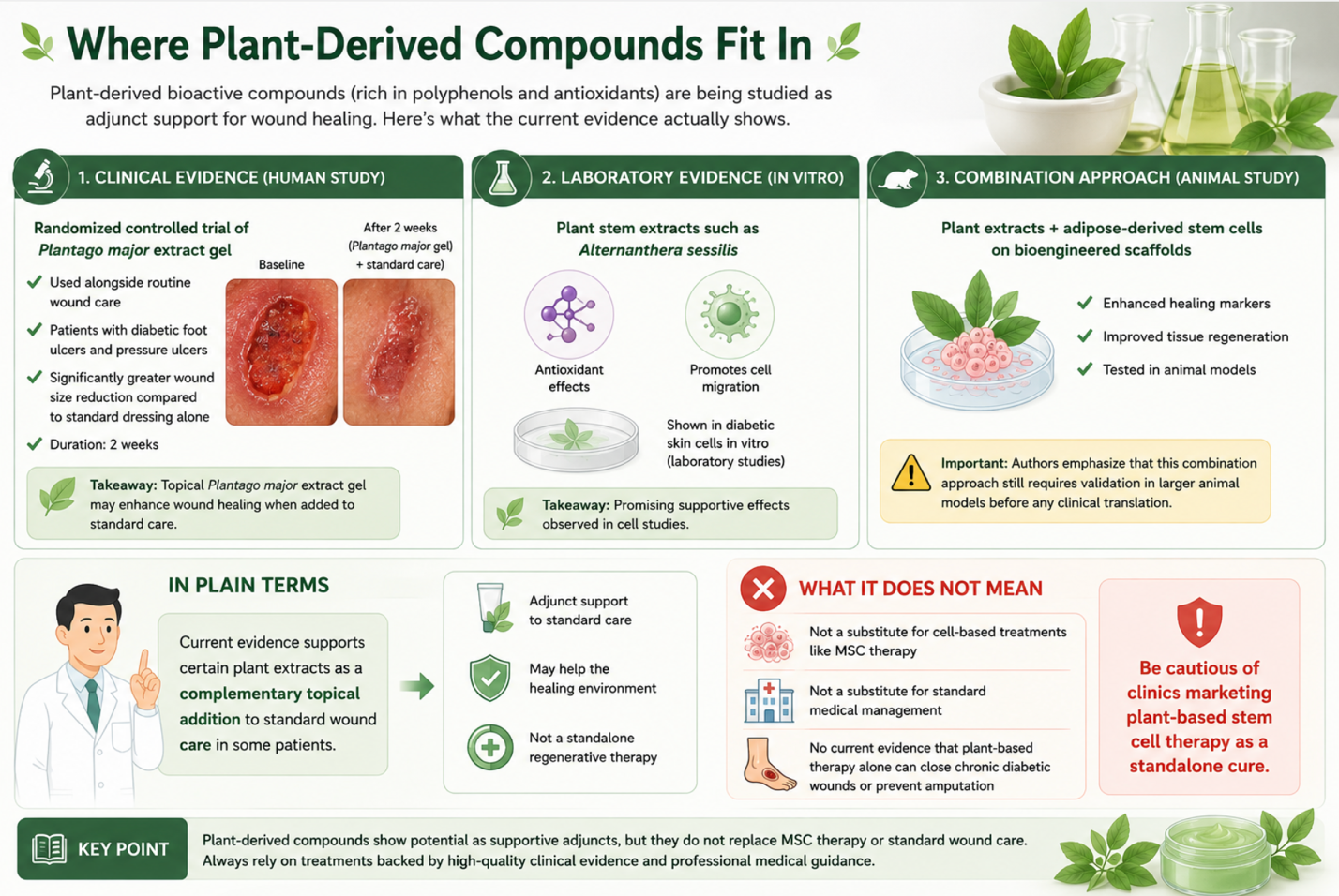
There’s a separate, smaller body of research exploring plant-derived bioactive compounds botanical extracts rich in polyphenols and antioxidants as adjunct support for wound healing. This research is worth knowing about, but it’s important to be precise about what it actually shows.
A randomized controlled trial of topical Plantago major extract gel, used alongside routine wound care, found significantly greater wound size reduction compared to standard dressing alone in patients with diabetic foot ulcers and pressure ulcers over a two-week period. Separately, laboratory studies on plant stem extracts such as Alternanthera sessilis have shown antioxidant and cell-migration-promoting effects on diabetic skin cells in vitro. More recent research has also combined plant extracts with actual adipose-derived stem cells on bioengineered scaffolds, showing enhanced healing markers in animal models though the study authors are clear that this combination approach still requires validation in larger animal models before any clinical translation.
In plain terms: current evidence supports certain plant extracts as a complementary topical addition to standard wound care in some patients not as a standalone regenerative therapy, and not as a substitute for cell-based treatments like MSC therapy or standard medical management. Any claim that plant-based stem cell therapy alone can close a chronic diabetic wound or prevent amputation goes beyond what the current published research supports, and patients should be cautious of clinics marketing it that way.
Published research on MSC-based wound therapy generally reports a favorable safety profile, with most studies noting few serious adverse events directly attributable to the cells themselves. That said, researchers consistently emphasize that treatment protocols cell source, dose, delivery method, and frequency still vary across studies, and long-term outcome data continues to accumulate as the field matures.
Safety in practice depends on factors patients can verify directly with a provider: proper donor and cell screening, laboratory quality control, and physician oversight throughout treatment standards outlined on our Center of Excellence and laboratory pages.
Thailand has become a recognized destination for regenerative medicine, supported by a growing base of specialized clinics, laboratory infrastructure, and a diabetes-prevalent patient population that has driven clinical interest in advanced wound therapies. A typical evaluation and treatment pathway includes:
Comprehensive evaluation : wound assessment, vascular status, infection screening, and diabetes management history
Multidisciplinary wound care : debridement, infection control, and offloading remain part of the plan, not a replacement for it
Cell preparation : MSCs processed under laboratory quality standards
Administration : via injection, topical application, or scaffold-based delivery depending on wound characteristics
Ongoing monitoring : wound measurements and glycemic control tracked over the treatment course
Stem cell therapy is best understood as one component of a broader diabetic wound management plan, not a stand-alone fix a message our clinical team walks through during every consultation.
Stem cell-based treatment is typically considered for patients whose diabetic wounds have:
Not responded to several weeks or months of standard wound care
Signs of poor circulation limiting natural healing
Ongoing risk of worsening or progressing toward amputation despite conventional treatment
Candidacy always requires a full medical evaluation, since wound depth, infection status, and overall vascular and metabolic health all affect suitability and expected outcomes. You can review real patient outcomes on our results page.
Can stem cell therapy cure diabetic foot ulcers? No treatment including MSC-based stem cell therapy is currently established as a guaranteed cure. Research shows it may support faster healing and reduce complications in selected patients, but it works alongside, not instead of, standard diabetic wound management.
Are plant-based stem cell treatments proven for diabetic wounds? Not as a standalone therapy. Some plant extracts have shown modest benefit as an adjunct to standard wound care in clinical trials, but there is no strong clinical evidence that plant-derived products alone can heal chronic diabetic wounds or prevent amputation.
How is UC-MSC therapy different from a patient’s own stem cells? UC-MSCs are sourced from donated umbilical cord tissue (allogeneic), while autologous options come from a patient’s own bone marrow or fat tissue. Each source carries different practical and regulatory considerations.
Is stem cell treatment for diabetic wounds regulated in Thailand? Yes. Reputable Thai clinics operate under medical and laboratory regulatory oversight. Patients should always confirm a clinic’s licensing and ask directly about the regulatory status of the specific cell product being offered.
Adipose-Derived Stem Cells for the Treatment of Diabetic Wound: From Basic Study to Clinical Application. NCBI/PMC. https://www.ncbi.nlm.nih.gov/pmc/articles/PMC9309392/
The role of mesenchymal stem cell-derived EVs in diabetic wound healing. NCBI/PMC. https://www.ncbi.nlm.nih.gov/pmc/articles/PMC10011107/
Progress and expectation of stem cell therapy for diabetic wound healing. PMC. https://pmc.ncbi.nlm.nih.gov/articles/PMC9923865/
Adipose-Derived Stem Cells for the Treatment of Diabetic Wound: From Basic Study to Clinical Application. NCBI/PMC. https://www.ncbi.nlm.nih.gov/pmc/articles/PMC9309392/
The Effect of Plantago major Hydroalcoholic Extract on the Healing of Diabetic Foot and Pressure Ulcers: A Randomized Open-Label Controlled Clinical Trial. NCBI/PMC. https://www.ncbi.nlm.nih.gov/pmc/articles/PMC11607841/
In Vitro Wound Healing Potential of Stem Extract of Alternanthera sessilis. NCBI/PMC. https://www.ncbi.nlm.nih.gov/pmc/articles/PMC5836361/
Shoeblackplant extract–loaded carboxymethyl cellulose/collagen scaffolds seeded with adipose-derived stem cells enhance diabetic wound healing. ScienceDirect, 2026. https://www.sciencedirect.com/science/article/pii/S0040816626000856
Innovations in Stem Cell Therapy for Diabetic Wound Healing. PMC. https://pmc.ncbi.nlm.nih.gov/articles/PMC10468561/