Our Services
Others
- DFPP
- Shockwave
- IV Drip

Natural Cellular Regeneration with Autism: A Biological Perspective on Neurodevelopment and Supportive Therapies
Abstract: Autism Spectrum Disorder (ASD) involves a range of biological processes including neuroinflammation, immune dysregulation, oxidative stress, synaptic differences, and blood-brain barrier changes that researchers are working to understand. This has led to growing interest in whether cellular approaches, particularly mesenchymal stem cell (MSCs), might interact with these processes. This article explains what these biological mechanisms actually are, why understanding them matters, and critically why a biological mechanism worth studying is a very different claim from a therapy that works.No cellular regeneration approach is currently proven or approved for treating autism.
Why Look at Biology at All?
Autism is diagnosed and described primarily through behavior differences in communication, social interaction, and patterns of behavior. But behavior is downstream of biology, and researchers have long asked what’s happening at the cellular and systemic level that might relate to these behavioral differences. This isn’t a new or fringe question it’s a legitimate and active area of neuroscience research. Understanding it, though, requires being precise about the difference between identifying a biological process that may be relevant and having a treatment that addresses it. This article focuses on the first part, and is honest about how far the second part still has to go.
Five Biological Processes Researchers Are Studying in Autism
Neuroinflammation Some studies have found elevated inflammatory markers in brain tissue or cerebrospinal fluid in a subset of individuals with ASD, raising questions about whether this affects how neurons communicate. This is an association under investigation, not an established cause.
Immune dysregulation Differences in immune signaling separate from classic autoimmune disease have been observed in some research cohorts, prompting questions about the immune system’s role during neurodevelopment.
Oxidative stress Cells that experience more oxidative damage than they can repair may function differently. Some research has explored whether this pattern appears more often in ASD, though findings vary across studies.
Synaptic differences Autism has been linked to differences in how neurons form and prune connections during development, affecting the balance between excitation and inhibition in certain brain circuits.
Blood-brain barrier changes A small body of research has explored whether the barrier separating the brain from peripheral circulation functions differently in some individuals with ASD, which could theoretically let peripheral inflammatory signals reach the brain more easily.
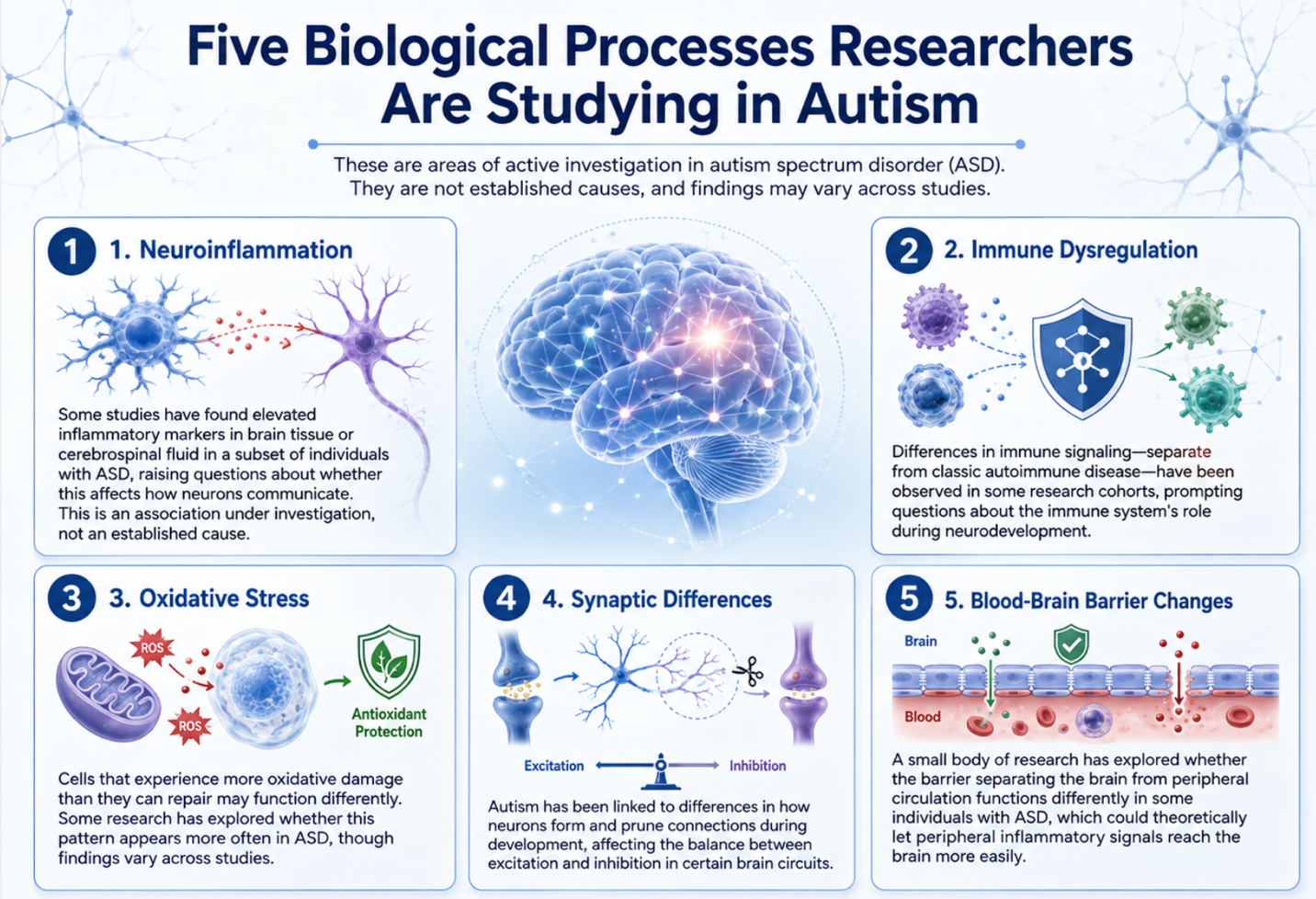
A crucial caveat: each of these is an active research area with mixed, evolving, and sometimes contradictory findings. None of them has been established as the cause of autism — autism’s biological picture appears to vary considerably between individuals, and a mechanism relevant to one subgroup may not apply to another.
Where Cellular Approaches Enter the Picture
Because several of the mechanisms above relate to inflammation and immune signaling, some researchers have asked whether mesenchymal stem cell (MSCs) including those derived from umbilical cord tissue might be relevant. MSC stem cell therapy bangkok thailand are not typically studied as cells that become neurons; rather, the interest is in the signaling molecules they release (growth factors, cytokines, extracellular vesicles) and whether these might influence inflammation or the broader cellular environment.
This is a reasonable scientific question to ask. But asking a good question is not the same as having a good answer. As of now:
There is no large, peer-reviewed, placebo-controlled clinical trial demonstrating that MSC therapy changes core autism symptoms in humans.
Most of the supporting mechanistic evidence comes from general immunology research or preclinical models, not autism-specific human trials.
Any specific claims about improved communication, social function, or “neuro-supportive” benefits in ASD should be treated as unproven unless backed by a citable, autism-specific clinical study.
What This Means (and Doesn’t Mean) for Families
None of this is a case against biologically-informed autism research quite the opposite. Understanding neuroinflammation, immune function, and cellular signaling in autism is valuable science that may eventually inform better-targeted interventions. But eventually is doing a lot of work in that sentence. Right now, this research explains possible mechanisms, not available treatments.
Established interventions behavioral therapy, speech-language therapy, occupational therapy, and structured educational support remain the approaches with the strongest evidence for helping people with ASD build skills and improve quality of life today. These interventions have real, documented limitations: progress varies between individuals, some challenges persist despite therapy, and outcomes aren’t always predictable. That’s an honest description of where the field stands not a gap that any current cellular therapy has been shown to close.
If You’re Considering a Cellular Therapy Program
Any legitimate research program studying MSC stem cell therapy bangkok thailand or related cellular approaches for autism should be able to show you:
Public registration of the study with a clear protocol
Approval from an independent ethics committee or IRB
Full disclosure of the procedure’s risks including risks specific to the delivery method (IV infusion carries different risks than more invasive procedures)
Honest acknowledgment that this is investigational, with no guaranteed outcome
A plan for you to continue evidence-based therapies alongside any research participation, not instead of them
If a program cannot provide this information, or frames participation as a treatment rather than research, that’s a significant reason for caution — regardless of how sophisticated the biological explanation sounds.
Conclusion
The biology of autism or neuroinflammation, immune signaling, oxidative stress, synaptic development, and the blood-brain barrier is a genuinely important and active area of research. It deserves serious scientific attention. But describing a plausible biological mechanism is not the same as demonstrating a working treatment, and families deserve that distinction stated plainly, not blurred by hopeful language. For now, evidence-based therapies remain the foundation of autism care, and any cellular regeneration research should be approached as exactly that: research, undertaken with a qualified physician and full awareness of what remains unknown.
This article is for general informational purposes only and is not medical advice. It does not endorse or promote any specific clinic, treatment, or outcome. Please consult a qualified developmental pediatrician and independently verify the ethical and regulatory standing of any research program before making decisions about a child’s care.
For more infomation you can reach me directly on WhatsApp or Email. Here’s our official link:
WhatsApp :+66982509599
Email : vegastemcell@gmail.com