Our Services
Others
- DFPP
- Shockwave
- IV Drip

If you’ve spent months or years caring for a wound that simply won’t close, you already know how exhausting chronic wound care can be. Stem cell therapy for chronic wounds has emerged as one of the more promising options in regenerative medicine, offering a way to restart the body’s own healing process when standard dressings, antibiotics, and debridement haven’t been enough. This guide walks through what the science actually says, how the treatment works, who tends to benefit most, and where the research is heading.
A wound is generally considered chronic when it fails to progress through the normal healing stages within four to six weeks. Chronic wounds affect millions of people worldwide, and they carry a substantial economic and quality-of-life burden in the United States alone, chronic wounds affect more than 6 million people and cost an estimated $25 billion a year to manage, with similar strain on healthcare budgets in Europe.
Common types include:
Among the most difficult chronic wounds to treat, diabetic foot ulcers develop from a combination of nerve damage, poor circulation, and elevated blood sugar, all of which interfere with normal tissue repair.
Caused by poor blood return from the legs, venous leg ulcers often recur even after they appear to close, making long-term wound healing strategies especially important.
Prolonged pressure on the skin, especially in people with limited mobility, cuts off blood supply and leads to tissue breakdown.
Post-surgical wounds can stall due to infection, poor blood flow, or underlying conditions that impair the body’s repair mechanisms.
Standard treatment cleaning, dressing changes, compression therapy, offloading, and infection control resolves most wounds. But when a wound stalls despite these measures, clinicians increasingly look toward regenerative medicine for wound care, including stem cell-based wound treatment.
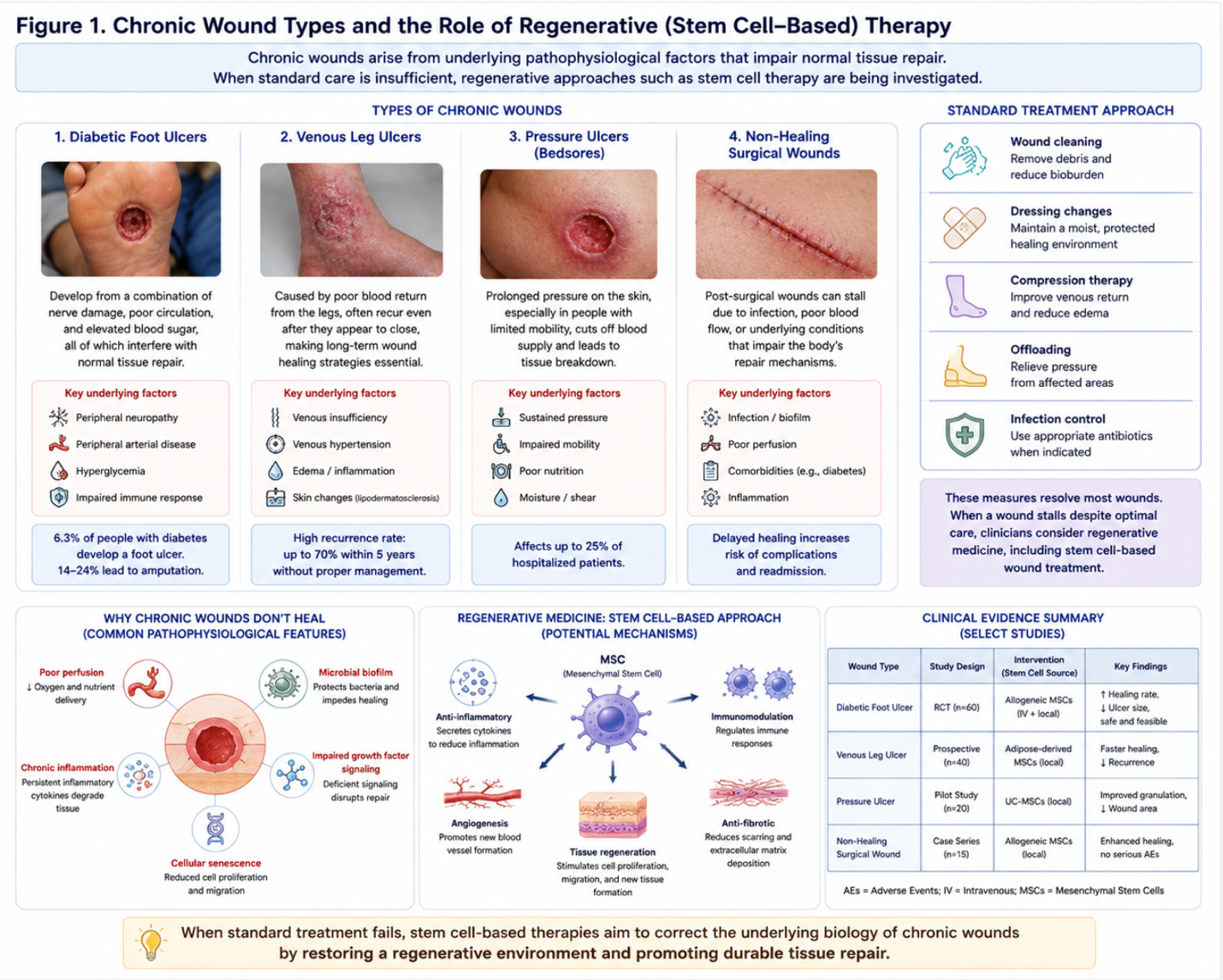
Stem cell therapy uses the body’s own regenerative cells or cells sourced from donor tissue to stimulate healing at the wound site. Stem cells are unique because they can both self-renew and differentiate into specialized cell types such as skin, blood vessel, and connective tissue cells. In a chronic wound, this dual ability allows stem cells to rebuild damaged tissue while also signaling the surrounding cells to resume normal healing activity.
This is different from a simple skin graft. Rather than just covering the wound, stem cell-based wound treatment aims to correct the underlying biological stall the chronic inflammation, poor blood supply, or cellular exhaustion that is keeping the wound open in the first place.
Mesenchymal stem cells (MSCs) are by far the most widely studied and used cell type for chronic wound care. Recent clinical and preclinical reviews describe how MSCs promote tissue regeneration through several overlapping mechanisms, including differentiating into skin cell lineages, modulating inflammation, encouraging new blood vessel growth, and releasing bioactive signaling molecules at the wound site. MSCs can be harvested from bone marrow, adipose (fat) tissue, or umbilical cord tissue, and each source has slightly different regenerative properties.
Epidermal stem cells are specifically involved in regenerating the outer skin layer. They help form new skin over the wound bed, which is particularly useful for surface-level chronic wounds.
Induced pluripotent stem cells (iPSCs) are adult cells reprogrammed to behave like early-stage stem cells, capable of turning into almost any cell type. Their use in chronic wound care is still largely experimental, but early research suggests long-term potential.
Understanding how stem cells help heal chronic wounds comes down to five overlapping biological actions:
Stem cells differentiate into skin, muscle, and endothelial cells (the cells lining blood vessels), directly replacing damaged tissue at the wound site.
Long-standing wounds are often trapped in a prolonged inflammatory phase. Stem cells help modulate this immune response, shortening the inflammatory stage so the wound can move into the repair phase.
Angiogenesis the formation of new blood vessels is one of the biggest hurdles in chronic wound repair, especially in diabetic wound healing, where circulation is already compromised. Stem cells release growth factors that stimulate blood vessel formation, improving oxygen and nutrient delivery to the wound.
Stem cells have immune-modulatory properties, secreting antimicrobial peptides and supporting the body’s natural infection response at the wound site an important factor given how often chronic wounds become colonized by bacteria.
Stem cells release key growth factors including vascular endothelial growth factor (VEGF), fibroblast growth factor (FGF), and platelet-derived growth factor (PDGF) — that drive collagen production, wound contraction, and overall tissue regeneration.
There are three main stem cell delivery methods for wound healing:
Stem cells are injected directly into or around the wound, integrating with existing tissue to begin regenerative activity right at the source of the injury.
Stem cells are incorporated into specialized wound dressings or gels applied directly to the wound bed, allowing for a slower, sustained release of both cells and growth factors.
A biomaterial scaffold provides a supportive structure that helps stem cells stay in place at the wound site, encouraging sustained tissue regeneration rather than a single burst of activity.
Faster wound closure — accelerated tissue repair shortens overall healing time
Better tissue quality — regenerated tissue often shows less scarring and improved cosmetic outcomes
Reduced pain — faster healing generally means a shorter period of wound-related discomfort
Lower amputation risk — particularly relevant for diabetic foot ulcers, where poor healing can otherwise lead to limb loss
The clinical picture is encouraging but still developing. A 2023 review in Frontiers in Cardiovascular Medicine examined MSC-based therapy specifically for chronic limb-threatening ischemia wounds a severe form of non-healing wound tied to poor circulation and found meaningful potential for improving limb salvage outcomes in patients who had exhausted standard revascularization options.
Broader reviews of mesenchymal stromal cell applications across diabetic ulcers, venous ulcers, pressure ulcers, and burns highlight the same core advantages: MSCs are relatively easy to isolate, have a broad secretory profile, and carry low immunogenicity, making them attractive candidates for regenerative wound care, That said, researchers consistently note real challenges — inconsistent outcomes between studies, limited MSC survival once introduced into the harsh wound environment, and variability depending on which tissue source the cells came from. Because of this, most current reviews call for standardized preparation protocols and larger, long-term randomized clinical trials before stem cell therapy for chronic wounds becomes a first-line treatment rather than a specialist option.
Stem cell therapy is typically considered when:
A wound has not responded to standard wound care (dressings, debridement, offloading, compression) for several weeks or months
Underlying circulation issues are limiting natural healing
The patient has a diabetic foot ulcer, venous leg ulcer, or pressure ulcer at risk of worsening or leading to amputation
Standard wound infection control measures haven’t resolved persistent bacterial colonization
As with any regenerative treatment, candidacy should be evaluated by a wound care specialist, since underlying health conditions, wound depth, and infection status all affect suitability.
Is stem cell therapy for chronic wounds FDA-approved? Most stem cell wound treatments remain in clinical research or specialized clinical use rather than being broadly approved as standard-of-care, so availability varies by country and treatment center.
How long does it take to see results from stem cell wound therapy? Timelines vary by wound type, cell source, and delivery method, but many studies report measurable improvement in wound size within several weeks of treatment.
Are there risks to stem cell therapy for wounds? As with any regenerative treatment, risks can include infection at the injection site, variable healing response, and — since research is ongoing — outcomes that aren’t yet fully predictable across all wound types.
Ongoing research is focused on improving stem cell harvesting methods, refining cell delivery techniques, and developing standardized dosing protocols so outcomes become more predictable across patients. As regenerative medicine continues to mature, stem cell therapy for chronic wounds particularly using mesenchymal stem cells is likely to become a more accessible and reliable option for patients whose wounds haven’t responded to conventional treatment. For now, it remains one of the most promising frontiers in advanced wound care, offering real hope for patients facing diabetic foot ulcers, venous leg ulcers, and other stubborn, non-healing wounds.
Advancements in mesenchymal stem cell therapy for chronic wounds: challenges, innovations, and future directions. Frontiers in Cell and Developmental Biology, 2025. https://pmc.ncbi.nlm.nih.gov/articles/PMC12832901/
Advancements in mesenchymal stem cell therapy for chronic wounds: challenges, innovations, and future directions. NCBI. https://www.ncbi.nlm.nih.gov/pmc/articles/PMC12832901/
Huerta CT, Voza FA, Ortiz YY, Liu ZJ, Velazquez OC. Mesenchymal stem cell-based therapy for non-healing wounds due to chronic limb-threatening ischemia: A review of preclinical and clinical studies. Frontiers in Cardiovascular Medicine, 2023. DOI: 10.3389/fcvm.2023.1113982. https://www.ncbi.nlm.nih.gov/pmc/articles/PMC9930203/
Harnessing Mesenchymal Stromal Cells for Advanced Wound Healing: A Comprehensive Review of Mechanisms and Applications. NCBI. https://www.ncbi.nlm.nih.gov/pmc/articles/PMC11719717/
Mesenchymal Stem Cells and Cutaneous Wound Healing: Current Evidence and Future Potential. NCBI. https://www.ncbi.nlm.nih.gov/pmc/articles/PMC4461792/