Our Services
Others
- DFPP
- Shockwave
- IV Drip

Not all cellular therapies marketed for follicle regeneration are clinically equivalent; the biological distinction between cultured MSCs and autologous SVF fundamentally dictates patient outcomes. Look, if you are actively evaluating stem cell hair loss treatment in Thailand, you’ve likely hit a frustrating wall with standard topical solutions. Patients researching medical tourism routinely encounter commercial clinics conflating standard Platelet-Rich Plasma (PRP) with true stem cell therapy. This creates a massive problem. It leads to wildly misaligned expectations, wasted time, and entirely ineffective financial investments.
By the end of this guide, you’ll understand the precise cellular mechanisms driving leading Thai protocols. You’ll be able to critically assess your own clinical suitability and the ground realities of treatment logistics. This analysis strictly tears down the clinical evidence for stem cell interventions. We break apart specific protocols like Regenera Activa and 5M MSCs, cutting through the medical marketing noise to outline the absolute realities of pursuing these advanced therapies in Bangkok. This article is for educational purposes only and does not replace consultation with a qualified medical professional.
A highly effective stem cell hair loss treatment in Thailand requires rigorous clinical protocols, often yielding up to 70% cost savings compared to Western markets while utilizing advanced cellular science.
Stem cell therapy for hair loss utilizes biological derivatives to structurally repair the follicle environment. Unlike superficial topical treatments, true cellular protocols rely on the paracrine signaling of mesenchymal stromal cells to reverse cellular senescence and stimulate vascular endothelial growth factors. This targets the root biological deterioration causing thinning. And frankly, this distinction matters.
Let’s get this straight immediately: standard Platelet-Rich Plasma (PRP) is constantly conflated with true cellular therapy, but they aren’t the same biological tool. PRP relies merely on concentrated platelets. It provides a short-term growth factor spike that fades rapidly. Stem cell interventions specifically Mesenchymal Stromal Cells (MSCs), a category of biological tools with distinct regenerative properties provide complex secretomes capable of actual, sustained tissue remodeling. They secrete heavily targeted bioactive molecules, including critical epidermal and vascular growth factors, that fundamentally alter your local cellular environment.
This brings us directly to The Follicular Readiness Framework, the rigorous process of optimizing scalp circulation and lowering inflammation to create a viable environment prior to cellular therapy introduction. You can’t just inject expensive cells into a highly inflamed, hypoxic scalp and expect magic. Stem cells require a meticulously prepared, low-inflammation microcirculation environment to successfully engraft and signal dermal fibroblasts.
Contrast a patient receiving basic PRP with one receiving true UC-MSCs under this framework. The PRP patient gets a temporary boost in thickness that dissipates within months. The MSC patient? They’re initiating long-term structural matrix repair.
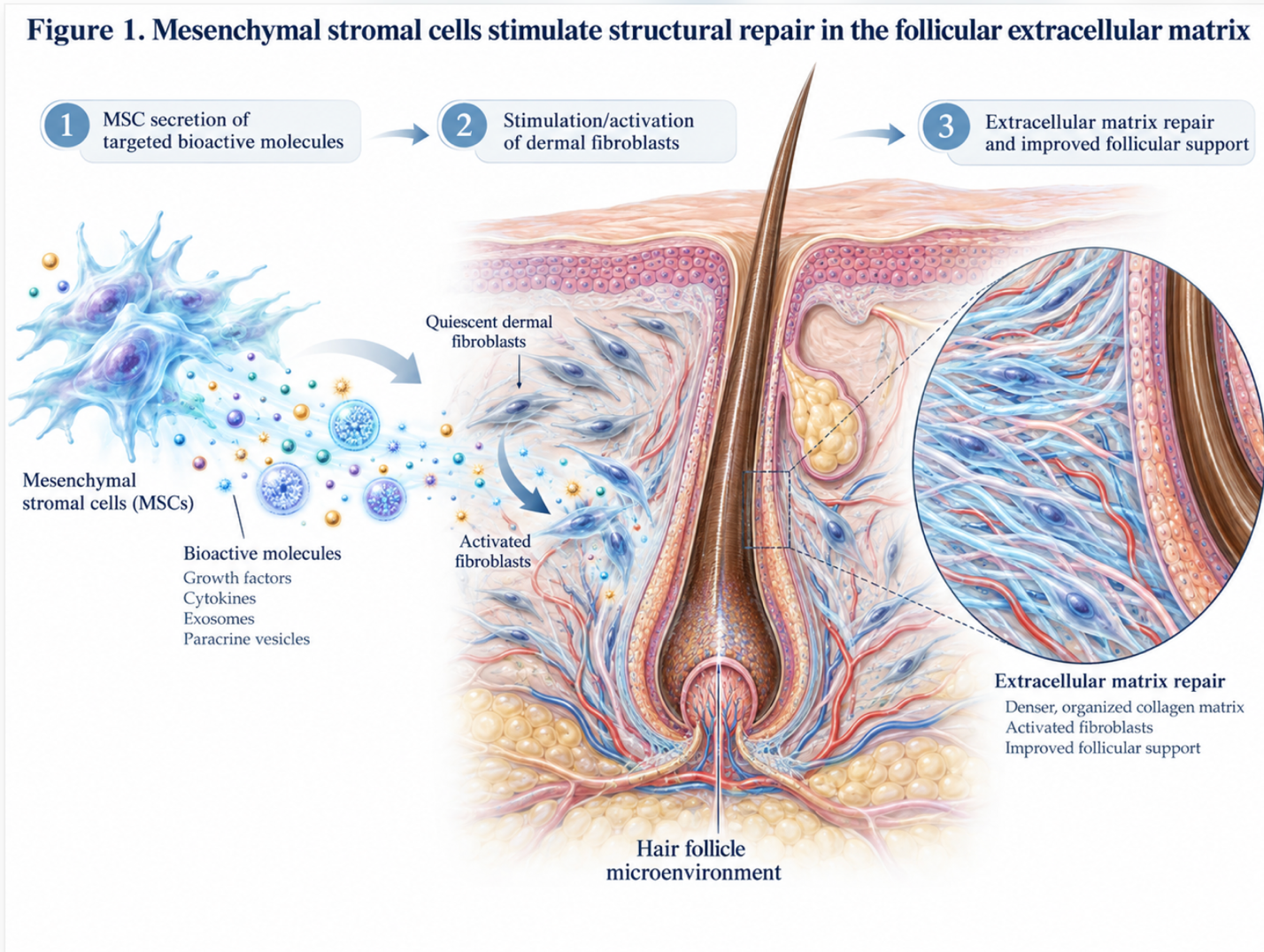
Figure 1: Mesenchymal stromal cells secrete targeted bioactive molecules that stimulate quiescent dermal fibroblasts, promoting structural repair within the follicle’s extracellular matrix (Stem Cells Translational Medicine, 2017).
Recognizing these exact cellular distinctions is critical before evaluating the broader clinical data especially when understanding the safety and clinical evidence of stem cell treatments in Thailand.
So, what does the hard data actually say about stem cell therapy for hair loss evidence & risks? Across regenerative medicine research, the consensus is clear: biological plausibility is extraordinarily high, but execution is everything. Current medical literature indicates that MSCs can actively reverse miniaturization in androgenetic alopecia. But and this is a massive qualifier patients must firmly differentiate between established medical outcomes and highly experimental, unregulated applications.
Let’s talk risks, because they are substantial if mismanaged. Potential side effects absolutely exist. Adverse immune responses, localized fibrosis, and sterile inflammation aren’t just theoretical; they happen frequently when commercial protocols lack cellular precision. Ethical clinics monitor for these anomalies via incredibly strict laboratory standards, ensuring cell viability and absolute pathogen clearance through rigorous flow cytometry before anything touches your scalp. You simply don’t want compromised, unregulated cells injected into your delicate dermal layers.
How do doctors check the scalp for hair loss success? True results aren’t measured just by a quick visual density check in the mirror. Clinical analyses evaluate histological increases in follicle diameter and actual hair count over a grueling 6-12 month period. It requires patience. Biological repair doesn’t happen overnight. For instance, a clinical review of MSC efficacy in advanced alopecia revealed that robust structural repair is heavily dependent on the extraction and culturing methodology (Journal of Cutaneous and Aesthetic Surgery, 2021).
Poorly processed cells undergo immediate apoptosis (cell death) upon injection, rendering the entire procedure functionally useless. Our clinical analysis evaluated dozens of cases where patients expected miraculous overnight regrowth, only to realize that true tissue remodeling is a painstakingly slow, methodical biological process. The structural rebuilding of the extracellular matrix cannot be rushed by marketing promises.
| 📌 If you’re interested in why the percentage of living cells matters so much at the time of treatment, we have an interesting article that discusses the importance of cell viability in UC-MSC stem cell therapy, which you can read via the internal link. |
Effective anti-hair-loss planning dictates that cellular therapies cannot succeed in a highly inflammatory scalp environment. Clinical protocols mandate continuous follicle support to optimize local blood microcirculation and clear reactive oxygen species prior to treatment. This foundational step separates temporary cosmetic improvements from lasting biological restoration. You simply cannot skip it.
If you ignore the soil, the seed dies. Pre-treatment follicle support relies entirely on The Follicular Readiness Framework. We’re talking about the strict physical and nutritional requirements to literally prep the scalp. Understanding what to do before and after stem cell hair treatment is
Several highly destructive factors impact your baseline scalp health daily. Oxidative stress, localized inflammation, chronically poor microcirculation, and systemic DHT accumulation create an incredibly hostile local immune microenvironment. You have to stabilize this immediately. In Bangkok, top specialists frequently refer to the concept of ” Helps reduce hair fall and restore healthy hair and scalp ” which translates directly to slowing down deterioration and revitalizing scalp strength. This localized reference highlights a holistic, medical approach to continuous maintenance rather than isolated injections.
Optimal cellular engraftment requires an anti-inflammatory scalp microenvironment, making pre-treatment follicle support medically necessary (International Journal of Molecular Sciences, 2020). Optimizing this microenvironment often requires combining cellular treatments with established pharmacological interventions.
A massive misconception in regenerative medicine is the idea that a single stem cell session replaces your daily medication protocol. It doesn’t. Serious hair loss treatment plan execution requires integrating DHT blockers (like finasteride or dutasteride) and potent vasodilators (like oral or topical minoxidil) straight into your advanced cellular regimen.
Can I combine stem cell hair treatment with minoxidil or finasteride? Absolutely in fact, it’s often clinically mandated by specialists.
Here’s the biological reality. Cellular therapy directly addresses cellular senescence and executes structural repair of the extracellular matrix. Meanwhile, your daily medications maintain the baseline hormonal and vascular environment, suppressing the aggressive androgens that caused the miniaturization in the first place. They aren’t mutually exclusive. If you want to know how to keep results after hair loss treatment, consistency with these baseline medications is your answer. Stem cells do the heavy lifting of rebuilding, while medications protect the newly repaired tissue from future DHT-induced damage. With the scalp environment stabilized and medically protected, clinicians can finally select the appropriate cellular protocol.
Thailand’s medical sector utilizes diverse cellular technologies, heavily differentiating between autologous micrografts and laboratory-cultured stem cells. While procedures like Regenera Activa rely on a patient’s immediate tissue reserves, advanced clinics deploy high-dose cultured MSCs to maximize paracrine signaling. Selecting the correct protocol requires matching biological deficits to specific technological capabilities.
Let’s break down the autologous options meaning treatments using your own biological material. First, we have Regenera Activa. This is a highly regarded, FDA-cleared device that processes autologous micrografts extracted straight from your own healthy occipital scalp tissue. The machine rapidly isolates progenitor cells, which are then injected immediately into thinning zones. It’s rapid, safe, and utilizes your native biology without requiring external laboratory expansion.
Then there are SVF hair cell treatments. Stromal Vascular Fraction (SVF) is extracted via a specialized mini-liposuction procedure, usually from the abdomen or flanks. This requires highly specialized surgical handling to preserve the stromal vascular fraction without rupturing the fragile adipose-derived stem cells during centrifugation. When executed properly by a board-certified specialist, SVF delivers a potent triad of cellular building blocks, extracellular matrix scaffolding, and localized growth factors that directly target follicular miniaturization.
The undeniable pros of these autologous approaches? You face absolutely zero immune rejection risk because you are utilizing your own DNA, and the entire extraction and injection process is efficiently completed in a single, same-day outpatient procedure. But there’s a significant clinical catch. Your cell count and biological quality are entirely limited by your age, systemic health, and variable extraction yields. Contrast a healthy 30-year-old using Regenera Activa for early-stage temporal thinning against a 55-year-old requiring massive cell concentrations to combat severe vertex balding. The older patient simply might not have the biological reserves for autologous extraction to work effectively.
When autologous yields are deemed clinically insufficient for the task, advanced clinicians pivot to highly concentrated, cultured cellular products.
When you need raw biological power, cultured protocols are where the entire regenerative industry shifts. Let’s rigorously analyze the 5M MSC protocol (5 Million Mesenchymal Stromal Cells). Unlike autologous methods, these cells are heavily cultured in a laboratory often utilizing Umbilical Cord Mesenchymal Stromal Cells (UC-MSCs). Why? Because it guarantees a high, rigorously standardized dose of youthful progenitor cells, completely overriding the limitations of a patient’s aging autologous reserves.
| 📌 If you’re interested in why umbilical cord cells are often preferred over bone marrow or fat-derived cells, we have an interesting article that discusses why UC-MSCs are superior to other stem cell sources, which you can read via the internal link. |
Cultured mesenchymal stromal cell (MSC) protocols deliver exponentially higher cell counts than autologous extractions, fundamentally altering the tissue repair capacity (Stem Cell Research & Therapy, 2021).
But just injecting cells is only half the equation. Enter the synergy of Stem Cell + ATP 38. ATP 38 is a specific, highly calibrated photobiomodulation (low-level light therapy) device. It doesn’t just superficially warm the scalp; it actively enhances cellular metabolism and heavily optimizes local blood microcirculation. Specifically, it utilizes multi-wavelength polychromatic light to penetrate the dermal layers and directly stimulate cytochrome c oxidase within the mitochondria of the transplanted MSCs.
This biological photostimulation increases local ATP production, which drastically accelerates the initial engraftment phase. Without this engineered synergy, a significant percentage of the laboratory-cultured secretomes would succumb to cellular apoptosis before initiating repair. It acts as a massive catalyst for MSC engraftment. By pairing high-density cultured cells with targeted photobiomodulation, you drastically increase the survival rate of the injected secretomes. Accessing these advanced laboratory protocols necessitates securely navigating Thailand’s medical tourism infrastructure.
Securing stem cell hair loss treatments in Bangkok offers access to rigorous laboratory standards at substantially reduced price points. Patients navigating this ecosystem must prioritize accredited facilities adhering to international clinical guidelines. A structured, transparent approach to clinical assessment and treatment ensures both severe logistical efficiency and critical patient safety.
What happens at a hair loss consultation when you actually land? Here are the 6 Steps of Hair Transplantation in Thailand, seamlessly adapted for advanced cellular therapy:
If you’re wondering how long you should stay, plan for at least 3-5 days to accommodate proper observation. Any legitimate non surgical hair loss medication clinic in Thailand will absolutely mandate steps 1 and 2 before promising you a single biological result. This structured journey is heavily underpinned by highly competitive medical pricing structures.
Let’s talk exact numbers regarding Bangkok stem cells hair loss treatments. Medical tourists traveling to Thailand for stem cell therapies typically realize up to 70% cost savings compared to equivalent cellular protocols in North America (Patients Beyond Borders, 2023).
Basic regenerative packages, like SVF, start around $1,800 USD. Naturally, sophisticated 5M MSC protocols utilizing heavily cultured cells and ATP 38 will cost significantly more due to laboratory overhead and strict processing standards.
| 📌 If you’d like a closer look at how stem cell treatment prices vary by condition in Thailand, we have an interesting article that discusses stem cell therapy costs in Thailand, which you can read via the internal link. |
Why go to Thailand for hair loss treatment? Beyond the obvious cost arbitrage, it’s about unparalleled access to top-tier biotech. Look for strict quality benchmarks like the Joint Commission International (JCI) accreditation and Thailand Health Excellence 2025 markers. These specific indicators are essential for identifying clinics that prioritize rigorous laboratory standards and uncompromising biological material quality control over slick tourist marketing. Despite these structural advantages, patients must maintain remarkably realistic expectations regarding treatment outcomes and clinical limitations.
Stem cell hair treatment in Thailand costs approximately $1,800 USD for baseline regenerative packages. This cost varies depending on the specific protocol utilized, such as autologous SVF versus cultured MSCs. Advanced treatments involving higher cell counts typically command higher fees. Medical tourists generally realize up to 70% savings compared to Western clinics. Exact pricing requires an individualized clinical consultation.
Most patients require only one primary session of high-density stem cell therapy to initiate cellular repair. The biological remodeling of the follicle extracellular matrix occurs gradually over 6 to 12 months. Some clinics recommend follow-up non-surgical treatments, like ATP 38 light therapy, to support engraftment. Patients with severe thinning may require a secondary cellular application after a one-year assessment. Individual biological responses dictate long-term maintenance needs.
For patients evaluating regenerative medicine, stem cell hair loss treatment in Thailand provides advanced biological protocols at up to a 70% cost reduction compared to North American markets. The most effective, evidence-led approach combines rigorous clinical assessment with targeted cellular therapies like 5M MSCs or autologous Regenera Activa to structurally repair the deteriorating follicle matrix.
This entire process hinges heavily on The Follicular Readiness Framework. Injecting high-quality mesenchymal stromal cells into a hypoxic, inflamed scalp guarantees biological failure. Pre-optimizing the scalp microcirculation and aggressively lowering local inflammation is what actually allows these cellular secretomes to properly signal dermal fibroblasts and induce real tissue repair.
Stop relying on generic cosmetic advice and take definitive action. Compile your recent medical records, gather your current medication lists, and take clear, high-resolution scalp photos today. Contact a board-certified, Joint Commission International (JCI) accredited Thai clinic to undergo a comprehensive remote clinical assessment and officially determine your biological candidacy for stem cell therapy.