Our Services
Others
- DFPP
- Shockwave
- IV Drip

The Pressing Demand for Enhanced Skeletal Regeneration
Injuries to the skeleton as well as congenital deformities of the skeletal system can lead to serious and permanent functional limitations and loss of quality of life. Patients who have large deficits in the structural continuity of their skeleton suffer daily from pain and limited mobility. Current and traditional methods of treatment are inadequate and unable to provide a long-term solution to the growing and stretching demands of large skeletal tissue deficits. These methods and the nature of the complaints emphasize the need for sophisticated and advanced regenerative solutions and methods. The trend in modern medicine is to move away from repair and restoration of functions by mechanical means toward achieving biological regeneration. The advanced and specialized cellular therapy is an innovative frontier and opens many avenues for the skeletal compromised patients around the globe. It is high time to offer patients hope, where hope is otherwise lost, with innovative biological therapies like stem cell therapy Thailand. The use of UC-MSCs is one of the many available innovative biological therapies to treat complex and large Bone Defects.
Bridging the Limitations of Traditional Grafts
The current traditional methods rely mostly on the use of autografts or allografts to close large and massive structural deficits like severe Bone Defects. Autografts are achieved by the removal of a healthy tissue or a healthy tissue construct from a site in the patient’s body. Allografts involve the use of healthy tissue from a donor, or even tissue from a body that has been declared clinically dead. Allografts, while saving the donor from the injury, still carry risks of tissue rejection due to immunological incompatibility and loss of healthy tissue. These traditional methods of restoring structural integrity to large deficits suffer from the same limitations in achieving biological regeneration and in promoting vascularization. Newly implanted tissue cannot survive or integrate without a sufficient blood supply. Synthetic scaffolds provide a novel option to researchers and tissue engineers but completely lack the biological signals to stimulate and guide tissue regeneration. These significant limitations to functional biomedical engineering cannot be ignored, and solutions like UC-MSCs need to be developed to improve tissue regenerative processes safely. Here, cutting-edge stem cell therapy Thailand offers one of the most innovative solutions in the field of tissue regeneration.
Harnessing the Power of Cellular Repair Mechanisms
Replacing traditional surgical interventions with cellular therapy involves the guiding principles of biological healing, heavily utilized in stem cell therapy Thailand. One source of highly effective cellular therapy is the umbilical cord-derived UC-MSCs. These cells have the potential to differentiate into a variety of cell types, including osteoblasts, which are the predominant cells involved in the synthesis of the bone extracellular matrix. When introduced into a site of extensive Bone Defects, UC-MSCs initiate the complex process of biological healing and repair. One of the primary processes includes the differentiation of osteoblasts. UC-MSCs readily respond and migrate to the site of injury among the evolving and changing environments. In addition to differentiating into bone-forming cells, UC-MSCs secrete numerous factors that influence the healing process through paracrine signals. One of the paracrine signals includes the secretion of vascular endothelial growth factor, which guides angiogenesis. Angiogenesis is the formation of new blood vessels and is needed to supply the healing tissue with nutrients and oxygen.
Modulating The Local Healing Microenvironment
Additionally, UC-MSCs have important, strong immunomodulatory characteristics central to stem cell therapy Thailand. Severe Bone Defects involve resilient, destructive, chronic inflammatory responses which prevent the natural healing process. The cells that are delivered work to calm the aggressive, local immune response through the secretion of focused anti-inflammatory cytokines. The regulation of macrophages and/or T-cells responds with the formation of a healing microenvironment that promotes the synthesis of new tissues, as opposed to the degradation of old/damaged tissues. The tissue formation and local environment modification imply the combinations of the local environment and structural support as opposed to traditional, passive, and inert bone substitutes.
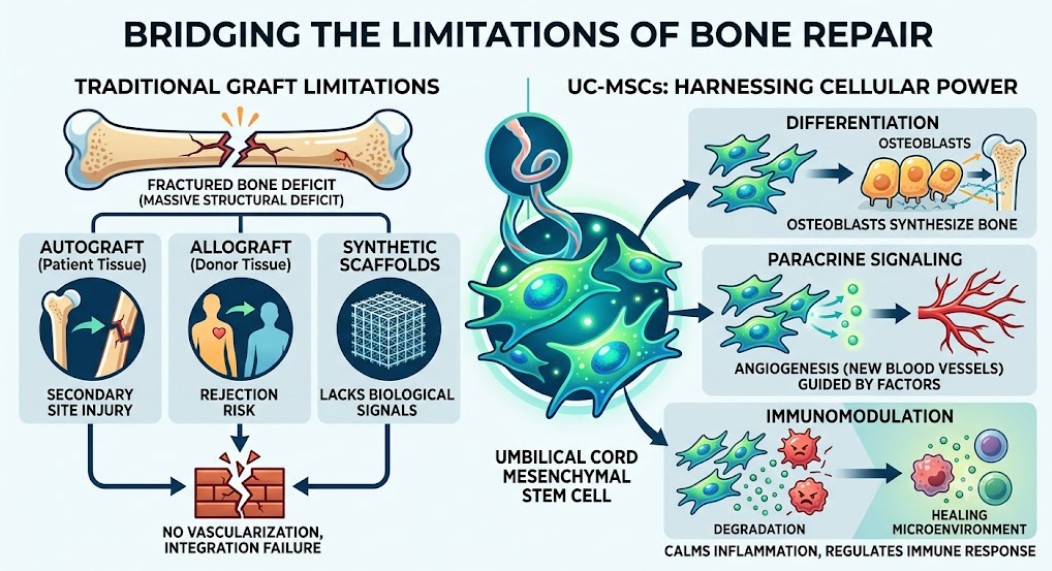
Figure 1: Bridging the Limitations of Traditional Grafts and Power of Cellular Repair Mechanisms
Regional Innovations and Future Horizons
The Southeastern region of Asia is quickly developing as the world’s leading zone for the advanced study of the sciences. The therapeutic use of UC-MSCs for the difficult and complicated studies of skeletal regeneration, such as treating Bone Defects, is the focus of many activities in this region. The new, strong stem cell therapy Thailand sector is leading projects from the major Medical Research Facilities, which have the new supportive infrastructures of advanced, safe, and regulatory science, along with partnerships of local researchers and international reinforcing firms. With the rise of internet-accessible medical information, patients from other countries come to Thailand for specialized regenerative care. The new strong, advanced, cell-based therapies will ensure stem cell therapy Thailand creates a world standard of care that is easier to access.
Restoring Structural Integrity for Tomorrow
The support of regenerative therapies needs to overcome the problems of skeletal gaps and conventional grafting methods pose complications that significantly limit their long-term efficacy. The use of UC-MSCs changes the nature of the treatment for patients with structural deficits. UC-MSCs have the capacity to differentiate, the ability to promote angiogenesis, and the capacity to modulate the immune system. This makes the use of UC-MSCs an effective means of treating complicated Bone Defects. The continuous development of sophisticated stem cell therapy Thailand will attract clients who seek these advanced medical treatments. Innovative medical treatments will continue to evolve with the continued development of stem cell therapy. Once the clinical research on the therapy is completed, the use of stem cells will become the standard practice in the medical field.