Our Services
Others
- DFPP
- Shockwave
- IV Drip

Patients experiencing early pattern hair loss often navigate a frustrating array of options—from daily minoxidil applications to invasive surgical transplants. But here’s the reality: chemical treatments frequently act as biological band-aids, temporarily masking follicular deterioration. Transplants relocate healthy hair, but they don’t stop the progressive loss of your native hair. This leaves a significant gap in treatment.
Today, stem cell therapy for hair restoration fills that gap. It represents a cellular-level intervention designed explicitly to address the root cause of follicular senescence. It doesn’t just move hair around; it changes the biological environment of your scalp.
This clinical guide evaluates the exact molecular mechanisms, realistic biological timelines, and clinical safety data behind cellular hair regeneration. We’ll bypass the marketing hype. Instead, we’ll analyze how laboratory-tested umbilical cord cells compare directly against conventional PRP, outline procedural expectations, and establish exactly who actually qualifies for this treatment—because it isn’t for everyone.
Stem cell therapy for hair loss utilizes mesenchymal stromal cells to reactivate dormant hair follicles by promoting angiogenesis and modulating the scalp’s immune microenvironment.
Stem cell therapy for hair loss is an advanced regenerative intervention that utilizes mesenchymal stromal cells to reverse follicular senescence and stimulate dormant dermal papilla cells. Clinical evaluations show these cells initiate tissue repair primarily through paracrine signaling rather than direct cellular differentiation. This makes it a foundational, evidence-informed approach for treating early pattern hair loss.
UC-MSCs secrete over 40 distinct growth factors stimulating dormant follicles to restart anagen growth. (Journal of Dermatological Science, 2020).
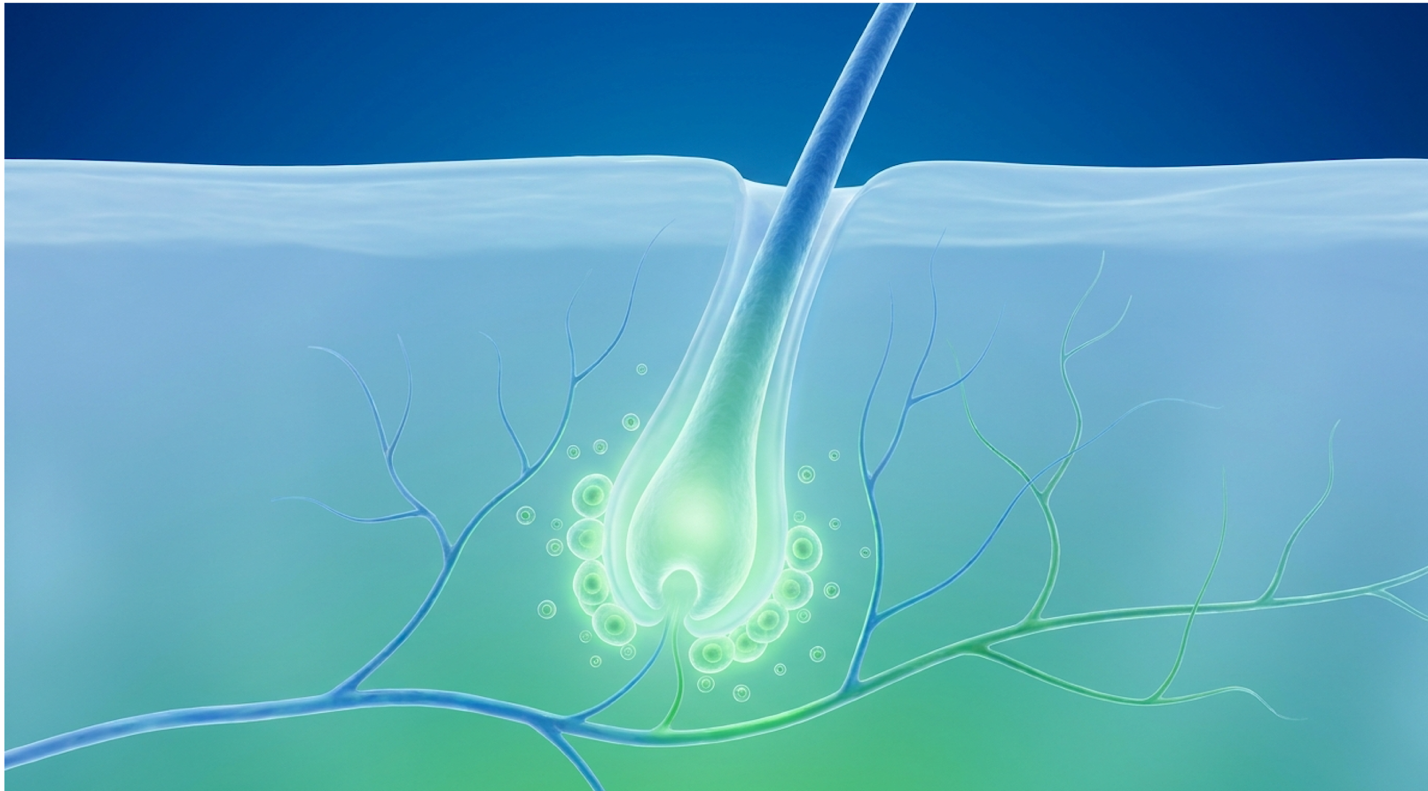
To understand how stem cells regrow hair, you have to look at the base of the hair follicle. The dermal papilla is the biological engine room of your hair. During androgenic alopecia, DHT binding and chronic micro-inflammation cause these dermal papilla cells to undergo senescence. They essentially fall asleep. The follicle miniaturizes, the hair shaft thins, and eventually, the hair stops growing entirely.
When a clinician introduces UC-MSCs into this deteriorating scalp microenvironment, the cells don’t magically turn into new hair. Instead, they act as cellular dispatchers. They release bioactive
But it goes much deeper than just supplying growth factors. These exosomes bind directly to the senescent dermal papilla cells. This binding explicitly activates the ERK MAPK and Wnt/β-catenin signaling pathways the critical biological circuits that regulate hair follicle cycling. Wnt/β-catenin activation effectively forces the follicle out of the telogen (resting) phase and back into the anagen (growth) phase. Studies indicate that UC-MSC secretomes contain up to 300% higher concentrations of these specific signaling proteins compared to adult stem cells. Simultaneously, these factors trigger angiogenesis, building new blood vessels to feed the starving follicle. Better blood flow means better nutrient delivery.
This brings us to The UC-MSC Follicular Viability Framework. This framework dictates that the success of regenerative therapy entirely depends on delivering high-viability cells to a scalp microenvironment that still possesses salvageable follicles. You need living, albeit dormant, cellular targets for the paracrine signals to work. Recent dermatological research demonstrates that Wnt pathway activation strictly requires viable dermal papilla receptors.
| 📌 If you’re interested in why the percentage of living cells matters so much at the time of treatment, we have an interesting article that discusses the importance of cell viability in UC-MSC stem cell therapy, which you can read via the internal link. |
While understanding what is stem cell hair restoration mechanistically is crucial, patients must distinguish between the specific types of biologics used in these treatments.
Not all regenerative therapies are created equal. The industry frequently conflates simple blood treatments with actual cellular therapies, causing immense patient confusion.
Take Platelet-Rich Plasma (PRP). PRP is a conventional benchmark utilizing patient-derived blood components. You draw blood, spin it down, and inject the platelets. But PRP lacks active progenitor cells. Furthermore, it relies entirely on your aging biology. If you are forty-five, your PRP growth factors reflect a forty-five-year-old biological age.
Adipose-derived stem cells for hair loss offer a step up. By extracting fat via a minor liposuction procedure, clinicians can isolate actual stem cells. However, this is an invasive autologous procedure, and the stem cells extracted still carry the epigenetic wear-and-tear of the patient’s age.
Laboratory-tested umbilical cord stem cells for hair loss bypass these limitations entirely. UC-MSCs are day-zero cells. They possess the highest proliferative capacity and a massive, youthful secretome. More importantly, UC-MSCs perform phenotypic macrophage “reprogramming.” They actively switch the scalp’s immune response from a pro-inflammatory state (which kills hair) to an anti-inflammatory, regenerative state. This M1 to M2 macrophage polarization is arguably the most vital step in halting androgenic progression.
Comparative clinical analyses highlight the significantly higher proliferative capacity of these neonatal tissues over aging adipose cells. This superior paracrine and immunomodulatory profile is exactly why leading clinics like Vega Stem Cell utilize lab-tested UC-MSCs.
| 📌 If you’re interested in why umbilical cord cells are often preferred over bone marrow or fat-derived cells, we have an interesting article that discusses why UC-MSCs are superior to other stem cell sources, which you can read via the internal link. |
Stem cell hair restoration results depend entirely on the patient’s baseline follicular health and strict adherence to the biological hair growth cycle. Unlike surgical transplants that offer an immediate physical relocation of follicles, cellular therapy repairs the scalp microenvironment over months. Evidence-informed practice dictates that patients require meticulous clinical monitoring and reassessment to track changes in hair caliber and density accurately.
Clinical observations show visible hair density improvements typically emerge 3 to 6 months post-treatment requiring patience during biological integration. (ClinicalTrials.gov Data, 2020).
Patients often expect rapid aesthetic changes. That isn’t how biology works. A realistic timeline for stem cell hair growth follows the rigid chronological constraints of the human hair cycle.
During Months 1 and 2, cellular integration occurs. You will not see new hair growth in the mirror. Instead, the UC-MSCs are working sub-dermally—reducing scalp inflammation, enhancing local microcirculation, and stabilizing active hair shedding. You might actually experience mild shedding during this early phase as older, weaker hairs are pushed out to make way for new anagen growth. Don’t panic; this is a completely normal biological response.
Between Months 3 and 6, initial anagen activation begins. The dormant follicles finally re-enter the growth phase. During this window, patients typically note that their existing hair shafts feel substantially thicker and early structural repair becomes visible under a trichoscope. Dermatologists utilize digital trichoscopy to map these minute changes. Clinicians look specifically for increases in the hair shaft diameter and the number of hairs per follicular unit. Digital trichoscopy provides measurable data—often showing a 15% to 20% increase in hair caliber long before changes are visible to the naked eye. This means those tiny, invisible peach-fuzz hairs start gaining pigment, structural integrity, and measurable thickness.
From Months 6 to 12, the results mature. This is when patients achieve peak results in terms of overall density and visual scalp coverage. Digital measurements at this stage frequently demonstrate a sustained 30% or greater increase in absolute hair density compared to baseline. Clinical follow-up data tracking MSC interventions shows peak density increases distinctly at the 6-to-9-month mark.
This timeline is a fundamental rule of human biology, not a limitation of the therapy. Because this timeline relies on reactivating existing biology, patient selection is the single most critical factor in achieving these results.
Let’s address a harsh clinical truth: cellular therapy is not a universal solution.
Ideal candidates for stem cell hair restoration for women and men are individuals aged 25 to 55 experiencing early to moderate pattern hair loss (androgenic alopecia) or diffuse thinning. In these cases, the hair follicles are miniaturized and dormant, but they are still alive. For men, this typically encompasses Norwood stages II through IV. For women, Ludwig stages I and II are the clinical sweet spot.
The critical biological marker we look for is the presence of vellus hairs. These thin, wispy hairs indicate that the follicle is still alive and capable of responding to paracrine signals. Without them, the microenvironment is essentially a barren field.
Can stem cells regrow hair on a bald scalp? Absolutely not. Individuals with completely bald, shiny scalps or those suffering from advanced scarring alopecia are non-candidates. If the follicle
This distinction perfectly illustrates the core principle of the UC-MSC Follicular Viability Framework. You must have viable targets for the treatment to work.
Therefore, a professional medical suitability assessment is mandatory. In our clinical practice, we insist on reviewing high-resolution scalp photos before approving any patient for travel or treatment.
For appropriate candidates, understanding the clinical protocol helps alleviate procedural anxiety.
The stem cell hair transplant procedure is a minimally invasive clinical protocol that entirely avoids the surgical incisions, scarring, and extended recovery times associated with traditional follicular unit extraction (FUE). Utilizing lab-tested UC-MSCs allows clinicians to deliver concentrated regenerative factors directly into the scalp dermis via precision micro-injections under local anesthesia.
The procedure is minimally invasive, completing in under two hours allowing patients an immediate return to normal activities without surgical downtime. (Journal of Clinical Aesthetic Dermatology, 2021).
So, how does stem cell hair restoration work on the day of treatment? It is a rigorous, sterile medical procedure, not a casual spa visit.
The protocol begins with thorough scalp sterilization. A specialized local anesthetic ring block is applied to ensure patient comfort, numbing the targeted areas of the scalp completely.
Next comes the cell preparation. Because we utilize laboratory-tested UC-MSCs, the biologic material is carefully thawed and prepared under strict sterile conditions immediately prior to use. Remember, unlike adipose therapies, there is no painful liposuction required for the patient.
The clinician then executes the delivery phase. Using ultra-fine 30-gauge needles, the cellular matrix is micro-injected directly into the areas of thinning hair. The depth of injection is precisely calibrated to reach the dermal layer where the senescent follicles reside.
Following the injections, immediate post-procedure protocols involve a gentle scalp cleanse and brief observation. The entire appointment usually lasts between one and two hours. Patients walk out of the clinic the same day.
As with any medical intervention, a thorough understanding of the safety profile is required before proceeding.
Is stem cell hair therapy safe? Yes, particularly when utilizing carefully screened UC-MSCs. These specific cells are immunoprivileged, meaning they lack the major histocompatibility complex (MHC) class II markers that typically trigger immune rejection. They have an exceptionally low immunogenicity profile.
However, patients should anticipate a standard stem cell hair recovery time involving minor, localized reactions. Common side effects include mild scalp tenderness, temporary redness at the injection sites, and occasionally slight swelling that resolves within 24 to 48 hours. Severe adverse reactions are exceedingly rare.
Extensive clinical reviews evaluating allogeneic MSC injections confirm the absence of significant adverse immune events.
Patient safety relies heavily on the clinic’s laboratory standards and quality control of biological materials. For those exploring international options, understanding the safety protocols for stem cell therapy in Thailand is a critical prerequisite to booking treatment.
With clinical safety established, patients must next evaluate the financial investment and clinic quality.
In our clinical practice, setting boundaries is just as important as highlighting possibilities. Regenerative medicine is powerful, but it remains bound by human genetics and biological constraints.
Stem cells do not permanently reverse your underlying genetic sensitivity to DHT.
If you have aggressive androgenic alopecia, cellular therapy will rescue dormant follicles, but your body will eventually continue its genetic attack on those hairs. Outcomes are inherently heterogeneous. A profound biological improvement at the cellular level does not always equate to the patient’s desired aesthetic functional outcome. Dermatological guidelines explicitly note that genetic alopecia requires ongoing management. Often, combining stem cell treatments with 5-alpha reductase inhibitors (like finasteride) or periodic maintenance sessions is necessary to sustain the regenerative results long-term.
| 📌 If you’re interested in whether a second dose can extend the benefits of the first, we have an interesting article that discusses why double-dose UC-MSC therapy may offer greater benefits than a single dose, which you can read via the internal link. |
We also need to address the science fiction surrounding this industry. When will hair cloning be available?
Hair cloning the concept of extracting a few of your follicles, multiplying them by the thousands in a lab, and implanting those net-new hairs is strictly experimental. It is currently unavailable outside of highly restricted clinical trials. Recent bioengineering reviews suggest commercial hair cloning remains at least a decade away due to massive hurdles in controlling hair growth direction and preventing tumor formation.
Contrast this futuristic concept with currently available stem cell therapy, which uses MSCs to repair existing follicles rather than generate net-new ones.
To summarize the most critical points of this clinical guide, we have addressed the most common patient inquiries below.
Stem cell hair restoration is currently categorized as an investigational and off-label use of biologics, meaning it does not hold specific FDA approval for the treatment of alopecia. Regulatory bodies permit the use of certain cellular products provided they meet stringent safety and minimal manipulation guidelines. Several late-stage clinical trials are currently underway globally to formally evaluate their long-term efficacy. Clinics operating internationally, such as those in Thailand, follow their respective national medical council regulations. Patients must always ensure their provider operates under strict, transparent regulatory oversight.
Visible improvements from stem cell hair restoration typically take 3 to 6 months to emerge. This timeline corresponds directly to the natural biological hair growth cycle, as dormant follicles must re-enter the anagen growth phase. Clinical data indicates that maximum hair density and shaft caliber improvements are generally observed around the 9 to 12-month mark. Results vary individually based on the initial degree of follicular degradation and the patient’s overall biological response.
No, stem cells cannot regrow hair on a completely bald scalp where the follicles have permanently died or scarred. Cellular therapy functions strictly by repairing the microenvironment around living, albeit dormant, hair follicles. A professional medical assessment is mandatory to determine if viable follicles remain for cellular reactivation.
The primary difference is that PRP utilizes isolated platelets from the patient’s own aging blood, whereas stem cell therapy delivers active progenitor cells like UC-MSCs. PRP provides a temporary influx of growth factors. In contrast, stem cells actively secrete a sustained matrix of cytokines and immunomodulatory proteins to fundamentally alter the scalp microenvironment. These day-zero cells also reprogram local immune responses to reduce inflammation. Consequently, stem cell therapies generally yield more profound and longer-lasting structural repair for patients with thinning hair.
For men and women experiencing early pattern hair loss, stem cell therapy for hair restoration provides a scientifically grounded intervention that targets follicular senescence at the cellular level. Clinical evidence demonstrates that utilizing regenerative paracrine signaling can dramatically increase hair density and caliber, with visible structural repair typically emerging within a 3 to 6-month biological timeline. The most effective approach combines strict patient selection with the administration of high-quality, lab-tested cellular therapeutics rather than aging autologous treatments.
Applying the UC-MSC Follicular Viability Framework is critical to achieving these outcomes. Because cellular therapy repairs the microenvironment rather than cloning new hair, success fundamentally requires matching highly active umbilical cord mesenchymal stem cells with a scalp that still retains dormant, salvageable follicles. This biological reality separates evidence-based regenerative medicine from commercial over-promises.
Before committing to any international medical travel or financial investment, patients must undergo a rigorous clinical suitability assessment. Vega Stem Cell offers a free, preliminary medical evaluation to determine if you are a candidate for cellular therapy. Send high-resolution photos of your scalp via WhatsApp or email today to receive an evidence-informed analysis from our clinical team before booking your procedure.