Our Services
Others
- DFPP
- Shockwave
- IV Drip

Parkinson’s disease has become a complicated global neurodegenerative problem impacting millions. It results from a slow degeneration of dopamine neurons in the substantia nigra pars compacta. The devastating loss of these neurons results in a poor quality of life. The signature pathology for these patients is the aggregation of α-synuclein and chronic neuroinflammation. There are a multitude of motor symptoms that result in severe disability including bradykinesia and rigidity, in addition to tremors. However, it is important to recognize the non-motor symptoms that often result in a more significant and severe disability. These symptoms include, but are not limited to, cognitive impairment, anhedonia (the loss of the ability to feel pleasure), and various sleep disorders. This highlights the importance of finding a sufficient treatment option for patients. In the past couple of decades, regenerative medicine has provided an exciting new treatment option. From the many alternative treatment options, Stem Cell IV Therapy Bangkok Thailand has proven to be an exciting option, particularly utilizing UC-MSCs, and one that has the potential to be disease modifying. The financial and emotional burden of the disease to the caregivers should be a large motivator for finding new treatments. The current options are proven to be ineffective and, as this review will highlight, there has been a large shift to more biological treatments.
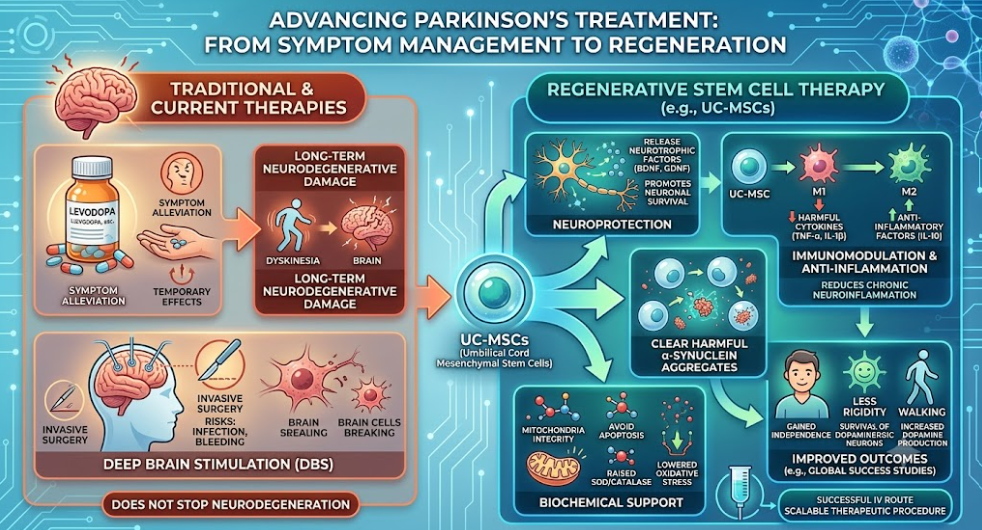
In the past, the only option for treatment was management of symptoms due to the lack of regenerative treatments like Stem Cell IV Therapy Bangkok Thailand utilizing UC-MSCs. Levodopa is the primary drug treatment for Parkinson’s disease that is used the world over. While it alleviates some of the symptoms due to the central nervous system regulating some of the dopamine, there is severe long term neurodegenerative damage. One of the major disabling symptoms is severe, uncontrollable dyskinesia. It has been theorized that during the long-term treatment, the fluctuations become so debilitating that the treatment is deemed worse than the disease.
Dopamine agonists and monoamine oxidase inhibitors are alternative therapies that offer modest positive effects, but many patients experience troublesome side effects. For patients refractory to other therapies, there are surgical options such as deep brain stimulation (DBS). However, DBS and other surgical options are invasive and carry risks such as infection and intracranial bleeding. Furthermore, these are palliative surgeries that do not stop the progressive loss of dopaminergic neurons. The limitations of all current Parkinson’s disease therapies emphasize the need for better therapies. Current therapies do nothing to stop the progressive neurodegeneration and do nothing to ameliorate the chronic neuroinflammation. As a result, researchers are focusing on developing disease-modifying therapies like Stem Cell IV Therapy Bangkok Thailand using UC-MSCs and, ultimately, neuroprotective therapies for Parkinson’s disease.
The release of neurotrophic factors such as brain-derived neurotrophic factor (BDNF) and glial cell line-derived neurotrophic factor (GDNF) is an important aspect of tissue healing and repair induced by mesenchymal stem cells, such as UC-MSCs, as a result of their immunomodulatory and paracrine signaling effects in Parkinson’s disease models. BDNF and GDNF bind to receptors on neurons and activate intracellular signaling pathways to promote neuronal cell survival. Extracellular vesicles (EVs) and, in particular, exosomes from stem cells also play a role in protection against apoptosis in neurons and promote neuroregeneration by facilitating neurite outgrowth. Stem Cell IV Therapy Bangkok Thailand utilizes the immunomodulatory effects of these stem cells.
They alter the polarization of microglia from the pro-inflammatory M1 phenotype to the reparative M2 phenotype. M1 to M2 phenotype transition leads to a considerable decrease in the release of harmful cytokines like tumor necrosis factor-α and interleukin-1-β. In addition, the release of anti-inflammatory factors like interleukin-10 increases significantly. UC-MSCs provide researchers with excellent neuroprotection from harmful toxins. Biochemically, the therapy lowers oxidative stress by raising the levels of anti-oxidative factors like superoxide dismutase and catalase. It also maintains the integrity of mitochondria and prevents apoptosis by lowering the levels of activated caspase-3. In addition to these factors, recent research in this review has shown that some stem cell populations like UC-MSCs can also clear harmful α-synuclein aggregates which are the defining characteristic of Parkinson’s disease in patients. It is important that we analyze these factors thoroughly to better understand how they improve the overall strength of the neural networks when applying Stem Cell IV Therapy Bangkok Thailand.
There have been some clinical applications for Parkinson’s disease that mirror the success of preclinical research on animal studies. An interesting case study is of a 77-year-old female with a 17-year case of severe idiopathic neurodegeneration. During the 2-year period of autologous cellular infusions, there were continuous positive changes in her Unified Parkinson’s disease Rating Scale. Following this, she regained her complete independence during all activities of daily living due to substantial reductions in her previous severe rigidity and freezing episodes. Her FDG-PET scans showed improvements of varying metabolic activities of the parieto-occipital cortices and thalamus. Though this case study employed an infusion of autologous cells of other tissue types, the preclinical studies of UC-MSCs suggest more benefits than the sources employed in the cited case study, providing further support for Stem Cell IV Therapy Bangkok Thailand.
Transplantation of UC-MSCs into animal models of Parkinson’s disease suggest improved outcomes for the survival of dopaminergic neurons, increased production of dopamine, and recovery of behavior. Given these outcomes, UC-MSCs are likely to be preferred biological materials. The use of the intravenous route has been highly successful and provided safety evidence, both of which support the Stem Cell IV Therapy Bangkok Thailand, as a viable and scalable therapeutic procedure. In addition, Stem Cell IV Therapy Bangkok, Thailand, has gained international interest and provided more evidence of its regenerative potential.
The practice of regenerative medicine in Southeast Asia is rapidly advancing and likely to become the center of international practice. Thailand has established its primacy in the application of advanced therapeutic interventions. Researchers are focusing on regenerative technologies in combination with advanced therapeutic interventions, expanding the scope of Stem Cell IV Therapy Bangkok Thailand. This is an important step for the health care system for the evidence it provides to advance the practice of regenerative medicine in Southeast Asia. Existing challenges include variations in quality of each batch, the frequency of applications, and the duration of effects. Standardized testing for the degree of beneficial effects between the participating clinics will allow for the practical application of Stem Cell IV Therapy Bangkok Thailand. The combination of UC-MSCs and other therapeutic interventions, especially physical rehabilitation, may also have significant positive effects for the treatment of neurological disorders. The treatment of Parkinson’s disease with advances in cellular therapy, as explored in this review, is a prime example of combination therapies and collaborative innovations at the international level, and the potential to repair and reconquer previously lost autonomy is great.