Our Services
Others
- DFPP
- Shockwave
- IV Drip

Stem cell clinic Bangkok breakthroughs in cellular healing utilizing UC-MSCs alongside stem cell PRP for face
Chronic wounds alter the normal topographical arrangement of tissues and cause persistent physical, psychological, and emotional suffering. Healing of wounds involves tissue reorganization the biological mechanisms of hemostasis, inflammation, and cellular proliferation. Many patients suffer from chronic wounds because the repairs and closures of their wounds become a cycle, ultimately leading to the complications of widespread or local necrosis, infections, and the need for amputation. Due to the continual failure of traditional modalities of wound care, there is an ongoing search for various means to stabilize and expedite the processes of tissue regeneration. Currently, the therapeutic use of regenerative medicine is the next frontier to expedite and improve the outcomes of the healing of chronic wounds. Many patients are now seeking evidence-based, safest regenerative medicine practice facilities, such as a stem cell clinic Bangkok. These clinics utilize the science of regenerative biology—employing UC-MSCs and treatments like a stem cell PRP for face—to alter the state of chronic wounds rapidly and advantageously by harnessing the body’s innate capacity of healing. This paper will provide a review of these novel regenerative therapies with a special interest on their mechanisms of action, therapeutic use, and clinical practice in transcending regenerative therapies in Thailand.
Traditional therapies for chronic ulcers primarily provided dressings to cover the ulcers. Some basic therapeutic measures included antiseptic applications and offloading. These wound care therapies presented numerous limitations due to the lack of biological stimuli. This significantly prolonged recovery and increased the economic burden. Traditional wound therapies presented a lack of biological stimuli and signals to encourage the formation of new capillaries, and the removal of local chronic inflammation. As a result, in recent years UC-MSCs therapies have emerged at any premier stem cell clinic Bangkok and proved to be superior regenerative therapies, inspiring aesthetic applications like a stem cell PRP for face.
The application of platelet-rich plasma is notable for its ability to bring healing factors to injury sites. In aesthetic medicine, rejuvenating facial skin techniques like a stem cell PRP for face use the same principles. A stem cell clinic Bangkok will combine these techniques with UC-MSCs for improved healing. Consistent advancements in these procedures stems from medical professionals monitoring the healing outcomes of their patients. Here, we will explore why the advancements in regenerative medicine are as remarkable as the procedures themselves. For example, the platelet-rich plasma technique utilizes the various Phases of Tissue Healing, more specifically the Inflammatory Phase, to bring about the release of bioactive signaling molecules. These molecules influence healing and repair through a variety of mechanisms, one of which is the recruitment of stem cells. When you combine the effects of platelet-rich plasma with the regenerative capabilities of UC-MSCs, the outcomes are even greater and more impressive than when used alone. Upon introduction to a wound, UC-MSCs release a variety of signaling molecules. One of which is the potent angiogenic prostaglandin, which causes the formation of new blood vessels and capillary supply. The exciting part about both UC-MSCs and the combination of therapies with platelet-rich plasma is that a thorough review shows their effects are synergistic and complementary, a concept applied at a stem cell clinic Bangkok for both wound healing and a stem cell PRP for face. Plasma lysate has a myriad of effects on UC-MSCs, including preservation of their immune-privileged state, extension of their chromosomal and cellular senescence, and the preservation of cellular stability during prolonged cultivation. Researchers study the MSC-plasma lysate interaction extensively to maximize its therapeutic potential. A leading stem cell clinic Bangkok will use these pathways to design treatments for complex and severe degenerative diseases. The same molecular pathways and cascades are used in the stem cell PRP for face rejuvenation treatments of stem cell clinics to enhance the production of collagen and the elasticity of the skin.
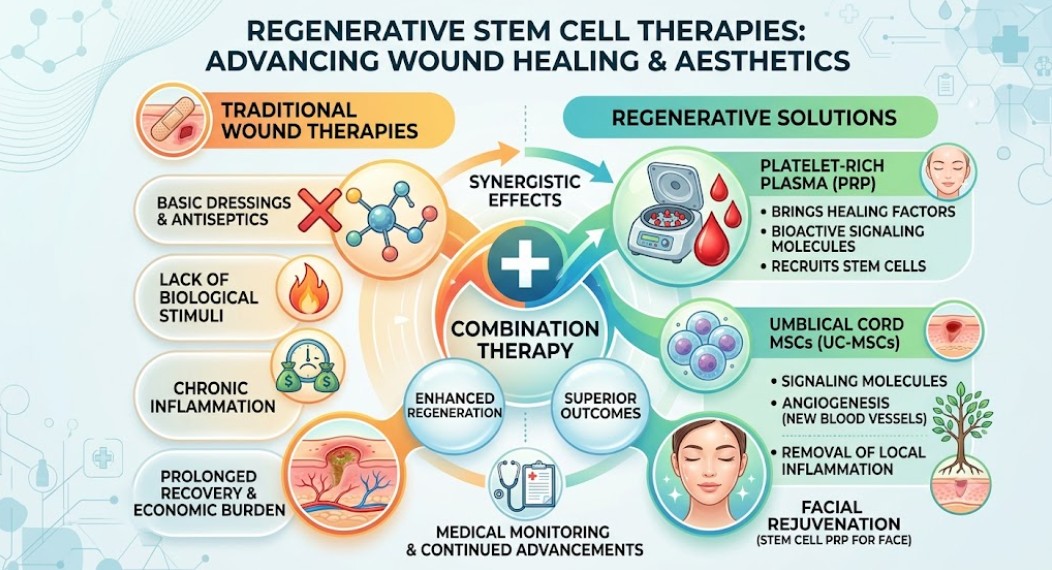
The transition from conventional to advanced cellular therapies is well supported by an abundance of rigorous clinical trials and evidence. One of the most recent and comprehensive studies done on the treatment of severe diabetic foot ulcers compared the effects of a gel containing UC-MSCs to a gel containing platelet-rich plasma. The UC-MSCs gel exhibited a 93.93% complete healing rate by day ten, compared to the 77.20% healing rate in the platelet-rich plasma group. Furthermore, the MSC group exhibited greater improvement in vascular indices, increased local blood flow, and a greater decrease in local inflammation as evidenced by C-reactive protein. In addition, an extensive meta-analysis that included thirty-four studies validated the effects of both MSC and platelet enriched therapies and demonstrated that they significantly decreased the time for complete healing of ulcers. A clinical review of updated guidelines by medical boards validated these outcomes. A leading stem cell clinic Bangkok utilizes the same peer-reviewed data to ensure the safety of their patients, whether for ulcer treatments or a stem cell PRP for face.
A stem cell PRP for face is performed with the same clinical rigor that ensures cosmetic procedures at a stem cell clinic Bangkok utilizing UC-MSCs are supported by evidence-based medical science. Regenerative medicine in Thailand is developing rapidly. The therapies will be developed in the context of Thailand’s strong biomedical research. The best stem cell clinic Bangkok is making laboratory innovations integral to the clinic. We expect the production of clinical-grade UC-MSCs to occur on-site and for the therapies to be made available to the larger Thai population. A final review of the cosmetic industry shows it will develop quickly and the use of a stem cell PRP for face will be the standard in the dermatologic community. The use of continuing education will help Thai researchers be more competitive globally. Thailand has the potential to be a leading country in the cosmetic and aesthetic industries.