Our Services
Others
- DFPP
- Shockwave
- IV Drip

Sensorineural hearing loss (SNHL) is a multifactorial auditory disorder driven by cochlear hair cell vulnerability, microvascular compromise, oxidative stress, and localized neuro-inflammation. When presenting bilaterally with pronounced interaural asymmetry, SNHL imposes substantial functional deficits in speech discrimination and spatial hearing that extend beyond conventional acoustic amplification. This review examines the biological rationale for adjunctive mesenchymal stem cell (MSC) support in neuro-otology, emphasizing paracrine-mediated immunomodulation and preservation of the cochlear microenvironment. To contextualize these mechanisms in clinical practice, we present a nine-month longitudinal audiological case analysis of an adult Thai male with asymmetric bilateral SNHL. The clinical timeline spans a pre-intervention baseline audiogram (February 2026), cellular administration (July 2026), and an initial four-month post-intervention audiometric follow-up (November 2026). Frequency-specific pure-tone air conduction comparisons demonstrated 10–15 dB threshold improvements across primary speech frequencies (500–2,000 Hz) in the severely impaired left ear corresponding to a reduction in the three-frequency pure-tone average (PTA) from 82 dB to approximately 68 dB alongside a concurrent shift in the right ear from 38 dB to approximately 28 dB, notwithstanding a high-frequency decline at 8,000 Hz. Finally, we outline essential laboratory quality assurance benchmarks and methodological considerations specifically contralateral masking and speech audiometry standardization required for rigorous longitudinal evaluation in regenerative otology.
Bilateral sensorineural hearing loss (SNHL) encompasses auditory deficits originating from structural or functional pathology within the cochlea, the vestibulocochlear nerve, or central auditory pathways. Because cochlear sensory hair cells and spiral ganglion neurons exhibit high metabolic demand and minimal intrinsic regenerative capacity, progressive injury frequently leads to irreversible threshold elevation. In asymmetric presentations—particularly when severe unilateral impairment coexists with persistent tinnitus—patients experience disproportionate challenges in speech comprehension in noise, sound localization, and overall quality of life.
Standard otological management centers on diagnostic surveillance, acoustic protection, avoidance of ototoxic agents, and auditory rehabilitation via hearing aids or cochlear implantation. While these interventions remain foundational for functional communication, they do not directly target the underlying micro-inflammatory or oxidative pathways within the inner ear. Consequently, regenerative otology has investigated supportive cellular protocols strictly as an adjunctive biological intervention, designed to stabilize the cochlear niche alongside continuous specialist ENT oversight.
Current neuro-otological research has moved beyond the hypothesis of direct cellular engraftment and physical replacement of damaged cochlear hair cells. Instead, mechanistic interest focuses on the role of mesenchymal stem cells (MSCs) as dynamic trophic and immunoregulatory modulators within the inner-ear niche via two primary pathways:
The subject is an adult Thai male (aged 44 years at follow-up) presenting with asymmetric bilateral SNHL and persistent left-sided tinnitus. He elected to pursue adjunctive cellular support while maintaining audiometric monitoring according to the following chronological sequence:
| Date | Clinical Milestone | Key Clinical Documentation |
| February, 2026 | Pre-Intervention Baseline Audiometry | Pure-tone and speech audiometry performed under quiet testing conditions with good test reliability. Confirmed severe left-sided SNHL and mild-to-moderately severe sloping right-sided SNHL. |
| July 2026 | Cellular Administration | Administration of supportive stem cell therapy aimed at modulating the inner-ear biological microenvironment (approximately five months post-baseline). |
| November, 2026 | First Post-Intervention Follow-Up (4 Months Post-Treatment) | Follow-up pure-tone audiometry conducted four months post-administration (nine months from baseline). Audiologic diagnosis remained bilateral SNHL, with improved air conduction thresholds observed across speech-critical frequencies. |
The pre-intervention evaluation on February, 2026 provided comprehensive air conduction, bone conduction, tuning fork, and speech audiometry metrics:
Comparison of pure-tone air conduction thresholds between the pre-intervention baseline (February, 2026) and the initial four-month post-intervention follow-up (November, 2026) is detailed below:
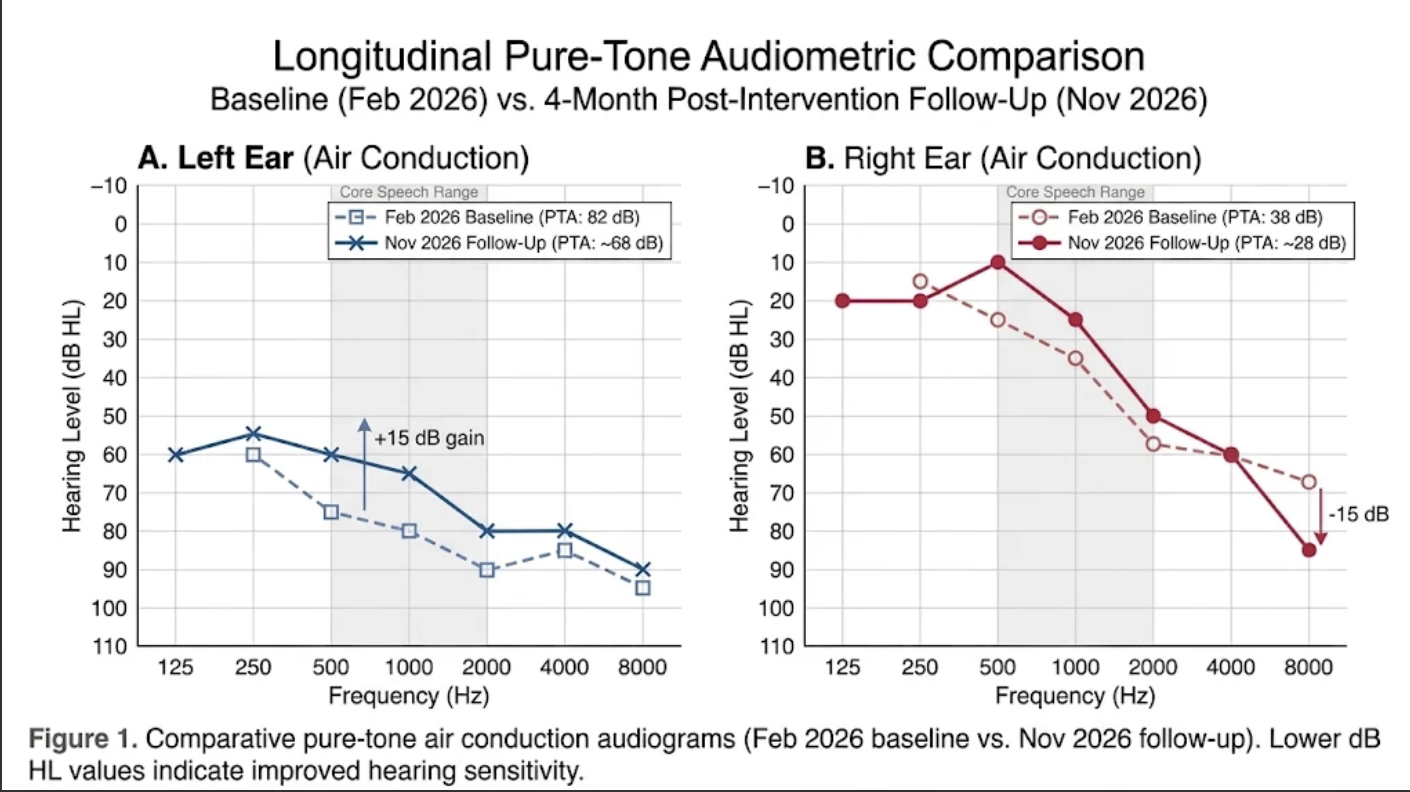
Figure 1. Longitudinal pure-tone air conduction audiograms comparing pre-intervention baseline (February 2026) and four-month post-intervention follow-up (November 2026) across the left ear (Panel A) and right ear (Panel B). Shaded bands denote core speech frequencies (500–2,000 Hz); lower dB HL values indicate improved hearing sensitivity.
Administering cellular biologics in neurological and otological contexts demands stringent pre-clinical verification.Batch-level transparency must be documented prior to clinical use through a comprehensive Certificate of Analysis (COA), verifying:
Interpreting longitudinal audiometric shifts in asymmetric SNHL requires evidence-based restraint. Supportive cellular therapy must be positioned strictly as an adjunctive biological modality rather than a curative treatment, as individual clinical trajectories vary widely according to underlying etiology, chronicity of impairment, residual cochlear reserve, and systemic health.
Transparent evaluation of cross-facility audiometric records requires acknowledging two key technical limitations present in the current dataset: