Our Services
Others
- DFPP
- Shockwave
- IV Drip

Medical note: This article is educational and does not replace an endocrinology consultation. Stem cell therapy for Hashimoto’s thyroiditis remains investigational; it should not be presented as a proven replacement for levothyroxine or other medically indicated thyroid-hormone treatment.
Stem cell therapy for Hashimoto’s thyroiditis is attracting attention because it targets a different biological problem from conventional hormone replacement. Levothyroxine replaces thyroid hormone when the gland can no longer produce enough of it. Mesenchymal stem cells, by contrast, are being studied for their ability to influence immune signaling and inflammatory pathways that drive autoimmune thyroid injury. That difference explains the scientific interest – but it does not establish stem cell therapy as superior treatment.
For patients researching UC-MSC stem cell therapy in Thailand, the most useful question is not simply whether stem cells are ‘better’ than conventional care. The better question is what each treatment is designed to do, how strong the evidence is, and whether an experimental cell-based intervention adds anything meaningful to a well-managed thyroid treatment plan. As of 2026, the strongest Hashimoto-specific evidence for mesenchymal stem cells remains preclinical rather than definitive human clinical evidence.
Sources: 2026 Frontiers review: cellular immunomodulation in autoimmune thyroiditis | American Thyroid Association hypothyroidism guideline
Hashimoto’s thyroiditis is an autoimmune disease in which immune cells and thyroid-directed antibodies are associated with progressive injury to the gland. Some people remain euthyroid for years, while others eventually develop hypothyroidism as thyroid hormone output falls. When hypothyroidism is present, the clinical goal is to restore normal hormone availability and normalize thyroid-stimulating hormone (TSH) using an appropriate dose of levothyroxine.
Levothyroxine is not merely a cosmetic treatment for symptoms. It replaces a hormone the body requires for metabolism, cardiovascular function, neurological function and many other systems. The American Thyroid Association recommends levothyroxine as the preparation of choice for hypothyroidism because of its efficacy, long clinical experience, favorable safety profile, ease of use and low cost. The limitation is different: hormone replacement does not directly retrain the immune system that initiated Hashimoto’s.
Sources: American Thyroid Association: Guidelines for Treatment of Hypothyroidism | UC Davis Health: Hashimoto disease overview
The rationale for stem cell treatment for autoimmune thyroid disease centers mainly on mesenchymal stromal or stem cells (MSCs). MSCs are not expected simply to turn into a new thyroid gland after an intravenous infusion. Their main therapeutic interest is immunomodulation: they can release signaling molecules and interact with immune cells in ways that may reduce inflammatory activity and encourage a more tolerant immune environment.
A 2026 review of cellular immunomodulation in autoimmune thyroiditis describes several mechanisms under study. MSC-derived factors can suppress effector T-cell activity, influence B-cell and plasma-cell responses, promote regulatory T-cell activity, alter dendritic-cell behavior and encourage anti-inflammatory macrophage phenotypes. In experimental autoimmune thyroiditis, these changes may reduce thyroid inflammation and preserve follicular architecture. This is the biological argument behind mesenchymal stem cells for Hashimoto’s – not a proven claim that injected cells regenerate a damaged thyroid in humans.
Sources: Frontiers in Immunology 2026 review | PubMed: 2024 MSC study in experimental autoimmune thyroiditis
The evidence gap is the most important part of this discussion. Recent Hashimoto-specific MSC studies remain largely preclinical. A 2024 study found that MSC treatment reduced inflammatory signaling and altered macrophage behavior in a rat model of autoimmune thyroiditis. A 2025 study using a mouse model also reported changes in thyroid antibodies, inflammatory markers and immune-cell balance after bone-marrow MSC transplantation. These are useful mechanistic signals, but animal improvement cannot be assumed to predict the same benefit in patients.
Human work is even earlier. A 2017 laboratory study used immune cells collected from women with Hashimoto’s and found that fibroblast-like stem cells could create a more tolerogenic immune environment in vitro. That study did not inject patients or demonstrate clinical thyroid recovery. The 2026 Frontiers review describes clinical translation as nascent and emphasizes that the encouraging findings come mainly from experimental autoimmune thyroiditis models. This is why claims of a defined Hashimoto’s stem cell success rate are not currently evidence based.
Sources: PubMed: MSCs and autoimmune thyroiditis, rat model (2024) | PubMed/PMC: bone-marrow MSCs in autoimmune thyroiditis model (2025) | PubMed: Hashimoto immune-cell coculture study (2017) | PubMed: 2026 autoimmune thyroiditis cell-therapy review
UC-MSC stem cell therapy generally refers to mesenchymal stromal/stem cells isolated from donated umbilical-cord tissue, commonly Wharton’s jelly. Clinics favor this source because cord tissue can yield cells with strong proliferative capacity, and allogeneic products can be manufactured in standardized batches. Researchers are interested in UC-MSCs for autoimmune disease because MSCs have broad immunomodulatory properties.
However, the phrase umbilical cord stem cells for thyroid disease can sound more established than the evidence really is. There is no U.S. FDA approval for an umbilical-cord MSC product to treat Hashimoto’s thyroiditis, hypothyroidism or autoimmune thyroid disease. The FDA’s first approved mesenchymal stromal cell therapy, Ryoncil, received approval for a completely different indication – steroid-refractory acute graft-versus-host disease in pediatric patients. Approval for one MSC product and one disease does not validate commercial UC-MSC protocols for Hashimoto’s.
Sources: FDA: Important patient information about regenerative medicine therapies | FDA: Ryoncil approval announcement
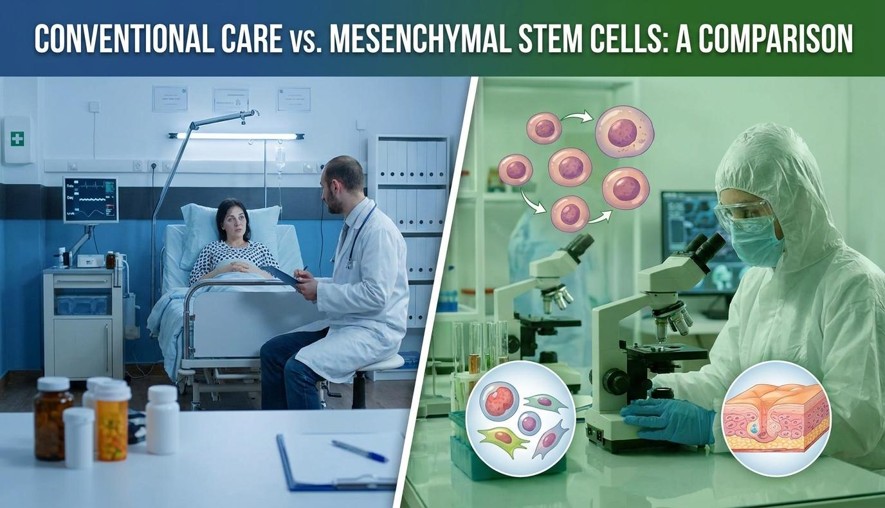
The keyword stem cell therapy vs levothyroxine suggests a competition, but medically the two interventions address different targets. Levothyroxine has an established role when the patient is hypothyroid. Stem cell therapy is being investigated as a possible disease-modifying approach to immune dysregulation. At present, one cannot be substituted for the other on the assumption that cells will restore hormone production.
| Question | Levothyroxine | MSC / UC-MSC therapy | Current position |
| Primary goal | Replace deficient thyroid hormone | Investigate immune modulation / tissue support | Different therapeutic targets |
| Evidence in hypothyroidism | Long-established standard care | Hashimoto-specific evidence mainly preclinical | Stem cells remain investigational |
| Can it normalize TSH? | Yes, with appropriate dosing in most patients | Not reliably established | Do not stop hormone therapy based on a cell infusion |
| Can it stop autoimmunity? | Not designed to do so | Potential immunomodulatory mechanism under study | Clinical disease modification not yet proven |
| Typical access | Routine prescription care | Research or commercial regenerative clinics | Requires careful regulatory and evidence review |
Sources: American Thyroid Association guideline | 2026 autoimmune thyroiditis cell-therapy review
Safety depends on the exact product and how it is manufactured and administered. MSCs have been studied in many autoimmune and inflammatory conditions, but safety data from one disease or one cell product cannot automatically be transferred to another. For Hashimoto’s specifically, the lack of large controlled human trials means there is no robust condition-specific long-term safety profile.
The FDA warns that unapproved regenerative medicine products have been associated with serious adverse events, including infections, unwanted immune reactions and tumor formation in some settings. The ISSCR similarly advises patients to distinguish approved treatments from legitimate investigational studies and unproven commercial interventions. A clinic saying a product is ‘natural’, ‘young’, ‘fresh’ or ‘from umbilical cord’ is not a substitute for sterility testing, identity testing, viability data, manufacturing controls and medical oversight.
Sources: FDA: Regenerative medicine patient and consumer information | ISSCR Guide to Stem Cell Treatments
People searching for stem cell therapy for hypothyroidism Thailand should first distinguish the diagnosis from the treatment claim. Hypothyroidism is a hormone-deficiency state with several possible causes; Hashimoto’s is an autoimmune disease and one common cause. A regenerative clinic should not treat every form of low thyroid function as though it were the same autoimmune problem.
Thailand is developing a formal framework for advanced therapy medicinal products (ATMPs), including cell-based therapies. That regulatory progress is important, but it does not mean that every stem cell treatment marketed in Bangkok is approved for every indication. Patients should ask the provider to identify the specific product, its regulatory pathway, where it is manufactured, whether the protocol is part of approved research where required, and who takes responsibility for adverse-event follow-up.
Sources: Thai FDA: Road to ATMPs (2026) | ISSCR patient resources
Search terms such as stem cell clinic Bangkok and best stem cell clinic Thailand naturally surface commercial providers. For an experimental autoimmune indication, however, the most useful comparison is not a popularity ranking. A credible clinic should be willing to put the important details in writing.
Sources: Thai FDA ATMP update | FDA patient checklist for regenerative medicine
There is no standardized stem cell therapy for Hashimoto’s cost because there is no established, guideline-approved Hashimoto’s MSC protocol with a standard cell dose, schedule or route of administration. Commercial quotes can vary by cell source, claimed cell count, number of infusions, laboratory testing, hospital setting and bundled services.
For context only, a current Bangkok medical-tourism listing reports general stem cell therapy prices of roughly US$4,800 to US$14,500, with mesenchymal stem cell therapy listings extending roughly from US$6,000 to US$18,000. Those figures are not Hashimoto-specific treatment standards, and a higher price or higher advertised cell count does not demonstrate better clinical outcomes. A patient comparing Thailand programs should request an itemized quotation showing exactly what is being paid for and which parts are evidence-based versus experimental.
Sources: Bookimed Bangkok stem cell pricing – commercial market example, not a clinical guideline
The title of this article asks why someone might choose stem cell injections over conventional treatment, but many patients should not make that choice. If levothyroxine has normalized thyroid function and symptoms are controlled, there is no established evidence that an expensive experimental infusion improves long-term outcomes. Persistent fatigue despite normal TSH also deserves a broader medical evaluation rather than being assumed to prove ongoing thyroid destruction.
Conventional care is especially important during pregnancy, in significant untreated hypothyroidism, and when thyroid hormone deficiency is causing clinically important symptoms. Abruptly stopping levothyroxine can lead to severe hypothyroidism. Any consideration of experimental regenerative treatment should be additive to appropriate medical management unless a treating endocrinologist, using repeat laboratory results, determines that a medication adjustment is appropriate.
Sources: American Thyroid Association hypothyroidism guideline
There is not enough Hashimoto-specific human evidence to call stem cell therapy broadly safe and effective for autoimmune thyroid disease. MSCs have an extensive research history in other conditions, but product quality, cell source, dose, processing and route matter. For Hashimoto’s, treatment should be regarded as investigational and evaluated with appropriate medical and regulatory oversight.
UC-MSC therapy uses umbilical-cord-derived mesenchymal stromal/stem cells with the intention of modulating inflammatory and immune pathways. Conventional levothyroxine replaces missing thyroid hormone. The biological targets are different, and UC-MSC therapy has not been proven to replace hormone therapy in Hashimoto’s.
Preclinical studies suggest MSCs can reduce inflammation and may help preserve thyroid structure in experimental autoimmune thyroiditis. Human thyroid regeneration sufficient to restore reliable hormone production has not been established in controlled clinical trials.
Not on the basis of the treatment alone. Medication changes should be based on repeat TSH and free T4 measurements and the judgment of the prescribing clinician. Stopping required thyroid hormone without supervision can cause significant hypothyroidism.
There is no standard Hashimoto-specific price because no standard clinical protocol exists. General Bangkok MSC packages are commonly advertised in the several-thousand to low-five-figure US-dollar range, depending on cell count and services. Obtain an itemized quote and do not treat price as evidence of effectiveness.
No U.S. FDA-approved umbilical-cord MSC product is indicated for Hashimoto’s thyroiditis or hypothyroidism. The existence of FDA-approved cell therapies for other diseases does not establish approval for thyroid disease.
Current evidence does not support that conclusion. Levothyroxine is an established treatment for thyroid-hormone deficiency. Stem cell therapy is being investigated for possible immune modulation, but clinical benefit in Hashimoto’s has not yet been established to the level required to replace standard care.
Stem cell therapy for Hashimoto’s thyroiditis is scientifically interesting because it aims at immune regulation rather than simply replacing hormones. Research into mesenchymal stem cells, including UC-MSC stem cell therapy, has identified plausible mechanisms involving regulatory T cells, inflammatory cytokines, macrophages and other components of autoimmune signaling. Recent animal studies reinforce that rationale.
What the field does not yet have is equally important: large, controlled human trials showing that stem cell therapy reliably reduces Hashimoto’s disease activity, restores thyroid function, eliminates the need for levothyroxine or produces durable remission. For that reason, the best evidence-based comparison is not ‘stem cells instead of conventional treatment.’ It is established hormone replacement when clinically indicated, plus careful consideration of investigational regenerative therapy only when the patient understands the uncertainty, cost, regulatory status and available alternatives.
For patients considering a stem cell clinic in Bangkok, an endocrinology consultation should come first. Bring recent TSH, free T4, thyroid antibody results, ultrasound reports if relevant, current medications and a clear symptom history. Then ask the clinic to document exactly what cell product is proposed, what evidence supports that exact use in Hashimoto’s, how the product is regulated and manufactured, what objective outcomes will be followed, and what happens if the treatment does not work.
Sources: 2026 Frontiers review on autoimmune thyroiditis cell therapy | American Thyroid Association guideline | Thai FDA ATMP update | FDA regenerative medicine patient guidance