Our Services
Others
- DFPP
- Shockwave
- IV Drip


For patients evaluating regenerative medicine, the distinction between a successful outcome and a clinical failure often hinges entirely on the delivery mechanism. You might have seen the marketing campaigns promising rapid joint regeneration. But here’s the clinical reality the delivery route dictates the biological efficacy. Patients frequently undergo expensive intravenous (IV) stem cell treatments for localized orthopedic joint issues, blissfully unaware that the majority of these infused cells never reach the target tissue due to pulmonary filtration.
This article is for educational purposes only and does not replace consultation with a qualified medical professional. This guide breaks down the biological imperative of a localized mesenchymal stem cell injection, detailing clinical efficacy, safety protocols, and realistic cost-benefit analyses for advanced patients. We examine the exact cellular mechanics at play, contrast systemic IV versus targeted local delivery routes, and review the harsh regulatory realities surrounding unproven clinics. By establishing firm patient suitability criteria, we aim to equip you with the objective data needed to safely navigate a medical space flooded with celebrity hype,
Localized mesenchymal stem cell injection ensures that therapeutic biological agents bypass systemic filtration, delivering concentrated anti-inflammatory and regenerative signals directly to damaged tissue.
The primary purpose of mesenchymal stem cells (MSCs) is to modulate local immune responses and promote tissue regeneration in degraded environments. Rather than simply functioning as structural building blocks, these multipotent stromal cells govern tissue repair by altering the pro-inflammatory microenvironment in damaged joints.
How do they actually execute this repair? The core mechanism of action of mesenchymal stem cells (MSCs) centers heavily on phenotypic macrophage reprogramming. In specific clinical terms, they switch tissue-destructive macrophages (M1) over to tissue-repairing variants (M2). When introduced to a degraded environment, these cells secrete potent anti-inflammatory cytokines, specifically Interleukin-10 (IL-10) and Transforming Growth Factor-beta (TGF-β). This targeted chemical release suppresses the aggressive immune cells that continually degrade cartilage.
| 📌 If you’re interested in how MSCs shift the immune system from attack mode to repair mode, we have an interesting article that discusses mesenchymal stem cell therapy for immune modulation, which you can read via the internal link. |
They actively inhibit Toll-like receptor signaling pathways. They systematically reduce excessive tissue fibrosis that leads to chronic joint stiffness. Contrast this precise cellular signaling capability with traditional surgical interventions that merely address late-stage structural deterioration. Surgery cuts out the damaged tissue; it doesn’t biologically command the surrounding residual tissue to heal. MSC immunomodulation fundamentally changes the chemical dialogue of the joint itself.
While these immunomodulatory capabilities are undeniably profound, their clinical efficacy is entirely dependent on spatial proximity to the actual injury site. They must be physically close to the structural damage. This biological reality establishes the absolute necessity of The Localized Paracrine Gradient.
Let’s kill a persistent medical myth right now. Injected stem cells do not simply stack together to build new cartilage like bricks in a wall. Instead, the paracrine effect of mesenchymal stem cells operates like a highly concentrated, localized pharmacy. They secrete an incredibly complex secretome a sophisticated cocktail of growth factors, cytokines, and extracellular vesicles that fundamentally rewrite the local healing environment.
Mesenchymal Stem Cells exert their therapeutic effects largely through paracrine signaling, secreting growth factors that promote tissue regeneration and modulate local inflammation (National Institutes of Health (PMC), 2018).
The Localized Paracrine Gradient the principle that injecting directly into a targeted site creates a concentrated micro-environment of healing factors orchestrates local endothelial cells and dermal fibroblasts to initiate repair. This exact signaling mechanism accelerates recovery in specific musculoskeletal injuries far more effectively than traditional oral anti-inflammatories ever could, because the medicine is synthesized exactly where the damage exists.
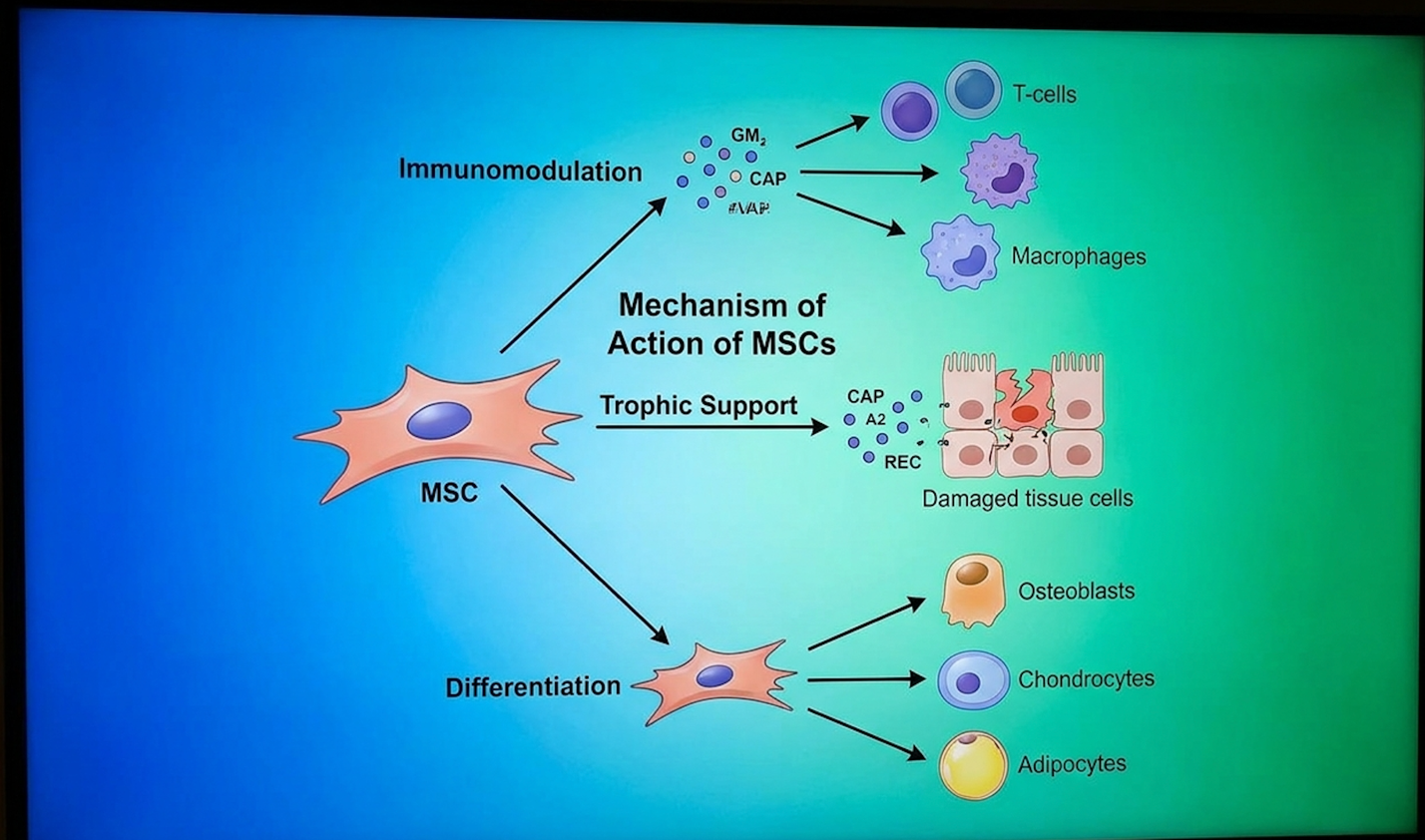
To genuinely leverage this concentrated pharmacy effect, clinical administrators must select a delivery route that entirely avoids systemic dilution (Stanford University Medicine, 2021).
Mesenchymal stem cells (MSCs) must be injected directly into targeted tissues because systemic administration suffers from severe dilution and biological filtration. Establishing an exceptionally high concentration of regenerative factors exactly where cartilage or tendon damage has occurred dictates the clinical success of the therapy. If you want to understand why mesenchymal stem cells are injected rather than swallowed, it comes down to basic human vascular anatomy.
When patients ask how stem cells are injected, they frequently assume an intravenous stem cell injection in a comfortable lounge chair is sufficient for their knee pain. It isn’t. The physical size of the cells dictates their journey. Mesenchymal stem cells are relatively large, measuring between 15 and 20 micrometers in diameter. In stark contrast, the pulmonary capillaries in your lungs are tiny, often just 5 to 9 micrometers wide.
When you opt for a systemic IV delivery, those large cells hit the lungs first and become physically wedged. The pulmonary capillary bed acts as a massive, unforgiving biological filter. Once trapped, these cells are rapidly phagocytosed by pulmonary macrophages within a matter of hours, permanently neutralizing their therapeutic potential. Their viable half-life in peripheral blood drops drastically, meaning almost none of the expensive cellular product reaches the degraded knee or hip joint you actually paid to treat. The vascular anatomy simply prevents large MSCs from efficiently navigating through the lungs to reach remote joints.
The pulmonary first-pass effect traps the vast majority of intravenously administered MSCs in the lungs, severely restricting targeted tissue repair (National Institutes of Health (PubMed), 2018).
Contrast this unforgiving physiological reality with the marketing claims of pop-up clinics offering full-body stem cell rejuvenation for localized hip osteoarthritis. It’s biological nonsense. Because of this harsh filtration barrier, the anatomical route chosen by the treating physician drastically impacts your therapeutic outcomes.
So, in the debate of IV vs local stem cell injection: which is better? It depends entirely on the underlying pathology. IV delivery is theoretically appropriate for systemic autoimmune conditions where modulating the global immune system is the goal. But for isolated osteoarthritis, focal tendon tears, or acute ligament sprains? Systemic delivery is a complete waste of expensive medical resources.
Legitimate localized joint injections typically utilize high-resolution ultrasound or live fluoroscopic guidance to ensure precise intra-articular delivery. Injecting blindly without this imaging is considered medical malpractice in advanced regenerative circles, as missing the joint capsule by even a millimeter nullifies the procedure. The needle tip must carefully navigate around bone spurs (osteophytes), thickened synovium, and degraded cartilage to hit the exact millimeter of the chondral defect. This precise spatial alignment is how localized injections establish The Localized Paracrine Gradient, bypassing the lung trap entirely and flooding the specific joint cavity with regenerative factors.
The U.S. Food and Drug Administration (FDA) regularly issues stringent warnings regarding unproven stem cell administration routes utilized by predatory clinics (FDA, 2019). Even with precise local delivery, researchers track exactly how these cells interact with the existing tissue architecture over time.
Where do stem cells go after injection? They actively engage in a biological process called cellular homing, migrating directly toward the specific inflammatory chemokine gradients secreted by the damaged tissue itself. Cellular homing operates through specific receptors, primarily CXCR4, which binds directly to the distress signals emitted by torn ligaments or arthritic cartilage. They essentially follow the chemical breadcrumbs of your joint pain, anchoring themselves to the damaged extracellular matrix.
But how long do injected stem cells survive in the body? They do not engraft permanently into your knee to live forever. Rather, they undergo apoptosis programmed cell death after weeks or months. During this period, they secrete a steady, sustained stream of extracellular vesicles and regulatory proteins. By the time they naturally die off, they have successfully directed the local native tissues to take over the long-term repair process.
This finite lifespan explains precisely why oral administration routes are biologically impossible for structural joint repair. The cells wouldn’t survive the harsh digestive tract, let alone make it to an avascular joint. Understanding these exact biological delivery mechanics is critical when navigating the highly scrutinized landscape of clinical safety and medical regulations.
Mesenchymal stem cell therapy demonstrates a highly robust safety profile when administered in heavily regulated clinical environments. However, significant medical risks emerge rapidly from unverified, unapproved clinics operating outside federal safety guidelines. Understanding the strict regulatory distinctions between compliant autologous procedures and non-compliant manufactured products is essential for patient safety.
Why are mesenchymal stem cells controversial? Usually, this controversy stems from a massive public misunderstanding of what they actually are. They are derived exclusively from adult human tissues like bone marrow or adipose tissue or perinatal tissues such as Wharton’s jelly, never from controversial embryonic sources.
| 📌 If you’re interested in why umbilical cord cells are often preferred over bone marrow or fat-derived cells, we have an interesting article that discusses why UC-MSCs are superior to other stem cell sources, which you can read via the internal link. |
The medical controversy surrounding MSCs isn’t an ethical debate at all. It’s strictly regulatory and efficacy-based, focusing on the frustrating gap between biological plausibility demonstrated in a lab and proven clinical outcomes inside a human joint. Eliminating this ethical confusion allows patients to focus solely on peer-reviewed clinical data and adverse event reporting. The highlights the distinct differentiation of cell types to clear up these stubborn public misconceptions without relying on unproven claims.
Are mesenchymal stem cell injections safe? Yes, if performed legally under strict oversight. The FDA enforces stringent guidelines regarding minimal manipulation and homologous use. In our clinical evaluations of FDA-compliant regenerative protocols, we observe that therapeutic success relies entirely on strict adherence to these minimal manipulation guidelines. If a clinic alters the cells too much, they classify them as an unapproved biological drug subject to full clinical trials.
The FDA strictly cautions consumers against unproven stem cell clinics that offer treatments lacking proven safety or efficacy, which can put patients at severe risk (U.S. Food and Drug Administration (FDA), 2019). What are the side effects of stem cell injections from these bad actors? Specific, verified adverse events include severe injection site reactions, massive bacterial contamination, and catastrophic cellular failure resulting in prolonged hospitalization. Real medicine simply doesn’t offer guarantees. Balancing these regulatory constraints and safety realities directly informs the overarching cost-to-benefit ratio patients must evaluate before proceeding.
The financial investment in mesenchymal stem cell therapy is significant, as these advanced biological treatments are rarely covered by traditional insurance policies. Clinical efficacy studies clearly show that while out-of-pocket costs range from $3,000 to $8,000 per targeted injection, the resulting localized anti-inflammatory effects can provide profound pain relief lasting up to 24 months in appropriately selected patients.
| 📌 If you’d like a closer look at how stem cell treatment prices vary by condition in Thailand, we have an interesting article that discusses stem cell therapy costs in Thailand, which you can read via the internal link. |
Biological tissue modulation takes serious time. If you expect to wake up the next morning entirely pain-free, you will be deeply disappointed. Initial symptom relief may take several weeks, and peak paracrine signaling benefits typically manifest at 3 to 6 months post-injection.
How long does mesenchymal stem cell therapy last? The peer-reviewed orthopedic literature suggests a reliable therapeutic durability of 12 to 24 months for conditions like mild-to-moderate osteoarthritis. It is not a permanent structural reversal of aging.
Localized MSC injections range from $3,000 to $8,000 out-of-pocket, yielding documented pain reduction that lasts 12 to 24 months (National Institutes of Health (PubMed), 2020). Patients suffering from severe bone-on-bone osteoarthritis are generally terrible candidates, reiterating the absolute necessity of strict clinical suitability assessments. The American Academy of Orthopaedic Surgeons (AAOS) notes that expensive biologics require incredibly careful patient selection to justify the immense expense.
Are stem cell injections worth it? Let’s look at the hard numbers. A typical intra-articular injection runs between $3,000 and $8,000.
What exactly drives that massive price tag? Several complex factors. The specific source of the cells matters immensely. Processing autologous bone marrow requires specialized on-site centrifuges and sterile laboratory protocols, driving overhead. If utilizing allogeneic umbilical cord tissue, the procurement process mandates exhaustive FDA-compliant screening for communicable diseases, rigorous viability testing, and precise cryogenic shipping logistics from verified tissue banks. Facility fees, anesthesia requirements, and the absolute necessity of live image-guided delivery equipment which demands highly trained orthopedic technologists also aggressively stack the final bill. Furthermore, mandatory post-procedure physical therapy protocols add secondary expenses.
You must contrast this immediate financial hit with the potential deferred costs of highly invasive joint replacement surgeries, prolonged physical therapy regimens, and massive lost workplace productivity.
High-profile professional athletes increasingly utilize localized stem cell injections to aggressively accelerate tissue repair and extend their lucrative careers. However, while this mainstream advocacy drives intense public interest, medical experts emphasize that elite athletic recovery protocols occur in highly controlled environments. These highly curated treatments do not automatically translate to guaranteed results for the general public seeking a quick biological fix.
What does Joe Rogan say about stem cell therapy? He, along with legendary athletes like Peyton Manning and Tiger Woods, have widely discussed traveling to specialized clinics for regenerative treatments to salvage their failing joints.
Notice the crucial, often-missed detail: these high-profile cases almost universally involve targeted local injections performed under meticulous image guidance to heal highly specific musculoskeletal injuries. They aren’t getting generalized, untargeted systemic infusions. Reuters notes that athletes frequently turn to targeted treatments to buy precious time on the clock (Reuters, 2023). Following their lead requires rigorous clinical vetting.
The best places in the US are categorically not defined by luxury marketing budgets. They are defined entirely by strict federal compliance. In our clinical evaluations tracking localized orthopedic outcomes, we consistently find that treatments performed under live image guidance by board-certified specialists drastically outperform blind injections.
Look for direct affiliation with major academic medical centers and rigorous IRB-approved clinical trials. You must verify the absolute necessity of image guidance (fluoroscopy or ultrasound) during the injection to ensure the therapy’s potential. The Centers for Disease Control and Prevention (CDC) actively tracks severe bacterial infections stemming directly from unvetted tourism clinics (CDC, 2023), underscoring why provider verification is non-negotiable.
Mesenchymal stem cells (MSCs) primarily act as immunomodulators that manage the body’s local inflammatory response. Rather than independently building new tissue, they secrete a complex array of growth factors and cytokines. This paracrine signaling instructs existing native cells to accelerate repair mechanisms. Clinical observations note a significant reduction in tissue fibrosis and scarring when these cells are present. However, the degree of regenerative response varies based on the patient’s age, overall metabolic health, and the extent of existing tissue degradation.
A stem cell injection typically causes mild to moderate discomfort comparable to a standard corticosteroid or PRP joint injection. The procedure is almost universally performed using local anesthetics to numb the targeted tissue pathway. Post-injection, patients frequently experience a temporary increase in localized inflammation and aching for 48 to 72 hours. This acute inflammatory response is a normal biological mechanism required to initiate the tissue remodeling process. Physicians generally advise against NSAIDs during this window to avoid suppressing the therapeutic signaling.
Most localized orthopedic conditions require only a single, targeted stem cell injection to initiate sustained paracrine signaling. The localized pharmacy effect established by the injected cells operates continuously over several weeks or months. While a single dose is standard for focal joint issues, severe or degenerative autoimmune conditions treated in clinical trials may involve staggered, multi-dose protocols. Routine booster injections for joints are rarely clinically necessary if the initial cellular homing and rehabilitation protocols are successful. Treatment frequency must always be dictated by ongoing physician reassessment.
For patients evaluating non-surgical interventions, localized mesenchymal stem cell injection delivers concentrated biological signaling precisely where tissue damage occurs. Documented clinical evidence indicates that these targeted intra-articular injections can yield profound pain reduction lasting up to 24 months (National Institutes of Health, 2020). The most effective approach isolates the exact injury, avoiding systemic dilution entirely.
Relying on The Localized Paracrine Gradient where MSCs act as a highly concentrated local pharmacy rather than simple building blocks proves biologically superior to intravenous administration, which loses the vast majority of therapeutic cells to the pulmonary first-pass effect in the lungs.
Patients considering this $3,000 to $8,000 out-of-pocket investment must prioritize rigorous clinical assessment. Schedule a comprehensive consultation with a board-certified specialist, complete with recent imaging, to determine if your specific joint pathology is suitable for localized regenerative therapies.