Our Services
Others
- DFPP
- Shockwave
- IV Drip

This article is for educational purposes only and does not replace consultation with a qualified medical professional.
Patients managing severe scalp psoriasis often reach a critical threshold where topical steroids and conventional biologics simply stop working. Based on our clinical review of longitudinal patient outcomes and methodology-backed analysis of dermatological trial registries, continuous reliance on aggressive chemical suppression invariably triggers adverse immune responses. It completely fails to address the underlying cellular senescence driving the plaques. The biological exhaustion is profound. You apply the highest-potency clobetasol, wrap the scalp overnight, and the thick, hyperkeratotic plaques still return within days.
Because of this widespread treatment resistance, clinical interest has heavily shifted toward investigational regenerative approaches specifically, stem cell therapy for scalp psoriasis. We
By the end of this guide, you will understand the objective clinical data behind stem cell treatment, exactly how these cells modulate autoimmune pathways, and what current trials indicate about long-term efficacy. We’ll examine the specific biological action of The Th17 Rebalancing Mechanism, review the verified Phase 1/2a trial benchmarks, and outline the strict clinical realities of patient evaluation. If you’re considering this intervention, you need facts not marketing hype.
Stem cell therapy for scalp psoriasis utilizing UC-MSCs is an investigational approach targeting the underlying autoimmune mechanisms driving chronic inflammation.
Severe scalp psoriasis presents profound treatment challenges due to anatomical barriers that obstruct conventional therapies. Up to 80% of psoriasis patients experience scalp involvement, characterized by dense hair follicles and thick hyperkeratotic plaques that severely limit the absorption of topical agents. This physiological roadblock necessitates systemic, biology-altering interventions rather than surface-level symptom management.
The human scalp is basically a heavily fortified biological barrier. You aren’t just dealing with thickened skin; you’re fighting dense terminal hair follicles, robust sebaceous glands, and an overlapping lipid matrix. When a patient applies a traditional scalp psoriasis treatment, the vast
It’s a structural nightmare for drug delivery. Even advanced foam-based vehicles struggle to penetrate this dense follicular network. Because of this, localized topicals almost never reach the deeper dermal layers where the autoimmune attack actually originates. This anatomy makes the condition notoriously difficult to treat due to dense hair follicles. In fact, keratinocyte hyperproliferation rates in these psoriatic plaques exceed normal skin turnover by nearly tenfold, compounding the barrier effect.
The localized immune microenvironment becomes locked in a continuous inflammatory loop. T-cells mistakenly attack healthy tissue, accelerating skin cell turnover from a normal 28-day cycle to a frantic 3-day sprint. You can’t scrub this away. It requires an intervention capable of crossing the follicular barrier systemically.
Up to 80% of psoriasis patients experience scalp involvement, which presents unique anatomical barriers that frequently render topical treatments ineffective (NCBI, 2019).
Here’s the harsh reality of long-term steroid use: tachyphylaxis. Your body simply stops responding. Topical corticosteroids act as the conventional first-line defense, but chronic application leads directly to physiological deterioration. The skin thins (atrophy), the local blood vessels permanently dilate (telangiectasia), and the local immune system develops a profound tolerance to the medication.
Dermatological research confirms chronic topical steroid application frequently causes clinically significant dermal atrophy in long-term users so patients frequently trade temporary plaque clearance for permanent dermal thinning. Furthermore, the biological exhaustion is staggering. The local immune system develops a profound tolerance, requiring increasingly potent steroid classes just to maintain a baseline. And when you attempt to taper off? Steroid-resistant scalp psoriasis frequently triggers massive rebound flares the moment you attempt to remove the drug, leaving the scalp worse than the original condition.
Merely masking the inflammation fails to reverse the cellular senescence process. The immune system is still producing pro-inflammatory cytokines at alarming rates; the steroid is just temporarily putting a lid on the boiling pot. Recognizing these compounding limitations, clinical researchers aggressively pivoted toward regenerative treatment for psoriasis therapies capable of reprogramming the dysfunctional immune environment rather than just suppressing it.
Umbilical cord mesenchymal stem cells (UC-MSCs) provide a targeted biological mechanism to disrupt the autoimmune feedback loop in psoriasis. Unlike traditional immunosuppressants that broadly weaken the entire immune system, UC-MSC for psoriasis utilizes targeted paracrine signaling to reprogram the local microenvironment. This targeted action makes them a primary focus in modern regenerative dermatology. You’re effectively leveraging the body’s own developmental pathways to suppress hyperactive immune responses.
| 📌 If you’re curious why umbilical cord cells are often preferred over bone marrow or fat-derived cells, we have an interesting article that discusses why UC-MSCs are superior to other stem cell sources, which you can read via the internal link. |
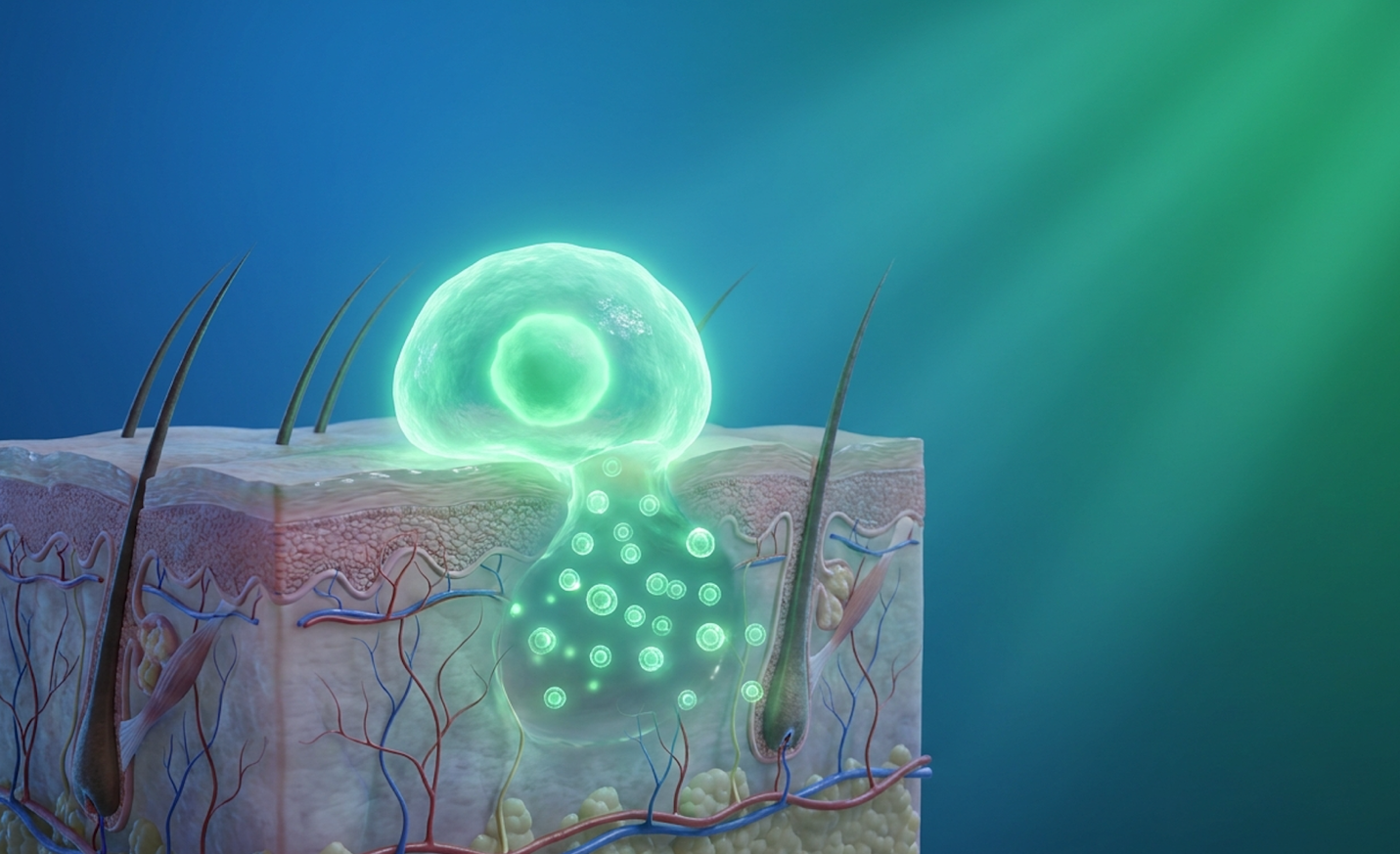
Let’s clear up a massive misconception. When discussing mesenchymal stem cells for psoriasis, many assume these cells physically differentiate to build new, healthy skin. They don’t. Instead, they act as microscopic pharmaceutical factories, secreting bioactive molecules a process known as paracrine signaling. Think of these secretomes as highly specialized software updates for your immune system. They don’t just kill cells; they reprogram them. Recent secretome analysis studies reveal that MSCs release potent immunomodulatory cytokines directly into the compromised tissue environment.
This brings us to The Th17 Rebalancing Mechanism the exact process by which UC-MSCs inhibit the hyperproliferation of Th17 cells and shift the local immune microenvironment from a pro-inflammatory to an anti-inflammatory state. Understanding exactly how MSCs reduce inflammation is central to grasping why this therapy succeeds where steroids fail. Th17 cells are the primary driver of psoriatic inflammation, flooding the scalp with interleukin-17 (IL-17) and tumor necrosis factor-alpha (TNF-α).
By inhibiting the hyperproliferation of Th17 cells, UC-MSCs address the autoimmune root of psoriasis by literally changing the chemical instructions being sent to your immune system. This phenotypic shift forces aggressive inflammatory macrophages to convert into tissue-repairing variants (the M1 to M2 macrophage transition), fundamentally altering the microenvironment.
UC-MSCs significantly lowered serum IL-17 levels in treatment responders, downregulating pro-inflammatory cytokines to address the autoimmune root of psoriasis (Cheng et al., Signal Transduction and Targeted Therapy, 2022).
Stem cell therapy for scalp psoriasis is currently undergoing rigorous clinical evaluation to measure objective reductions in plaque severity. While biological plausibility is strong, evidence-led medicine relies entirely on standardized clinical benchmarks. Recent trials have focused heavily on tracking these systemic immune shifts over defined therapeutic timelines to establish true clinical viability.
If you read any umbilical cord mesenchymal stem cells psoriasis clinical trial, you’ll quickly notice that researchers aren’t throwing around the word “cure.” They measure success in objective, quantifiable reductions of disease burden. The 2022 phase 1/2a clinical trial on UC-MSCs evaluated human umbilical cord cells administered intravenously to patients who had utterly failed standard therapies.
The trial methodology was strictly controlled. Patient inclusion criteria required participants to have severe, refractory psoriasis, meaning they had already exhausted at least two classes of FDA-approved biologics and high-potency corticosteroids without achieving sustained remission. In this single-arm study, researchers delivered calculated infusions based on patient body weight. They strictly monitored the severe psoriasis cohort for six months, tracking both systemic inflammation markers and local plaque severity.
The side-effect monitoring protocol was equally rigorous, requiring comprehensive weekly blood panels, liver enzyme tracking, and continuous observation for adverse immune reactions. The
It is vital to contextualize these findings: this is a severe scalp psoriasis treatment aimed at long-term management and deep remission. Anyone selling a guaranteed overnight stem cell psoriasis resolution is fundamentally misrepresenting the science. These clinical evaluations explicitly focus on objective reductions in the Psoriasis Area and Severity Index (PASI), ensuring that observed improvements aren’t just subjective patient reporting. True cellular reprogramming requires months of biological downstream effects to visibly manifest on the skin. Furthermore, clinical efficacy tracking demonstrates that systemic immunomodulation must compound over several cellular cycles.
The gold standard for psoriasis treatment efficacy is the Psoriasis Area and Severity Index (PASI). Specifically, clinical trials look for PASI 75, indicating a 75% reduction in overall disease severity.
In the aforementioned trial, 6 of 17 patients (35%) with severe psoriasis achieved PASI 75 six months after a targeted UC-MSC intervention, and 47% reached at least a 40% improvement (Cheng et al., Signal Transduction and Targeted Therapy, 2022). But what does that actually mean for the patient? In the context of a modern UC-MSC psoriasis treatment, reaching PASI 75 in highly refractory cases means roughly one in three treatment-resistant patients regains normal scalp functionality without daily topical applications. They can wash their hair without pain, wear dark clothing without severe flaking, and sleep without intense pruritus.
Beyond just the PASI 75 benchmark, researchers also monitored for PASI 90 and PASI 100 (complete clearance). While achieving complete clearance remains challenging in refractory cohorts, the transition from severe, localized scalp crusting to mild, easily managed inflammation represents a massive quality of life improvement. The physiological implications here are massive, as it demonstrates true biological modification.
This sustained remission is a direct physiological result of The Th17 Rebalancing Mechanism. Because the cells fundamentally altered the immune microenvironment rather than temporarily suppressing it, the therapeutic benefits persisted long after the administered stem cells had been cleared from the body.
This extended efficacy profile firmly positions UC-MSC interventions as a highly compelling new treatment for scalp psoriasis, even as large-scale Phase 3 trials continue to finalize exact dosing protocols.
Determining if stem cell therapy is safe and appropriate for psoriasis requires comprehensive clinical screening and medical record review. Because this is an advanced biological intervention, patients must navigate varying regulatory environments, understand projected out-of-pocket stem cell therapy for psoriasis costs, and undergo strict suitability assessments prior to treatment.
You can’t just walk into a clinic and demand an IV bag of stem cells. Legitimate regenerative medicine requires rigorous patient screening. During a consultation, physicians evaluate your complete medical history, comprehensive blood panels, and records of past biologic failures. They are looking for contraindications active cancers, active systemic infections, or profound immunodeficiencies that would disqualify you from treatment. Projected UC-MSC therapy costs typically range from $15,000 to $25,000 for a comprehensive treatment protocol in regulated North American facilities.
| 📌 If you’re comparing treatment budgets and want to see what UC-MSC therapy costs in Thailand, we have an interesting article that discusses stem cell therapy costs in Thailand, which you can read via the internal link. |
Patients constantly ask where to get UC-MSC therapy. The answer dictates your safety. You must seek out clinics operating under strict regulatory frameworks, utilizing ISO-certified laboratories, and providing transparent Certificates of Analysis (COA) for their cellular products. You must demand to see this COA to verify cell count, viability percentage, and sterility. Seeking treatment in medical tourism hubs requires extreme diligence to ensure regulatory compliance standards guarantee viable, ethically sourced Wharton’s jelly MSCs rather than unverified cellular products. If a clinic hesitates to provide this data, walk away immediately.
When discussing stem cell therapy for psoriasis side effects, the data is highly encouraging. A comprehensive systematic review of systemic MSC therapies administered intravenously pooled more than 1,000 patients across a range of clinical conditions. The treatment is overwhelmingly safe, noting only transient fever as a primary side effect, with no link to tumor formation (Lalu et al., PLoS One, 2012).
The administration itself is surprisingly anti-climactic: typically a simple intravenous drip lasting under an hour, sometimes combined with localized microneedling on the scalp to force localized absorption directly into the plaques. However, the timeline to results requires patience. Stem cells aren’t chemical steroids. The systemic immune modulation takes roughly 3 to 6 months to fully downregulate the Th17 pathways and visibly clear scalp plaques. While stem cell psoriasis treatment reviews from patient cohorts are often highly positive, individual functional outcomes will always vary based on genetic baselines.
Despite the promising data, stem cell therapy for scalp psoriasis is not a universal solution. Responsible clinical medicine demands that we explicitly acknowledge the treatment’s current limitations, recognize its investigational regulatory status, and identify exactly when conventional alternatives remain the superior medical choice.
The clinical evidence is still early. The 2022 Phase 1/2a trial enrolled only 17 patients in a single-arm design without a placebo group, so its results cannot yet be generalized to everyone with psoriasis. Responses also varied considerably between individuals, and large randomized Phase 3 trials are still needed to confirm efficacy, optimal dosing, and how long remission lasts.
UC-MSC therapy also remains investigational in most countries. It is generally not covered by insurance, so patients must pay out-of-pocket. People with active cancer, uncontrolled infections, or significant immunodeficiency are not suitable candidates.
For many patients, conventional options remain the better first choice. Modern biologics that target IL-17, IL-23, or TNF-α achieve high clearance rates in large clinical trials, and patients who have not yet tried them should discuss these therapies with a dermatologist first. Stem cell therapy is best viewed as an option for carefully selected patients whose disease has not responded to established treatments.
Stem cells cannot currently be classified as a definitive cure for scalp psoriasis. Instead, they function as an advanced immunomodulatory treatment designed to induce long-term remission by regulating autoimmune responses. Because psoriasis is a chronic genetic condition, patients should view this as a potential long-term management tool rather than a guaranteed permanent fix.
The therapeutic effects typically last six to twelve months or longer, depending on the patient’s individual immune response. Clinical studies observing UC-MSC interventions demonstrate sustained improvements in PASI scores persisting well past the six-month mark due to deep cellular reprogramming. However, ongoing monitoring is strictly required. Some patients may eventually need subsequent clinical assessments or booster treatments to maintain deep remission.
| 📌 If you’re wondering whether a second dose of cells could help extend your results, we have an interesting article that discusses why double-dose UC-MSC stem cell therapy may offer greater benefits than a single dose, which you can read via the internal link. |
Severe scalp psoriasis can cause temporary hair loss, though the autoimmune condition itself does not permanently destroy your hair follicles. The hair loss is primarily triggered by excessive physical scratching, the harsh physical removal of thick plaques, or high-strength topical treatments used to manage intense flaking. Once the underlying inflammation is controlled through appropriate therapies, the hair follicles typically recover entirely.
For patients battling treatment-resistant disease, stem cell therapy for scalp psoriasis offers a targeted biological approach to downregulate chronic inflammation where topical solutions consistently fail. Clinical evaluations demonstrate that 35% of patients receiving systemic UC-MSCs achieved a 75% reduction in disease severity at the six-month benchmark (Cheng et al., 2022). The most responsible, evidence-led approach combines rigorous patient screening, verified umbilical cord cellular sourcing, and strict clinical monitoring to ensure both patient safety and realistic functional outcomes.
This sustained clinical improvement is driven directly by The Th17 Rebalancing Mechanism. By shifting the local immune microenvironment away from hyperactive Th17 proliferation and drastically reducing IL-17 cytokines, UC-MSCs target the autoimmune root of the disease. They don’t just mask the biological deterioration at the skin’s surface; they reprogram the physiological environment that allows the disease to thrive.
Because stem cell therapy remains an advanced investigational procedure, thorough medical evaluation is strictly required before moving forward. Patients must compile their complete treatment history, previous biologic responses, and recent diagnostic records, and contact a