Our Services
Others
- DFPP
- Shockwave
- IV Drip

An autism diagnosis opens the door to a lot of decisions, and one families researching regenerative options don’t always realize they’ll eventually face is this: the science itself keeps moving. What counts as stem cell therapy in Thailand today isn’t fixed whole-cell UC-MSC infusion is the established, well-studied standard right now, but a genuinely newer approach is already in active clinical trials, and it’s worth understanding both where the field stands and where it’s actually headed.
Once Autism Spectrum Disorder (ASD) is diagnosed typically through a combination of developmental evaluation and tools like the ADOS and CARS families researching regenerative options step into a field that looks different than it did even two or three years ago. Cell-based therapy for autism isn’t static science; it’s an active research area where new delivery methods and cell products are being tested in real time.
Understanding this evolution matters for a practical reason: it helps families ask better questions of any clinic they’re considering, and it sets realistic expectations about what’s established care versus what’s still emerging research two very different things that get blurred together too often in marketing material.
Umbilical Cord–Derived Mesenchymal Stem Cells (UC-MSCs) remain the most researched and most widely used cell type in autism-focused regenerative medicine today. Rather than replacing neurons directly, UC-MSCs work through paracrine signaling releasing growth factors, cytokines, and exosomes that regulate immune activity and support neural function throughout the body.
Whole-cell UC-MSC therapy is studied for its ability to calm overactive microglia, reduce harmful cytokine activity, protect neurons from oxidative stress, and support the synaptic connectivity relevant to communication and social processing the core biological targets behind most current UC-MSC therapy for autism protocols.
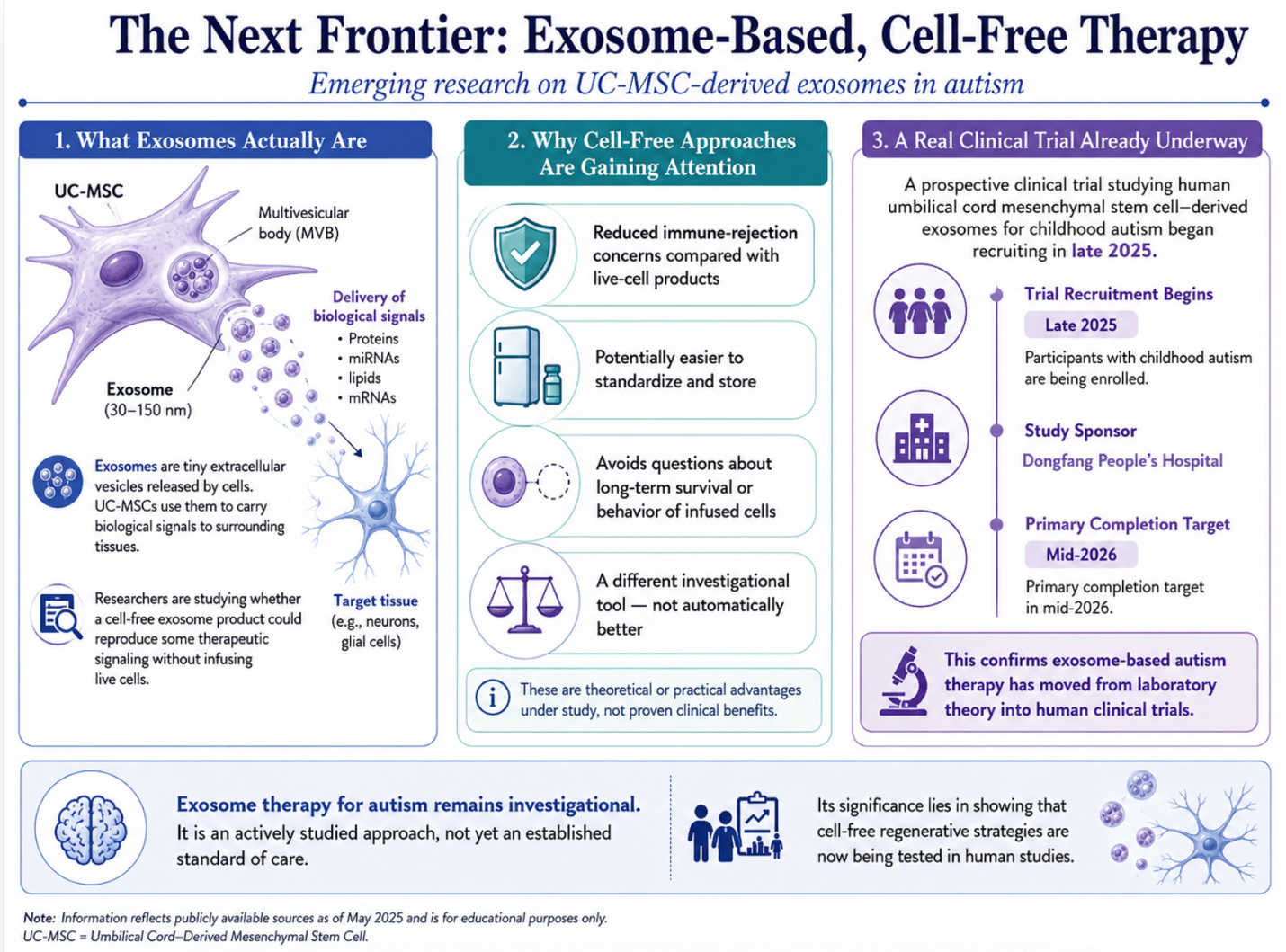
Exosomes are tiny extracellular vesicles essentially, message-carrying particles that cells release rather than the cells themselves. UC-MSCs produce exosomes as part of how they communicate with surrounding tissue, and researchers have increasingly asked a logical next question: if the exosomes are doing much of the therapeutic signaling work, could a cell-free exosome product deliver similar biological benefit without infusing live cells at all?
A cell-free approach carries some genuine theoretical advantages: exosomes don’t carry the same immune-rejection considerations live cells can, they may be easier to standardize and store, and they sidestep questions about long-term cell survival or behavior after infusion. None of that means exosome therapy is automatically better it means it’s a different tool being seriously investigated, not a marketing upgrade.
This isn’t theoretical. A prospective clinical trial specifically studying human umbilical cord mesenchymal stem cell–derived exosomes for childhood autism began recruiting in late 2025, sponsored by Dongfang People’s Hospital, with a primary completion target in mid-2026. Its existence matters for two reasons: it confirms exosome-based autism therapy has moved from lab-bench theory into actual human trials, and it’s a genuine reminder that this specific application remains investigational actively being studied, not yet an established standard of care the way whole-cell UC-MSC infusion increasingly is.
For families making decisions now, whole-cell UC-MSC infusion remains the better-established, more extensively studied option the one with a longer track record across published trials and real-world clinical use.
Cell-free exosome therapy is a legitimate research direction worth watching closely over the next few years, but it isn’t yet the kind of validated, widely available option that whole-cell therapy is today. Any clinic presenting it otherwise is getting ahead of where the evidence actually stands.
Certified ISO and GMP facilities across Bangkok and other major Thai cities ensure cell purity, safety, and viability the baseline that separates credible regenerative medicine Thailand programs from those cutting corners.
Physicians specializing in neurology and regenerative medicine design protocols around each child’s specific diagnostic and developmental picture rather than applying one fixed package to every patient.
The strongest clinics combine biological therapy with behavioral rehabilitation and nutritional support, reflecting how the research itself is structured UC-MSC therapy as one component of a broader plan, not a standalone fix.
Treatment in Thailand typically costs 50–70% less than equivalent programs in Western countries, while maintaining the same laboratory and clinical standards a major reason families researching stem cell therapy for autism internationally keep considering Thailand seriously.
Every plan should start with a full review of diagnostic history, developmental baseline, and medical background not a generic protocol applied regardless of the child’s actual presentation.
Reputable regenerative clinics work directly with developmental specialists to make sure UC-MSC therapy aligns safely with a child’s existing medical and therapeutic care, rather than operating in isolation from it.
Intravenous UC-MSC infusion allows cells to circulate systemically, while families continue occupational, speech, and behavioral therapy throughout functional skill-building and biological support working in parallel, not in sequence.
Vegastemcell’s approach to autism stem cell treatment in Thailand centers on today’s established whole-cell UC-MSC protocols, delivered through physician-supervised assessment, treatment, and structured follow-up coordinated with each child’s existing care team. As exosome-based research develops further, families deserve a provider that distinguishes clearly between what’s proven today and what’s still being studied not blurred marketing language.
UC-MSC therapy infuses whole living cells, which then signal to surrounding tissue partly through releasing exosomes. Exosome therapy uses those signaling particles alone, without live cells. UC-MSC therapy has a longer clinical track record; exosome therapy is newer and still in active trials.
It’s in active clinical trials, including a study that began recruiting in late 2025, but it isn’t yet an established, widely available treatment the way whole-cell UC-MSC therapy is today.
That’s a personal decision best made with a physician, weighing your child’s current needs against a therapy that’s still investigational. Whole-cell UC-MSC therapy has more established safety and outcome data available right now.
Stem cell therapy in Thailand combines ISO/GMP-certified laboratories, specialized multidisciplinary medical teams, integrated behavioral care, and costs 50–70% below Western countries.
No. Both whole-cell UC-MSC therapy and emerging exosome approaches are studied as complements to established behavioral, speech, and occupational therapy — not replacements for it.
Making a Well-Informed Decision Today
Understanding where the science actually stands whole-cell UC-MSC therapy well-established, exosome therapy real but still investigational helps families evaluate stem cell therapy in Thailand with clear eyes rather than marketing promises. If you’re trying to understand what’s genuinely available and appropriate for your child today, book a consultation with Vegastemcell for an assessment grounded in current, established evidence.
For more information you can reach me directly on WhatsApp or Email. Here’s our official link:
WhatsApp: +66982509599
Email: vegastemcell@gmail.com
References
Prospective Clinical Study on Human Umbilical Cord Mesenchymal Stem Cell-Derived Exosomes for the Treatment of Childhood Autism (NCT07243561). ClinicalTrials.gov, sponsored by Dongfang People’s Hospital. https://clinicaltrials.gov/study/NCT07243561 (Status: Recruiting; study start September 2025; estimated primary completion July 2026.)
Advancing regenerative therapies with umbilical cord-derived mesenchymal stem cells: A review. Biomolecules and Biomedicine, 2025. https://www.ncbi.nlm.nih.gov/pmc/articles/PMC12710621/ (PubMed-sourced review, 2014–2024, covering safety, efficacy, and translational limitations of UC-MSC-based approaches, including exosome/extracellular vesicle strategies as a future direction.)
Immunomodulatory Mechanisms and Therapeutic Potential of Mesenchymal Stem Cells. Stem Cell Reviews and Reports. https://link.springer.com/article/10.1007/s12015-023-10539-9
Dawson, G., Sun, J.M., Baker, J., et al. (2020). A Phase II Randomized Clinical Trial of the Safety and Efficacy of Intravenous Umbilical Cord Blood Infusion for Treatment of Children with Autism Spectrum Disorder. The Journal of Pediatrics, 222, 164–173. https://www.sciencedirect.com/science/article/abs/pii/S0022347620303346
Riordan, N.H., Hincapié, M.L., Morales, I., et al. (2019). Allogeneic Human Umbilical Cord Mesenchymal Stem Cells for the Treatment of Autism Spectrum Disorder in Children: Safety Profile and Effect on Cytokine Levels. Stem Cells Translational Medicine, 8(10), 1008–1016. Note: this paper was formally retracted in 2021 (retraction notice: Stem Cells Transl Med. 2021 Dec;10(12):1717). Included here only to flag that it should not be cited as valid evidence — a reminder of why checking retraction status matters before referencing any single autism stem cell study.