Our Services
Others
- DFPP
- Shockwave
- IV Drip

The integration of advanced cell-based applications into translational medicine has fundamentally altered our understanding of somatic tissue regeneration. For years, classical biology evaluated the efficacy of mesenchymal Stem Cell Therapy Bangkok Thailand through the lens of direct structural replacement hypothesizing that infused cellular grafts actively differentiated cell-for-cell to replace damaged host tissue layers. Modern molecular biology, however, has disproven this direct differentiation model.
When a physiological system experiences progressive structural decay, severe inflammatory trauma, or chronological senescence, the therapeutic impact of cell transplantation is driven by complex intercellular communication systems rather than physical cell replacement.
Embracing this scientific paradigm shift is essential for optimizing clinical outcomes in regenerative medicine. By shifting focus to targeted local microenvironmental modification, advanced medical protocols utilize Stem Cell Therapy Bangkok Thailand to alter the biological signaling lines of damaged organs. Administered through regulated systemic or localized pathways, fresh neonatal mesenchymal lineages function as highly responsive mobile bioreactors.
These youth-derived cell lines deploy millions of membrane-bound extracellular vesicles, orchestrate precise macro-immunomodulatory cascades, and perform active organelle transfer to initiate comprehensive metabolic rescue within degraded host environments.
1. Chemotactic Homing Kinetics: The SDF-1/CXCR4 Signaling Axis
The first phase of successful cellular repair relies on the targeted migration of transplanted cells toward areas of physical or pathological trauma a molecular tracking process known as chemotactic homing.
When structural tissues experience mechanical shock, poor local perfusion, or progressive oxidative strain, the compromised resident cells do not remain biologically silent. Instead, they upregulate and secrete specific chemical alert proteins into the immediate microenvironment.
As detailed in the signaling framework above, the primary molecular engine driving this cellular tracking is the SDF-1/CXCR4 axis. Stressed stromal cells synthesize and release high concentrations of Stromal Cell-Derived Factor-1 (SDF-1), creating a localized chemical path that reaches the adjacent capillary networks.
Transplanted cells expressing high levels of the surface receptor CXCR4 (C-X-C Chemokine Receptor Type 4) lock onto this gradient. This receptor-ligand binding triggers an internal signaling chain inside the cell, promoting immediate adhesion to the blood vessel wall and guiding transendothelial migration. This allows the healing cells to slide through the vascular border and settle precisely within the core injury site.
When designing protocols for Stem Cell Therapy Bangkok Thailand, preserving the structural integrity of these surface CXCR4 receptor lines is a primary laboratory benchmark, directly dictating how effectively the cells home in on damaged targets.
2. Exosomal Cargo Delivery: Intercellular Reprogramming via the Secretome
Once they complete their homing sequence, the cells adapt to the local tissue environment and begin manufacturing a customized mix of therapeutic proteins, growth factors, and active cytokines, collectively known as the paracrine secretome.
The main vehicle for this molecular communication is the exosome—a microscopic extracellular vesicle ranging from 30 to 150 nanometers in diameter.
The Paracrine Delivery System
Exosomes cross dense extracellular matrix barriers that larger structural cells cannot penetrate. They act as secure transport containers, protecting delicate biological instructions from enzymatic degradation until they reach target host cells.
Upon reaching stressed or failing host cells, these exosomes fuse seamlessly with the plasma membrane, releasing their highly concentrated payload of non-coding microRNAs (such as miR-21, miR-133, and miR-146a) directly into the cytoplasm. This cargo delivery reprograms the internal signaling of the host cell:
Halting the NF-B Inflammatory Loop: Exosomal miR-146a targets and suppresses key inflammatory proteins (IRAK1 and TRAF6), completely interrupting the destructive NF-B pathway to turn off localized tissue inflammation.
Upregulating Anti-Apoptotic Protections: The microRNA payload represses the transcription of pro-apoptotic Bax and p21 genes while expanding the expression of Bcl-2, a key survival protein that rescues struggling host cells from premature cell death.
Stimulating Endogenous Regeneration: Paracrine signaling prompts resident progenitor cells to exit dormancy, accelerating natural tissue replacement and local vascular growth.
3. Bioenergetic Rescue: Mitochondrial Transfer via Tunneling Nanotubes (TNTs)
The most notable recent development in cellular biology is the discovery of direct organelle transplantation a mechanism known as mitochondrial transfer. Chronic metabolic disease and tissue aging are fundamentally driven by mitochondrial failure; when the power plants inside host cells experience structural breakdown, they lose the ability to produce cellular energy (ATP), leading to severe oxidative stress and permanent cell death.
To resolve this energy crisis, transplanted cells deploy an advanced physical intervention. As illustrated in the biological mechanism map below, the cell extends physical membrane projections called Tunneling Nanotubes (TNTs) directly to the surface of the damaged host cells.
The cellular mechanism of mitochondrial transfer via Tunneling Nanotubes. Source: MDPI
This physical connection forms an active transport bridge across the intercellular space. Healthy, high-functioning mitochondria from the youth-derived cell travel down these nanotubes to cross directly into the cytoplasm of the injured host cell.
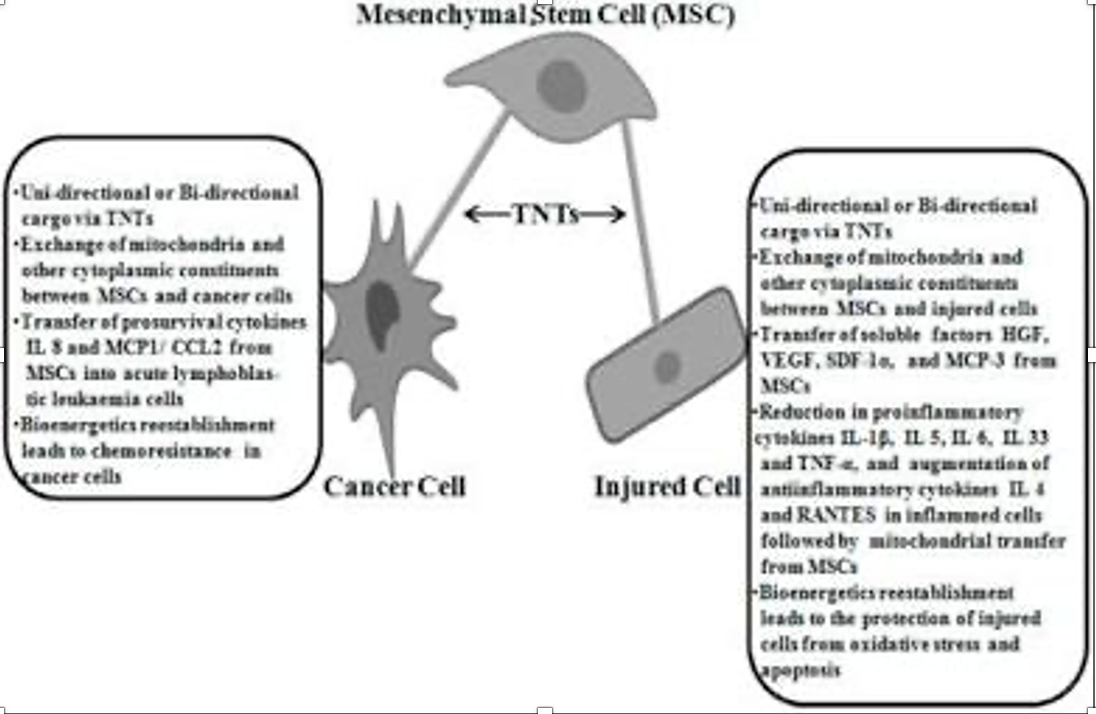
This direct organelle donation restores immediate, healthy ATP energy production inside the host cell, neutralizing harmful oxidative stress and stabilizing cell function. This bioenergetic rescue helps preserve structural tissue function long before permanent scarring or organ failure can take hold.
4. Operational Comparison Matrix: Mechanisms of Somatic Rebalancing
To understand how these molecular mechanisms apply across distinct clinical situations, it helps to analyze the specific target dynamics and the corresponding cellular interventions triggered by this molecular pairing:
| Cellular Mechanism | Primary Molecular Components | Target Host Pathology | Clinical Therapeutic Outcome |
| Chemotactic Homing | SDF-1 Chemokine Gradient, CXCR4 Surface Receptors | Localized tissue distress signals, vascular constriction. | Guides the targeted migration of cells directly to injury sites, maximizing cell yield. |
| Secretome Signaling | Exosomes, miR-146a, miR-21, Anti-inflammatory Cytokines | Hyper-activated M1 macrophages, permanent NF-κB cascades. | Shuts down systemic tissue inflammation, shifts immune cells to M2 repair phenotypes. |
| Organelle Transfer | Tunneling Nanotubes (TNTs), Functional Mitochondria | Severe ATP energy depletion, mitochondrial structural failure. | Restores cellular respiration, rescues weak host cells from premature death. |
| Matrix Anabolism | TGF-β3, VEGF, bFGF Growth Factors | Depleted collagen scaffolds, microvascular ischemia. | Stimulates fresh micro-capillary growth and rebuilds organized tissue matrices. |
5. Beyond Cryopreservation: Bypassing Logistical Degradation in Bangkok
The clinical success of Stem Cell Therapy Bangkok Thailand for complex metabolic and degenerative conditions relies entirely on a single technical benchmark: cellular viability, the exact percentage of live, functioning cells present at the precise second of delivery. Dead cells provide no therapeutic signaling; they cannot home, cannot perform mitochondrial transfer, and are quickly cleared away by the recipient’s immune system as biological waste.
Many international clinics source their cellular products from distant manufacturing facilities, requiring the cells to be deeply frozen and thawed right at the patient’s bedside. This cryopreservation process utilizing Dimethyl Sulfoxide (DMSO) introduces profound thermodynamic stress to delicate plasma membranes, frequently causing cell lysis and damaging the homing receptors required for targeted transendothelial migration.
Advanced biomedical institutions in Thailand bypass this logistical bottleneck. Operating state-of-the-art closed-system cleanrooms that comply fully with strict international Good Manufacturing Practices (GMP), local facilities culture, validate, and formulate high-potency cell lines locally.
The cells remain suspended in a nutrient-rich, temperature-regulated transport matrix right up to the minute of clinical delivery, completely avoiding the severe physical shock of deep freezing. This logistics structure guarantees authenticated cell viability scores exceeding 95%, ensuring maximum cellular yield and optimal tissue integration within heavily compromised joint spaces.
Conclusion: Empowering Long-Term Cellular Health
Chronic organ decline, metabolic failure, and progressive tissue degradation involve complex biological processes, but patients do not have to remain locked in a purely reactive cycle of managing symptoms with temporary pharmaceutical blocks while their underlying cellular health undergoes permanent decay. Continuing to treat a deep mechanical and cellular matrix failure with simple surface-level chemical suppression masks the physical decline without addressing the true biological crisis.
By choosing advanced, ATMP-compliant Stem Cell Therapy Bangkok Thailand, you give your body the highly potent, youth-derived resources it needs to cool chronic tissue inflammation, rescue failing mitochondria, and rebuild a resilient proteoglycan scaffold from the inside out. Embracing the cutting edge of Stem Cell Therapy Bangkok Thailand strict PIC/S GMP standards represents a powerful, proactive choice to avoid the constraints of progressive disease, protect your natural organ systems, and reclaim a vibrant foundation of long-term health and physical independence.