Our Services
Others
- DFPP
- Shockwave
- IV Drip

The body is genuinely good at healing itself most of the time. Cut your finger and within a couple of weeks it’s like nothing happened. But some wounds don’t play by those rules. Diabetic ulcers, burns, surgical wounds, deep trauma these can stall for months, and even when they do close, they often leave behind thick, disfiguring scar tissue. Stem cell therapy for wound healing and scar reduction has become one of the more closely studied answers to that problem, not because it replaces the body’s own repair process, but because it works directly with it. Here’s how that actually plays out, stage by stage.
Stem cells have two properties that make them useful in wound repair, and neither one is complicated:
Self-renewal : they can replicate themselves over long periods without wearing out.
Differentiation : they can turn into specialized cells: skin cells, blood vessel cells, connective tissue cells, depending on what the wound needs.
Put those two together and you get something like a biological toolkit. In practice, that means stem cells can:
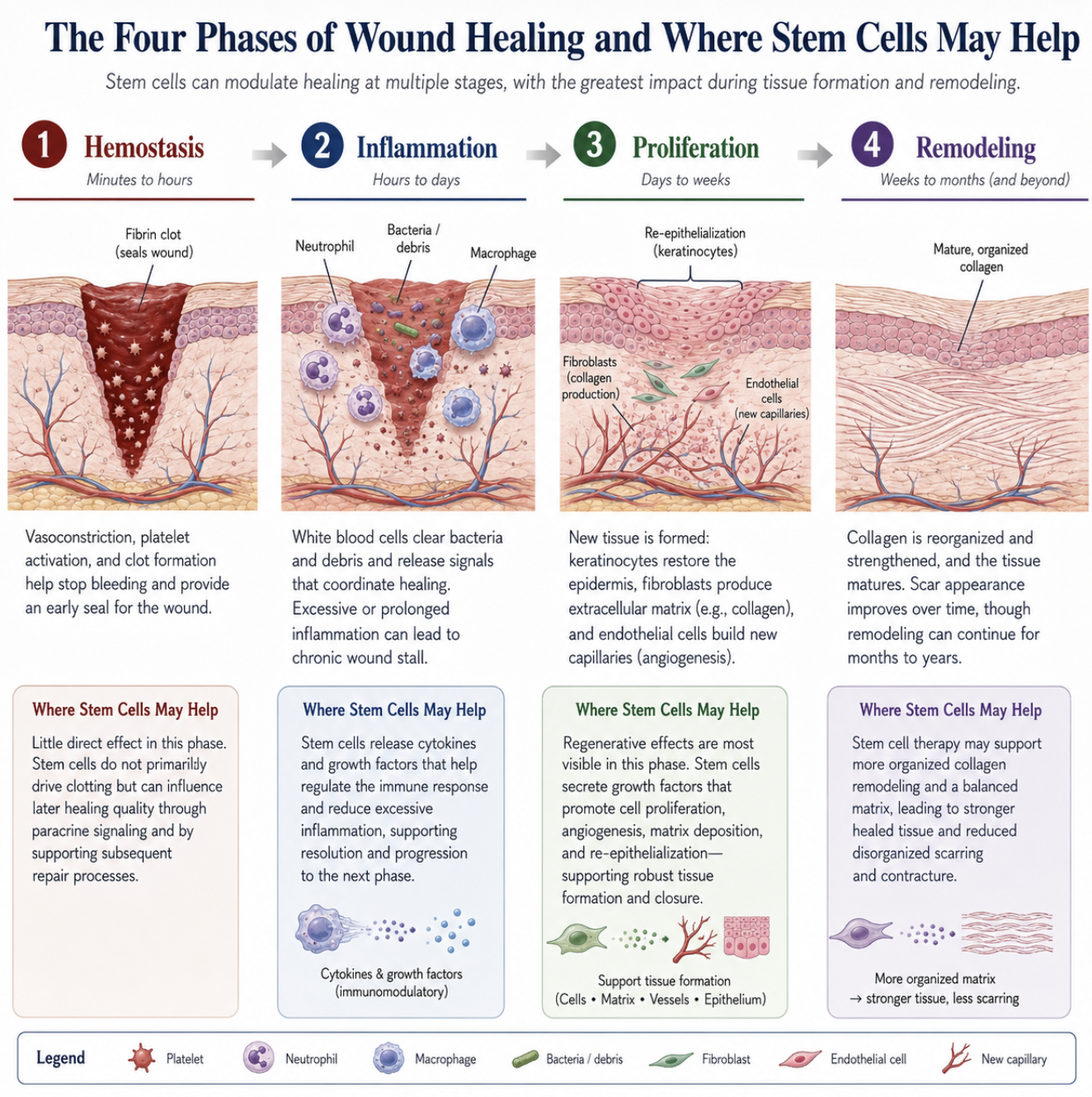
Every wound, healthy or chronic, moves through the same four phases. Where things go wrong in chronic wounds is usually a stall somewhere in this sequence and that’s exactly where regenerative therapy tends to have the most to offer.
This is the clotting phase the body’s first response, stopping blood loss. Stem cells don’t do much here directly, but the effects they have later on end up shaping how well this phase resolves.
White blood cells move in to clear bacteria and debris. In a healthy wound, this phase is short. In a chronic one, it can drag on indefinitely. Stem cells help by releasing cytokines that guide the immune response and, in many cases, reduce excessive inflammation that would otherwise keep the wound stuck here.
This is where new tissue actually starts forming new keratinocytes (skin cells), fibroblasts (connective tissue cells), and endothelial cells (the cells lining blood vessels). Stem cells contribute directly to generating all three, which is a big part of why this phase is where their impact is most visible.
Collagen gets reorganized and the tissue strengthens over the following weeks and months. This is also where scarring is decided. Stem cell therapy appear to help prevent the disorganized collagen deposition that leads to thick, raised scars supporting more natural tissue regeneration instead.
Not every stem cell source behaves the same way, and the choice often comes down to what the wound needs and how it’s going to be treated.
Harvested from a patient’s own fat tissue via liposuction, ADSCs are relatively easy to access and carry a rich supply of regenerative factors. They’re a common choice for promoting skin regeneration and vascular growth.
Extracted from bone marrow, BM-MSCs have been studied extensively in both acute and chronic wound care, and are well known for their immunomodulatory and pro-healing effects.
Collected from the umbilical cord after childbirth, UC-MSCs are notably young cells with strong growth factor secretion. Because they’re used in allogeneic (donor-based) treatment, they’ve become a frequent choice for more severe wounds where a patient’s own cells may not be a practical option.
Known for their anti-inflammatory and antibacterial properties, these cells are often incorporated into advanced wound dressings or grafts rather than delivered as an isolated cell suspension.
Cells are injected into and around the wound bed, working to stimulate healing from within rather than just at the surface.
Creams, serums, or hydrogels containing stem cells or just their secretions, known as exosomes get applied straight to the skin.
These are infused with stem cells and placed over the wound, giving the regeneration process a structured framework to follow rather than happening haphazardly.
Stem cells are frequently paired with platelet-rich plasma (PRP), microneedling, or laser treatments, since combining approaches tends to produce better results than any single method alone.
A few areas are worth knowing about if you’re trying to understand where this field is actually going, not just where it’s been.
Rather than delivering whole cells, researchers are increasingly working with just the exosomes the secretions cells release to trigger the same healing response. Recent studies combining exosomes from mesenchymal cells with 3D-printed hydrogels have shown accelerated wound remodeling and measurable angiogenesis in preclinical models, without needing to implant the cells themselves.
This is exactly what it sounds like using bioprinting technology to build custom, layered skin constructs seeded with stem cells or their exosomes. Recent work has shown these bioprinted scaffolds can support vascularized, functional skin regeneration, addressing one of the harder problems in tissue engineering: getting new tissue enough blood supply to actually survive.
Wound dressings are being developed that release stem cell-derived factors based on the wound’s actual condition in real time, rather than at a fixed rate an approach still largely in early research and development.
Broader reviews of MSC and exosome-based skin regeneration point to 3D scaffold platforms as a promising way to extend how long these therapies remain active at the wound site, addressing a known limitation of naturally derived exosomes breaking down too quickly to have a lasting effect.
Yes. Thailand has built up a solid base of licensed clinics and laboratory infrastructure supporting regenerative medicine, with cell-based treatments regulated under Thai FDA and Ministry of Public Health oversight. That combination of clinical expertise and regulatory structure is part of why the country has become a common destination for patients seeking stem cell therapy for wounds and scars.
Stem cell-based wound and scar treatment tends to be worth considering when:
A wound hasn’t responded to standard care after a fair trial period
Scarring is a significant concern, not just wound closure itself
The wound falls into a category diabetic, pressure-related, or radiation-induced that’s notoriously resistant to conventional treatment
As with any regenerative approach, this comes down to an individual medical evaluation. You can explore the full range of conditions we treat on our stem cell therapy page, or see real outcomes on our results page.
Does stem cell therapy work better for fresh wounds or old scars? Both are studied, but the mechanisms differ. For active wounds, the focus is on accelerating the four healing phases described above. For existing scars, treatment generally targets remodeling collagen structure to improve texture and reduce thickness, rather than “undoing” the wound itself.
What’s the difference between whole-cell therapy and exosome therapy? Whole-cell therapy delivers the stem cells themselves. Exosome therapy delivers just the signaling molecules those cells secrete no living cells involved which some researchers see as a way to get similar benefits with a simpler, more stable product.
Can stem cell therapy completely prevent scarring? No, no treatment can guarantee scar-free healing. What the current research supports is a reduction in scar thickness and improved tissue organization, not full prevention.
How does 3D bioprinting fit into actual clinical treatment right now? Mostly, it doesn’t yet this is still largely a research-stage technology. It’s included here because it represents where wound and scar therapy is likely heading, not because it’s a standard clinical option today.
3D bioprinting of engineered exosomes secreted from M2-polarized macrophages through immunomodulatory biomaterial promotes in vivo wound healing and angiogenesis. PMC, 2024. https://pmc.ncbi.nlm.nih.gov/articles/PMC11636135/
Same study, ScienceDirect listing. https://www.sciencedirect.com/science/article/pii/S2452199X24005176
Three-Dimensional Bioprinting Techniques in Skin Regeneration: Current Insights and Future Perspectives. PMC, 2025. https://pmc.ncbi.nlm.nih.gov/articles/PMC12113422/
3D-Printed Perfusable Lab-on-a-Chip-Based Engineering of MSC-Derived Exosome-Enriched Vascularized Grafts for Skin Regeneration. ACS Applied Bio Materials, 2025. https://pubs.acs.org/doi/10.1021/acsabm.5c00278
Revolutionizing dermatology: harnessing mesenchymal stem/stromal cells and exosomes in 3D platform for skin regeneration. PMC, 2024. https://www.ncbi.nlm.nih.gov/pmc/articles/PMC11127839/