Our Services
Others
- DFPP
- Shockwave
- IV Drip

Spinal stenosis is often described as a narrowing of the spinal canal, but for many patients, the problem is more complex than “less space in the spine.” When the spinal canal or nerve openings become narrow, nerves may be compressed or irritated. This can lead to back pain, neck pain, leg pain, numbness, tingling, weakness, heaviness in the legs, or difficulty walking.
This is why stem cell therapy for spinal stenosis in Thailand should be explained carefully. Stem cell therapy does not physically widen the spinal canal or remove bone spurs. It should not be promoted as a replacement for surgery when there is severe nerve compression. A more realistic and scientifically responsible way to discuss stem cell therapy is as a supportive regenerative medicine approach that may help improve the biological environment around irritated nerves, inflamed tissues, and degenerative spinal structures.
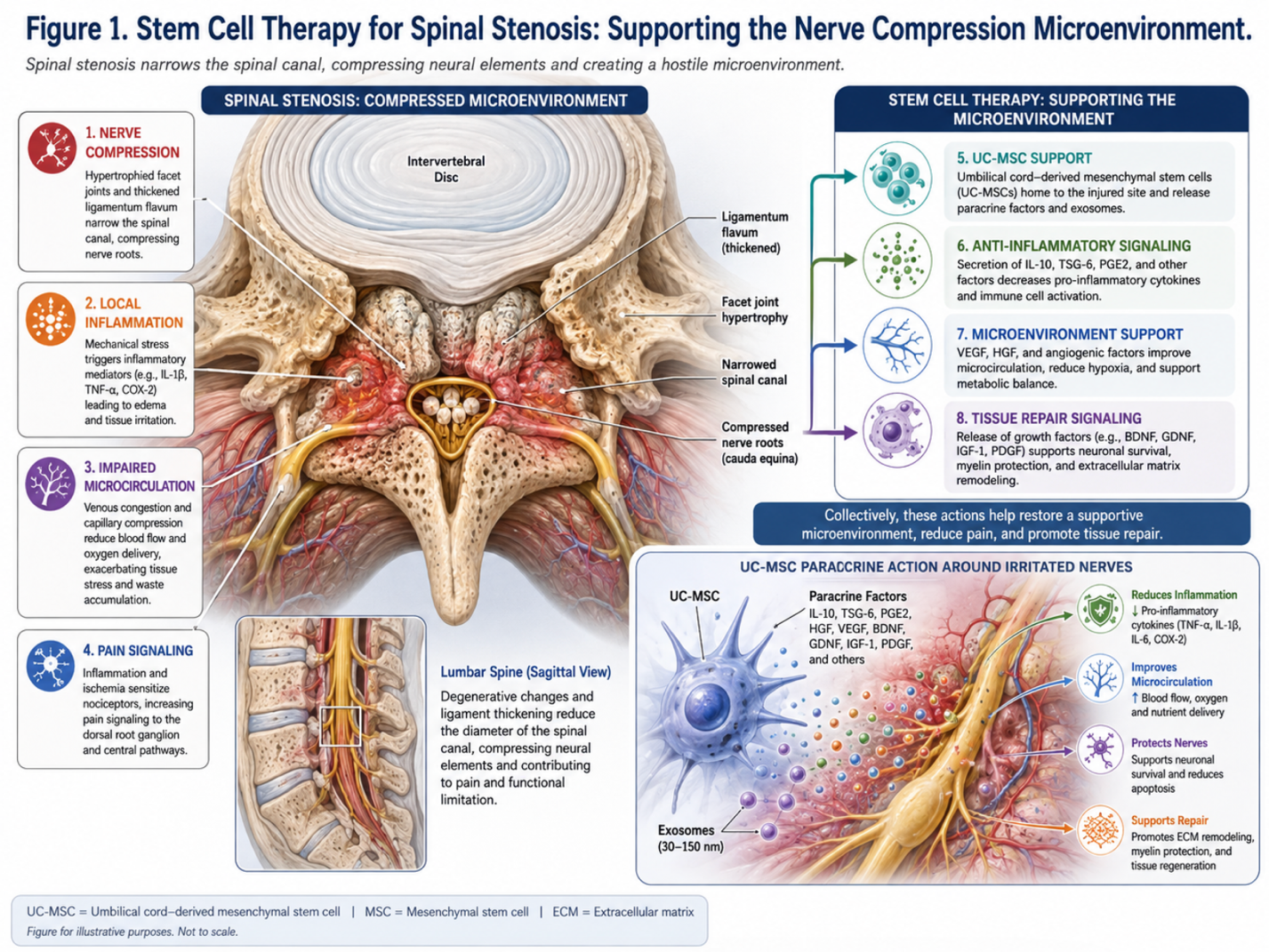
Spinal stenosis may occur in the neck or lower back. In the lumbar spine, patients may feel lower back pain, leg pain, numbness, weakness, or reduced walking tolerance. Some patients feel better when bending forward because this position can temporarily reduce pressure around the nerves.
However, the symptoms of stenosis are not caused by structure alone. Nerve irritation, inflammation, disc degeneration, facet joint changes, ligament thickening, poor microcirculation, and reduced tissue repair can all contribute to the patient’s experience of pain and limitation. This is where the idea of the stenosis microenvironment becomes important.
The stenosis microenvironment refers to the tissues surrounding compressed or irritated nerves. This includes the intervertebral discs, facet joints, ligaments, small blood vessels, inflammatory mediators, nerve roots, and supporting soft tissues.
When this environment is inflamed or metabolically stressed, nerves may become more sensitive. A narrow spinal canal may create pressure, but inflammation and poor blood flow can make the symptoms worse. This is one reason why two patients with similar MRI findings may have very different symptoms.
Some people with severe-looking imaging may have mild symptoms, while others with moderate stenosis may feel significant pain, numbness, or walking difficulty. This means treatment planning should not depend on MRI alone. It should combine imaging with symptoms, neurological examination, walking ability, pain pattern, and overall health condition.
In regenerative medicine, mesenchymal stem cells, or MSCs, are studied for their cellular signaling effects. MSCs may release growth factors, cytokines, extracellular vesicles, and other bioactive signals that may interact with inflammation, immune regulation, microcirculation, and tissue repair pathways. For spinal stenosis, the goal is not to “open the spine” with stem cells. That would be an inaccurate claim. The more realistic goal is to support the biological environment around affected tissues. Potential supportive goals may include:
Supporting inflammation balance around irritated nerves
Supporting the tissue repair environment in degenerative spinal structures
Helping reduce biological stress around compressed nerve roots
Supporting microcirculation and oxygen delivery
Supporting nerve comfort in selected patients
Improving rehabilitation readiness and mobility goals
Some patients with spinal stenosis may need urgent or surgical evaluation. Warning signs include progressive leg weakness, worsening numbness, difficulty walking, loss of balance, or bowel and bladder changes. In these situations, stem cell therapy should not delay proper neurological or surgical care.
For severe structural compression, surgery may be considered to relieve pressure on the nerves. Regenerative medicine may have a supportive role in selected cases, but it cannot replace decompression when the main problem is severe mechanical narrowing.
This distinction is important for patient safety and realistic expectations.
A strong treatment plan for spinal stenosis should be integrated. Physical therapy, posture modification, core strengthening, walking programs, weight management, anti-inflammatory strategies, pain management, and spine specialist review may all be part of care.
Stem cell therapy may support the internal environment, but rehabilitation helps patients translate biological support into function. For many patients, the real goal is not only reducing pain, but improving walking tolerance, leg comfort, balance, and daily activity.
Thailand is increasingly known for regenerative medicine, spine care, rehabilitation, and international patient support. Patients considering stem cell therapy in Thailand should ask about medical screening, MRI review, neurological assessment, treatment route, cell source, donor screening, sterility testing, safety monitoring, and follow-up planning.
The best approach is not a one-size-fits-all injection. It should be diagnosis-based, medically guided, and realistic.
Stem cell therapy for spinal stenosis in Thailand may be considered as a supportive regenerative medicine option for selected patients with inflammation, nerve irritation, degenerative disc changes, or tissue repair concerns around the spine.
However, stem cell therapy does not physically widen the spinal canal and should not replace surgery when severe compression or neurological decline is present. The most responsible way to understand this treatment is through the stenosis microenvironment: inflammation balance, microcirculation, nerve comfort, tissue repair signaling, and rehabilitation readiness.
For the right patient, regenerative medicine may support a broader spine care plan. The safest results come from careful diagnosis, realistic expectations, and coordination with standard spine treatment.