Our Services
Others
- DFPP
- Shockwave
- IV Drip

An ALS diagnosis changes everything almost overnight. The disease breaks down the motor neurons that control voluntary movement, it has no cure, and the handful of approved drugs only slow things down rather than stop them. So it makes sense that people start looking elsewhere and one place that search often leads is Bangkok, where clinics offer mesenchymal stem cell IV therapy, sometimes paired with a procedure called Double Filtration Plasmapheresis, or DFPP. Before anyone travels for this or spends money on it, though, it’s worth understanding what these two things actually are, where the science currently stands, and where it doesn’t.
Why Researchers Started Looking at Regenerative Medicine for ALS
For a long time ALS was thought of almost purely as a motor neuron problem, the neurons just die, and nobody was sure why. Over the last twenty years or so, that picture has gotten more complicated. Neuroinflammation, oxidative stress, and dysfunction in glial cells (the support cells around neurons) now look like they play a real role alongside whatever genetic or molecular processes are driving the disease in each patient. That’s roughly where stem cell therapy enters the conversation. MSC stem cell therapy are thought to calm inflammation and support the tissue environment around neurons rather than directly replacing dead ones, which is a different, more modest kind of promise than regrowing motor neurons.
Here’s the part that matters most, though: no stem cell therapy has FDA approval for ALS, and none has been shown in a large, well-controlled trial to actually stop the disease from progressing. Trials like Nur Own and various other MSC stem cell therapy protocols have produced results that are, frankly, all over the place some subgroups showed a signal of benefit, other trials missed their main endpoint entirely. This is still very much an open research question. It is not a solved one.
What an MSC IV Infusion Actually Involves
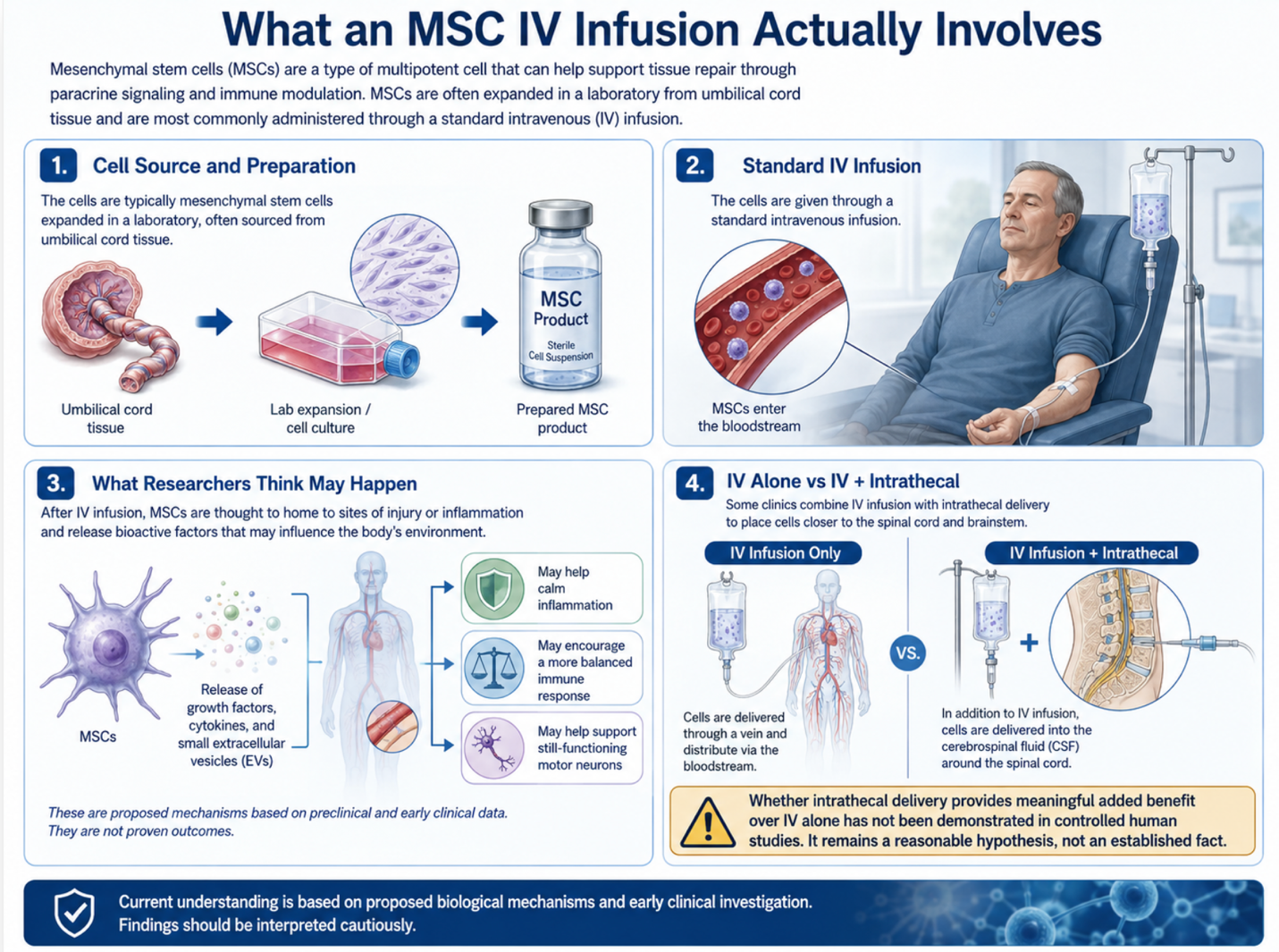
The cells used are usually mesenchymal stem cell therapy expanded in a lab, often sourced from umbilical cord tissue, and they’re given through a standard intravenous infusion. The idea is that these cells release growth factors, cytokines, and small extracellular vesicles once they’re in the body sort of a chemical signal that might dial down inflammation, nudge the immune system toward a calmer state, and support whatever motor neurons are still functioning.
Some clinics go further and combine the IV infusion with an intrathecal injection, delivering cells directly into the spinal fluid so they’re closer to the spinal cord and brainstem. Whether that actually adds meaningful benefit over IV alone hasn’t been demonstrated in controlled human studies. It’s a reasonable hypothesis, not an established fact.
DFPP: A Real Procedure, But Not the Same Thing as Stem Cell Therapy
DFPP tends to get talked about in the same breath as stem cell therapy, but it’s a fundamentally different procedure. No new cells are introduced. Instead, a patient’s plasma is passed through two filters in sequence, which separates out larger molecules antibodies, immune complexes, inflammatory proteins while sending the patient’s own blood cells and most of their plasma proteins back into circulation.
This isn’t experimental. DFPP has a genuine evidence base, published in peer-reviewed journals, going back decades. The catch is that almost all of that evidence comes from autoimmune neurological conditions of autoimmune encephalitis, myasthenia gravis, neuromyelitis optica where there’s usually one specific antibody driving the disease, and removing it produces a fairly direct, measurable improvement.
ALS doesn’t work that way. There isn’t a single circulating antibody responsible for the disease the way there is in, say, myasthenia gravis. Some clinics argue that lowering the overall inflammatory load with DFPP might make the body a better environment for stem cells to work in afterward. Maybe. But that’s a theory, not a demonstrated result there’s very little published trial data testing DFPP plus MSC stem cell therapy specifically in ALS patients, so it’s not accurate to borrow the outcomes seen in autoimmune encephalitis and assume they’ll transfer over.
Why Bangkok, Specifically
Thailand’s regenerative medicine industry has grown quickly, and Bangkok is its center. Part of the appeal is straightforward: GMP-certified cell labs, physician oversight, and costs that are a fraction of what similar treatment runs in the US, UK, or Australia. For patients facing regulatory walls at home, that’s a real draw, and reputable clinics do provide things like baseline neurological workups, tested cell products, and structured follow-up care.
None of that changes what the underlying data says, though. Good infrastructure and a lower price tag don’t substitute for outcome evidence. The questions worth asking a Bangkok clinic are exactly the same ones you’d ask a specialist anywhere else.
Questions Worth Asking Before Moving Forward
What outcome data exists specifically for ALS patients not autoimmune encephalitis, not other neurological conditions?
How is “improvement” being measured, and over what time frame?
What are the actual risks, especially when apheresis and cell infusion are combined?
Can this be done alongside standard ALS care riluzole, edaravone, respiratory support, a multidisciplinary ALS team rather than replacing it?
Is there peer-reviewed data available, or mostly patient testimonials?
Where This Leaves Things
Both of these treatments are real. DFPP has solid evidence behind it just not for ALS specifically. Stem cell therapy for ALS is a genuinely active research area, but it hasn’t crossed the line into proven treatment, and combining it with DFPP for this particular disease is still more theory than protocol.
None of that means the research isn’t worth pursuing, or that families exploring these options are doing anything unreasonable. It just means the decision deserves clear-eyed information about what’s actually been shown to work, what’s promising but unproven, and what a neurologist who knows the patient’s case would actually recommend.
This article is for general informational purposes only and is not medical advice. It does not recommend for or against any specific treatment, dosage, or provider. Anyone considering stem cell therapy or DFPP for ALS should consult a qualified neurologist and review current peer-reviewed evidence before making treatment decisions.
For more infomation you can reach me directly on WhatsApp or Email. Here’s our official link:
WhatsApp :+66982509599
Email : vegastemcell@gmail.com