Our Services
Others
- DFPP
- Shockwave
- IV Drip

If you or someone you love is dealing with kidney disease whether in the early stages or at the point of needing dialysis you’ve probably heard the term stem cell therapy for kidney treatment floating around. Today we’re diving into how this technology actually works, why the medical community worldwide is paying close attention, and whether it can truly change the lives of kidney disease patients.
Having followed research in this field closely for years, it’s fair to say that Stem Cell Therapy is no longer a distant concept but it’s also not a miracle cure that fixes everything. This article walks through the science in a balanced way: the mechanisms behind it, the clinically proven benefits, and what you should know before considering it.
Mesenchymal Stem Cells (MSCs) are a type of stem cell that can be harvested from several sources in the body, including bone marrow, adipose (fat) tissue, and umbilical cord tissue. What makes these cells stand out is their ability to regulate the immune system, reduce inflammation, and stimulate tissue repair qualities that align closely with the needs of patients living with Chronic Kidney Disease (CKD) and Acute Kidney Injury (AKI).
What’s particularly interesting is that MSCs don’t need to transform directly into kidney cells to be beneficial. Instead, they work by “communicating” with neighboring cells a mechanism far more complex than most people realize.
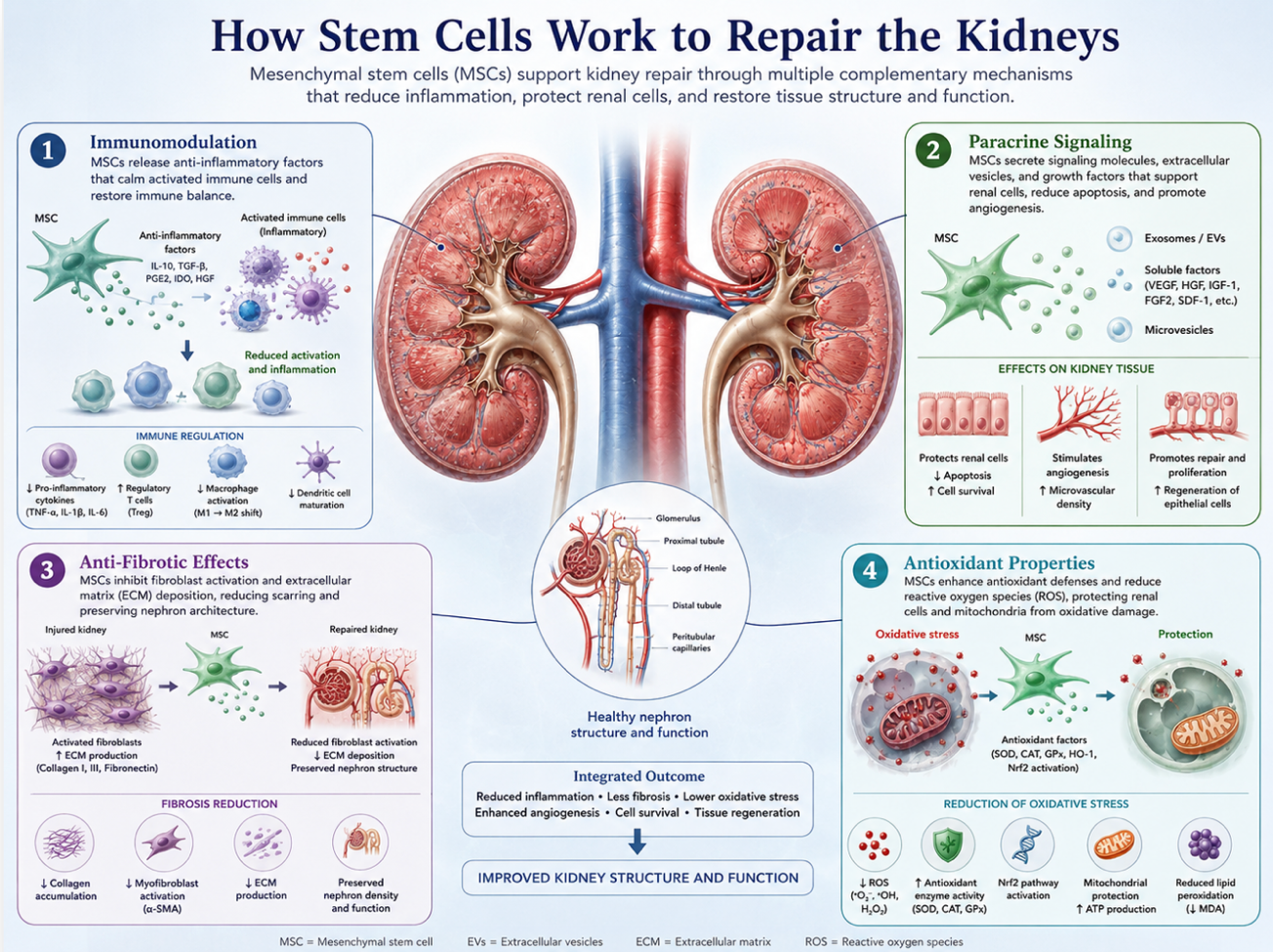
Many people wonder exactly how stem cell-based kidney treatment works at the cellular level. The answer is that MSCs don’t rely on a single function they operate through several mechanisms simultaneously to help restore kidney function.
MSCs secrete anti-inflammatory substances and growth factors that help regulate an overactive immune system, preventing it from attacking the kidney’s own tissue a core problem in many types of kidney inflammation.
Rather than embedding themselves to replace damaged kidney cells, MSCs release signaling molecules that prompt the body’s existing kidney cells to repair themselves. They also help inhibit cell death (apoptosis) and stimulate the formation of new blood vessels (angiogenesis), improving blood supply to injured areas.
Kidney fibrosis is a major driver of chronic kidney disease progression. MSCs help by reducing fibroblast activity and limiting the buildup of extracellular matrix, preserving more of the kidney’s functional filtering units.
Oxidative stress is one of the causes of kidney cell damage. MSCs help by producing antioxidant enzymes that significantly reduce the damage caused by reactive oxygen species (ROS).
Multiple clinical studies have shown that using MSCs in patients undergoing kidney transplantation, alongside standard immunosuppressive medication, helps reduce post-operative inflammation and improves graft survival rates. This is the kind of empirical evidence that has pushed the medical community to take the therapy’s potential more seriously.
Chronic inflammation accelerates kidney disease progression faster than normal. MSC-based therapy helps regulate immune cells so they don’t release excessive pro-inflammatory substances.
While direct differentiation of MSCs into kidney cells is still under investigation, their ability to stimulate repair through cell signaling has already been confirmed across multiple studies.
Many patients receiving this treatment show improvement in Glomerular Filtration Rate (GFR), along with reduced protein levels in urine both key indicators of kidney health.
By simultaneously reducing inflammation, fibrosis, and oxidative stress, MSCs effectively help slow kidney function decline, particularly in patients who still retain some residual kidney function.
MSCs help accelerate kidney recovery in patients with acute kidney injury by reducing inflammation and rapidly promoting cellular repair.
In CKD patients, MSC treatment may help slow disease progression, reduce fibrosis, and enhance the function of remaining healthy kidney tissue.
MSCs help balance the immune response, reduce the risk of organ rejection, and lower the amount of immunosuppressive medication needed in the long term.
Can stem cells really treat chronic kidney failure? Current research shows positive results in slowing disease progression and improving quality of life, but it is not yet a guaranteed cure in every case. Consulting a nephrologist before making a decision is essential.
Who is a good candidate for MSC treatment? Patients with early-to-mid stage chronic kidney disease, those preparing for or recovering from a kidney transplant, and acute kidney injury patients with recovery potential are typically considered first.
Are there risks or side effects? Based on available safety data, intravenous administration of MSCs is considered low-risk. However, as with any medical procedure, some risk always exists, so treatment should only be performed under the supervision of a specialized medical team.
Researchers are currently working on ways to boost the effectiveness of MSCs through genetic modification and preconditioning techniques to enhance their tissue-repair capabilities. This could be a major step toward making stem cell transplantation for kidney treatment a standard treatment option in the near future.
Mesenchymal stem cell therapy opens the door to a new approach to kidney disease treatment that complements standard care such as dialysis and kidney transplantation. Through mechanisms that reduce inflammation, inhibit fibrosis, combat oxidative stress, and stimulate tissue repair, patients have a better chance of restoring kidney function. That said, this treatment is still evolving, and interested patients should consult a kidney specialist to assess individual suitability before deciding to pursue treatment.