Our Services
Others
- DFPP
- Shockwave
- IV Drip

A small wound in a diabetes, poor circulation or neuropathy patient that does not heal properly can become a major chronic problem which takes years. This has relevant application, particularly for diabetic foot ulcers, where salubrious healing can be delayed with altered perfusion patterns (ischaemia), nerve damage and dysfunction increased risk of infection inflammation dysregulation impaired tissue repair.
When a patient or their family member says to me, “Can I get stem cell therapy in Thailand for my chronic wound?,” one of the first things i typically say is that healing a wound really does not just involve closing up an open patch of skin. Its focus is to reinstate a more normal healing environment below the wound.
Normal wound healing proceeds in a sequence of stages (inflammation, tissue formation and growth [angiogenesis], collagen remodeling, skin closure). This is the normal process for wound healing, but in chronic wounds this movement becomes stuck.
The wound may get stuck in the inflammatory phase for an excessive amount of time. Blood flow may be insufficient. Oxygen delivery may be reduced. Positive cultures or biofilm may be present. Patients with diabetes can experience prolonged hyperglycaemia, and this will additionally impair immune response, vascular function as well as tissue repair.
Chronic Wounds Requires More Than a Dressing Change They require medical evaluation, treatment for infection, pressure off-loading in addition to management of blood flow and tissue debridement when indicated as well as metabolic derangement control and a comprehensive wound care plan. The only recommended use of the stem cell therapy will be as an adjunct to this broader therapeutic approach.
Oxygen, nutrients, immune cells and repair signals are all required for every healing wound. They are communicated through the vascular system. Insufficient blood flow means the wound is not fully supported to move through stages of healing.
This is particularly crucial in the management of diabetic foot ulcer Microcirculatory impairment, Endothelial dysfunction or peripheral arterial disease a common state among diabetic patients. The appearance of superficial nature of the wound might not always correspond to underlying perfusion and oxygenation including oxygen tension.
The doctor should check if the wound has an adequate blood supply to heal before doing a regenerative treatment. In cases of severely compromised circulation, vascular evaluation/intervention is needed first. In the case of a wound/so-called tissue disease, we cannot request that skin regenerate if we are not giving it what to work with.
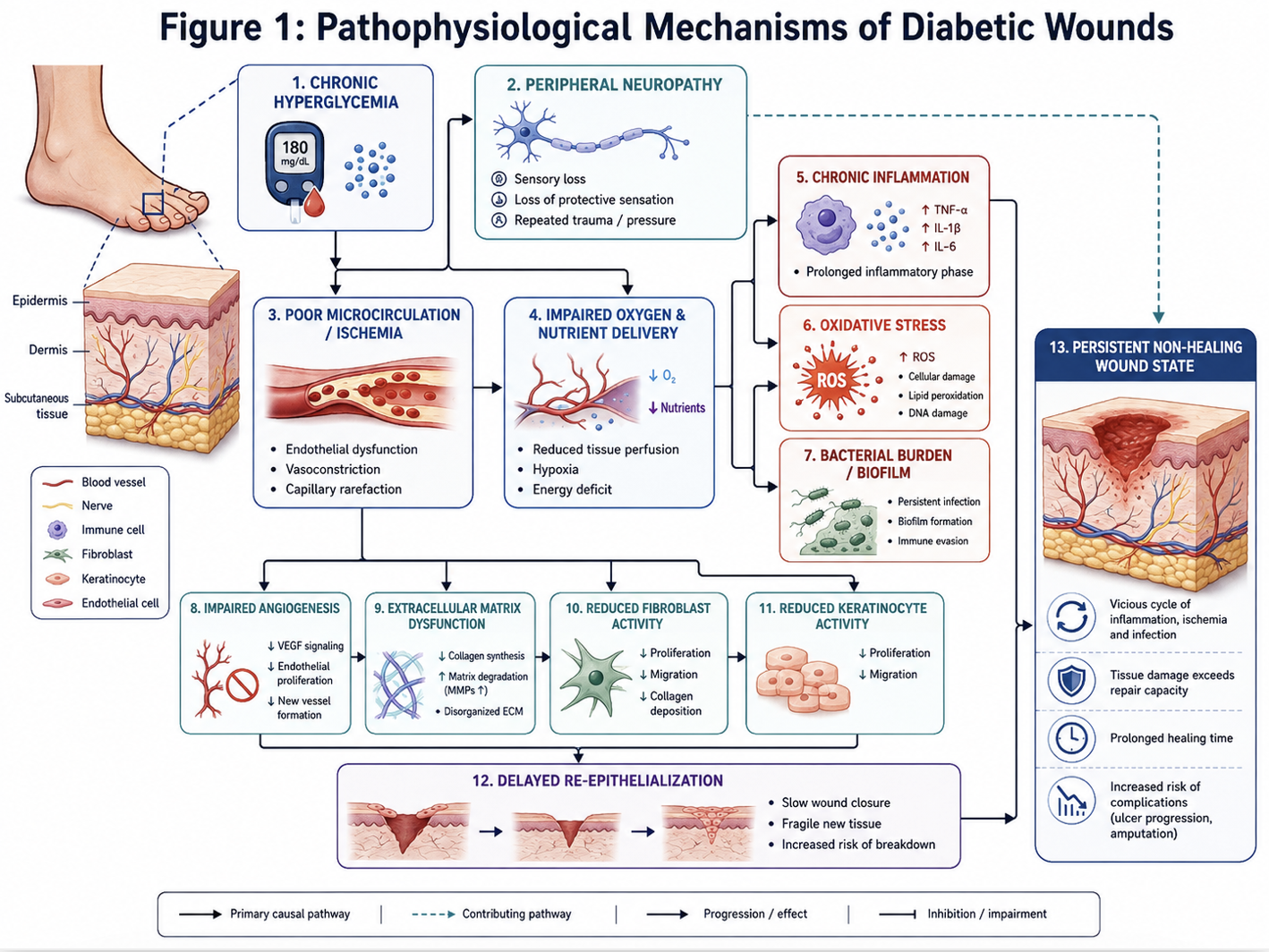
FIGURE 1: UC-MSC REGENERATIVE SUPPORT FOR DIABETES: VASCULAR REPAIR & MICROCIRCULATION (A) The diabetic microenvironment, illustrating systemic complications beyond blood sugar, focusing on chronic endothelial dysfunction, oxidative stress, and delayed repair signaling leading to peripheral risks (e.g., foot ulcers). (B) Transitioning the clinical paradigm from isolated glycemic control to integrated systems-level care aimed at microcirculation and tissue repair. (C) Paracrine mechanisms of Umbilical Cord-derived Mesenchymal Stem Cells (UC-MSCs), highlighting signaling molecules (such as VEGF for angiogenesis), cytokines for immune regulation, and extracellular vesicles for endothelial protection. (D) Chronological framework for physician-guided UC-MSC therapy integrated with wound-risk monitoring and tailored physical activity to enhance perfusion. (E) Essential patient selection guidelines emphasizing medical stability, controlled infection risks, and lifestyle compliance.
The initiation of wound healing requires inflammation. It aids in clearing damaged tissue and kicking the repair process into high gear. But when inflammation becomes chronic, it may be an obstacle to healing.
A chronic wound retains a persistently activated inflammatory state. These may impact fibroblast activity, collagen production, angiogenesis and healing of the skin. Inflammation often combines with oxidative stress, immune dysfunction and more slow cellular repair in diabetes. The intent of the clinical goal is not to eliminate inflammation. This enables the wound to progress from a chronic inflammatory state into a more regenerative phase, restoring balance.
UC-MSC stem cell therapy, or umbilical cord-derived mesenchymal stem cell therapy is a popular research method in regenerative medicine due to its paracrine and immunomodulatory properties. Do not mistake these cells as a definitive resolution for chronic wounds. One way to better understand their potential value is through cellular signaling. UC-MSC stem cell therapy can secrete growth factors, cytokines, extracellular vesicle and other bioactive signals that interact with immune cells as well as endothelial cells, fibroblasts and tissue-resident cells.
This might be relevant for the following biological processes occurring in wound-care: inflammation regulation, pro- and antiangiogenic signaling, extracellular matrix remodeling (collagen), endothelial support communication.
Simply put, UC-MSC stem cell therapy might help by providing support to the wound environment but it will not adequately replace required wound care. It also still needs cleaning, protection (dressings), offloading pressure from the wound and infection control monitoring.
Because a diabetic foot ulcer may be complicated by multiple events happening concurrently, it is typically quite challenging to manage one. The patient may not experience pain well due to neuropathy. Blood supply may be reduced. The immune response could be less strong. There may be no early signs of infection, however the wound can become infected.
That is why care should not be delayed by patients for a long time. From the above we can see that any simple wound on a diabetic foot should not be taken lightly. Stem cell therapy may be an option in certain cases, but only as supportive regenerative care after any overt medical complications have been addressed.
Stem cell therapy in Thailand is quite popular among international patients, who come to the country seeking physician-assisted regenerative medicine and wound care management with laboratory confirmation for treatment planning coordination. The right clinic will not just be the injector It should assess the whole wound picture: glucose levels, blood flow, infection setting (depth in the circulatory system), pressure points or “sacred” and healing means alongside with med history.
Patients should also inquire about the cell source, donor screening process, sterility testing for microbial contamination and endotoxin dose planning with a potency factor potential; method of administration (injection) or topical application(s), breach wound care protocol as follow-up post-application monitoring.
Therefore, stem cell therapy for chronic wounds in Thailand should be thought of as a supportive regenerative platform and not a substitute for standard wound care.
Diabetic foot ulcers and complex chronic wounds; healing is presently defined as the ability to improve blood flow, inflammation balance, control of infection at wound base pressure relief metabolism stability tissue repair signalling.
A more appropriate question would be: not only can stem cells close my wound.
Instead, is it possible for stem cell therapy to be included with a clinician supervised safe wound care program that optimizes blood flow, the inflammatory response and the normal repair process?