Our Services
Others
- DFPP
- Shockwave
- IV Drip

Virtually every person of any age would have at least one disc of degenerative grade, many people will find appreciable pain that can not only be ongoing but often also disabling. Standard management addresses symptoms. In contrast, MSC-based stem cell therapy for IVD targets the underlying causes of disc degeneration that include an inflammatory environment and cellular deficits from within. This article will look at the biology, go over some of the evidence and explain what patients need to know before embarking on this pathway.
The ailments have an ability to subtly transform a life. Back pain, for example. It begins the way it always does; its first morning is waking up stiff, and by its next twinge reaches for something on a shelf later that day and pretty soon it’s an organizing principle of everything else. What to avoid, what you should plan ahead for and what open plans are no longer relevant. Eventually and for many people the diagnosis that is ultimately placed upon that experience is degenerative disc disease a term which rings more solid than what the treatment options usually look like. Rests, physiotherapy visits, pain management solutions, epidural shots and surgery on the farthest line. None of these explain what is really going on in the disc itself.
And that gap is where stem cell therapy has been gaining real scientific interest. Not as an escape route from the hard labour of rehab but rather as a more biogically directed way to right cellular and inflammatory processes that traditional spine care was never designed even for.
The intervertebral disc is a fascinating tissue fibrocartilaginous cushion between the vertebrae, with an outer tough ring (annulus fibrosus) and inner gel like core of jelly-like fluid that makes up the nucleus pulposus. Its performance is contingent upon hydration and cellular health. They contain a unique population of cells nucleus pulposus cells, which maintain the extracellular matrix that contributes to the shock absorption capacity of disc.
They decline with age, mechanical overload and metabolic stress. The matrix they maintain degrades. The disc eventually dehydrates in both water content and height as well as mechanical stability. Importantly, this process does not take place in a biologically neutral setting rather it is mediated and exacerbated by sustained local inflammation. Pro-inflammatory cytokines, including IL-1β, TNF-α and IL−17 to a lesser extent accumulate in the degenerating disc space muscling matrix break down abroad sensitize adjacent nerve roots and lead to pain patterns radiation into limbs burning numbness embodiment of how functionally disabling canine disk disease is.
Mesenchymal stem cells (MSCs) administered into the disc space typically via fluoroscopically guided intradiscal injection largely act through paracrine rather than direct cellular replacement mechanisms. They secrete growth factors such as TGF-β1, GDF-5 and IGF-1 which promote survival of nucleus pulposus cells remnants and production matrix. They produce anti-inflammatory mediators — IL-10, prostaglandin E2 (PGE), and TSG-6 etc. that counteract the degenerative cytokine landscape they have caused. They also modulate the infiltration and behavior of macrophages and immune cells both in damaged disc tissue.
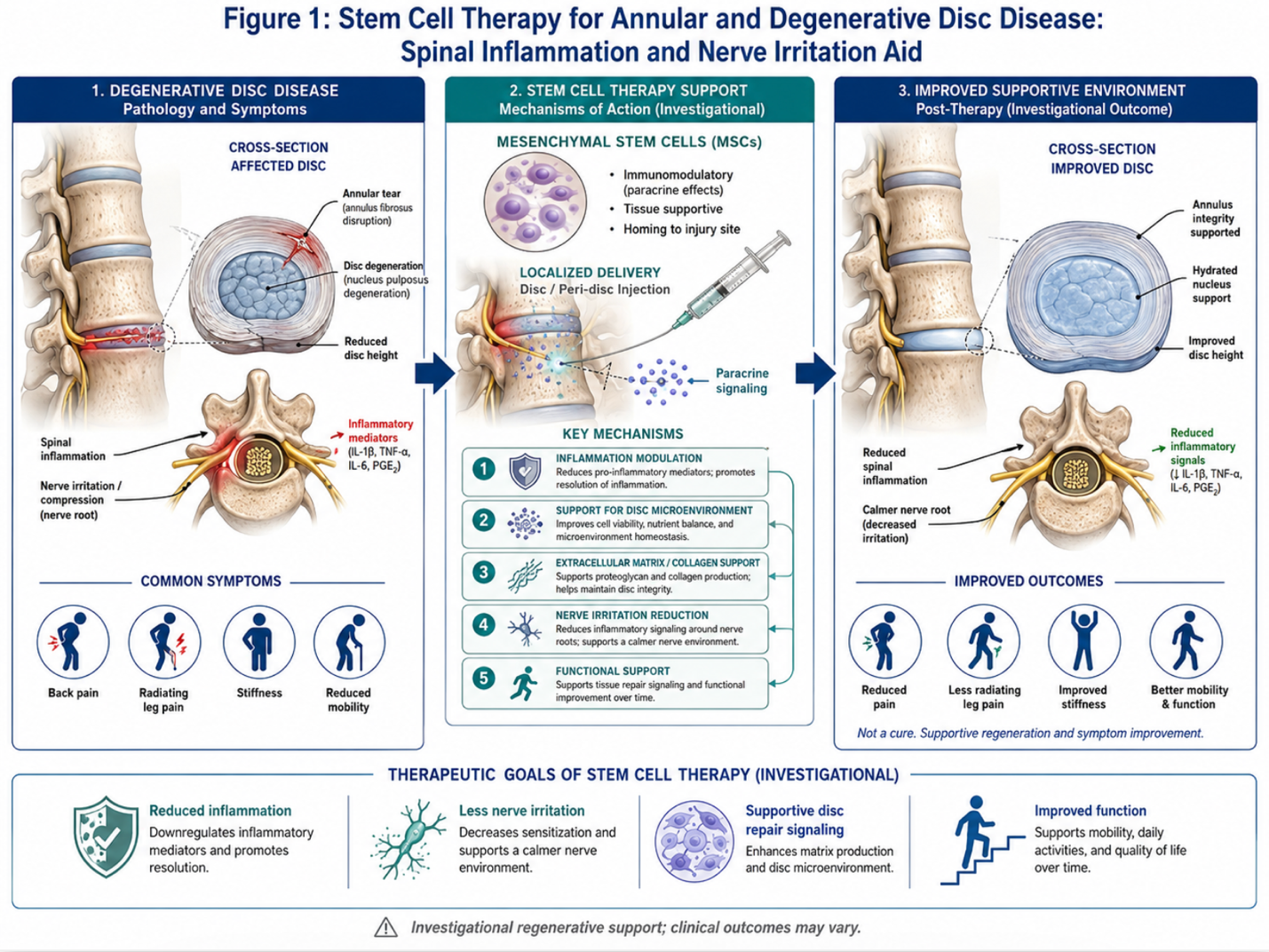
Figure 1: Stem Cell Therapy for Annular and Degenerative Disc Disease: Spinal Inflammation and Nerve Irritation Aid
This approach, in practical terms means MSC-based stem cell therapy is trying to promote the shift of disc away from inflammatory destruction and toward regenerative healing. It does not rebuild a disdegeneration disc. In appropriately selected patients, it may instead slow the path of degeneration, attenuate neuropathic inflammatory signalling driving nerve irritation and open up a time interval during which rehabilitation might yield more substantial structural reward.
Intradiscal MSC-based stem cell therapy also remains at an earlier stage in its clinical evidence base than knee osteoarthritis, but good quality data are emerging. The following study published in Stem Cells Translational Medicine is a milestone; Noriega et al. Furthermore, Chen et al. (2017) found that by twelve months of follow-up patients receiving an allogeneic MSC injection demonstrated statistically significant improvement in pain, disability and disc hydration measured by MRI T2 signal intensity compared to placebo controls; indicating this effect may last beyond one month but warrant further study exploration over longer time periods post-injection for definitive conclusions. These findings have been generally supported in a number of later controlled studies, and the most positive results were consistently found for moderate rather than end stage disc degeneration.
Overall, safety profiles across published studies have been reassuring. Intradiscal injection has some procedural risks mainly infection, and increased degeneration from the procedure itself that experienced interventional spine teams mitigate by patient selection and careful technique. To date, there have been no serious immune-mediated adverse events reported in allogeneic MSC trials for disc disease.
MSC-based stem cell therapy for disc disease most clinically pertinent but least talked about impact: Effect of MSC-based stem cell therapy on nerve root sensitisation Once the pathological process has begun, irritation of nerve fibers contributing to back and leg pain due to degenerative disc disease is not merely a mechanical compression. It is a largely chemical and inflammatory process: mediators of inflammation leaking from the degenerative disc flood nearby nerve roots, lowering their threshold for activation such that even modest degrees of structural compression seen on imaging result in disproportionate pain responses.
Through attenuating the intradiscal inflammatory burden, MSC-based stem cell therapy may alleviate chemical irritation of adjacent neural structures a phenomenon that is independent of realignment in disc height or outward herniation. This mechanism is clinically important for patients whose main presenting complaint is radicular pain rather than axial back pain alone, and several published trials suggest that many have reported improvement in either leg pain or neurological symptoms before any meaningful change from baseline measures on structural imaging.
Pfirrmann grade III or IV disc degeneration that is significant but not complete, and who have failed a sustained course of conservative management and for whom surgical options carry meaningful risk or been declined identify the population most likely to realistically derive clinically relevant benefit from intradiscal MSC-based stem cell therapy. Younger patients with persistent but preserved disc height and evidence of inflammatory markers on advanced MRI usually exhibit the most consistent responses.
This is not just a back pain treatment for anyone. It is an intervention directed against a pathological process in one specific population, and the responsible clinicians administering it will be quick to tell you so. On that evidence lies the hard-won discipline of careful patient selection, which makes for meaningful outcomes in regenerative spine medicine as elsewhere.
Clouet, J., Fusellier, M., Camus, A., Le Visage, C., & Guicheux, J. (2019). Intervertebral disc regeneration: From bench to bedside. Trends in Biotechnology, 37(4), 404–420.
Huang, Y.C., Urban, J.P., & Luk, K.D. (2014). Disc regeneration: Why, when, how. European Spine Journal, 23(Suppl 3), S299–S307.
Noriega, D.C., Ardura, F., Hernández-Ramajo, R., et al. (2017). Intervertebral disc repair by allogeneic mesenchymal bone marrow cells: A randomised controlled trial. Transplantation, 101(8), 1945–1951.
Richardson, S.M., Kalamegam, G., Pushparaj, P.N., et al. (2016). Mesenchymal stem cells in regenerative medicine: Focus on articular cartilage and intervertebral disc regeneration. Methods, 99, 69–80.
Zhao, C.Q., Wang, L.M., Jiang, L.S., & Dai, L.Y. (2007). The cell biology of intervertebral disc aging and degeneration. Ageing Research Reviews, 6(3), 247–261.