Our Services
Others
- DFPP
- Shockwave
- IV Drip

Parkinson’s disease wears people down slowly tremor, stiffness, slower movement, and eventually a lot more than that. Levodopa and other standard medications help manage symptoms, but none of them stop the underlying loss of dopamine-producing neurons. That gap is exactly why interest in Stem Cell IV Therapy Bangkok Thailand clinics offer has grown so much over the past few years, sometimes paired with a filtration procedure called DFPP. Before looking into either one, it’s worth understanding what the research actually shows, and where it still falls short.
Why Parkinson’s Research Has Turned Toward Stem Cells
Parkinson’s isn’t just about dying neurons anymore, at least not in how researchers think about it now. Chronic brain inflammation, oxidative stress, and disruption of the blood-brain barrier all appear to play a role in how the disease progresses. Mesenchymal stem cells (MSCs) are of interest here not because they replace lost dopamine neurons directly, but because of what they secrete once inside the body anti-inflammatory molecules, growth factors, and other signals that may help calm that inflammatory environment and support surviving neurons.
This is genuinely one of the more active areas of Parkinson’s research right now. A Phase 2 randomized, placebo-controlled trial of IV allogeneic bone marrow-derived MSC stem cell therapy, following an earlier Phase 1 study that enrolled 20 patients, found the treatment to be safe, with participants reporting some improvement in both movement symptoms and markers of brain inflammation. Separately, adipose-derived MSC stem cell therapy infusions have been studied in older Parkinson’s patients through expanded access programs, again showing feasibility and safety as the primary findings. Even a 2026 review covering multiple MSC trials in Parkinson’s disease describes the field the same way researchers keep landing on: promising for safety, but still investigational when it comes to actual disease-modifying benefit, with real variability across dosing and a lot of placebo effect showing up in the data.
That’s the honest state of things. No stem cell therapy currently carries FDA approval for treating Parkinson’s disease. What the trials mostly confirm so far is that IV-delivered MSCs appear to be reasonably safe in the short term not that they reliably slow or reverse the disease.
What Actually Happens During Stem Cell IV Therapy
Culture-expanded MSC stem cell therapy, often sourced from umbilical cord tissue or bone marrow, are delivered through a standard intravenous infusion. There’s no surgery involved and no direct injection into brain tissue. Once in the bloodstream, the cells are thought to travel toward areas of inflammation and release the signaling molecules mentioned above. It’s a systemic approach rather than a targeted one, which is part of why researchers describe the mechanism as supportive and immune-modulating rather than regenerative medicine in the literal sense of regrowing neurons.
This is the core of what Stem Cell IV Therapy Bangkok Thailand providers typically offer for Parkinson’s patients an infusion-based protocol, administered under physician supervision, usually alongside a baseline neurological assessment and some form of follow-up.
Where DFPP Fits Into the Picture
DFPP, or Double Filtration Plasmapheresis, is a separate procedure that sometimes gets bundled with stem cell protocols. Rather than adding cells, DFPP filters a patient’s plasma through two sequential filters, removing larger molecules like inflammatory proteins, immune complexes, and pathogenic antibodies while returning the patient’s own blood cells to circulation.
DFPP has solid, published evidence but that evidence sits mostly in autoimmune neurological conditions, such as myasthenia gravis or autoimmune encephalitis, where one identifiable antibody is usually driving the disease. Parkinson’s doesn’t have that same single antibody target. Some clinics propose that reducing overall inflammatory burden through DFPP might create better conditions for the MSC infusion that follows, and the underlying logic isn’t unreasonable given what’s known about neuroinflammation in Parkinson’s. Still, there’s very little direct clinical trial data testing DFPP combined with MSC stem cell therapy specifically in Parkinson’s patients, so the results seen in antibody-driven conditions shouldn’t be assumed to carry over.
Why This Combination Is Offered in Bangkok
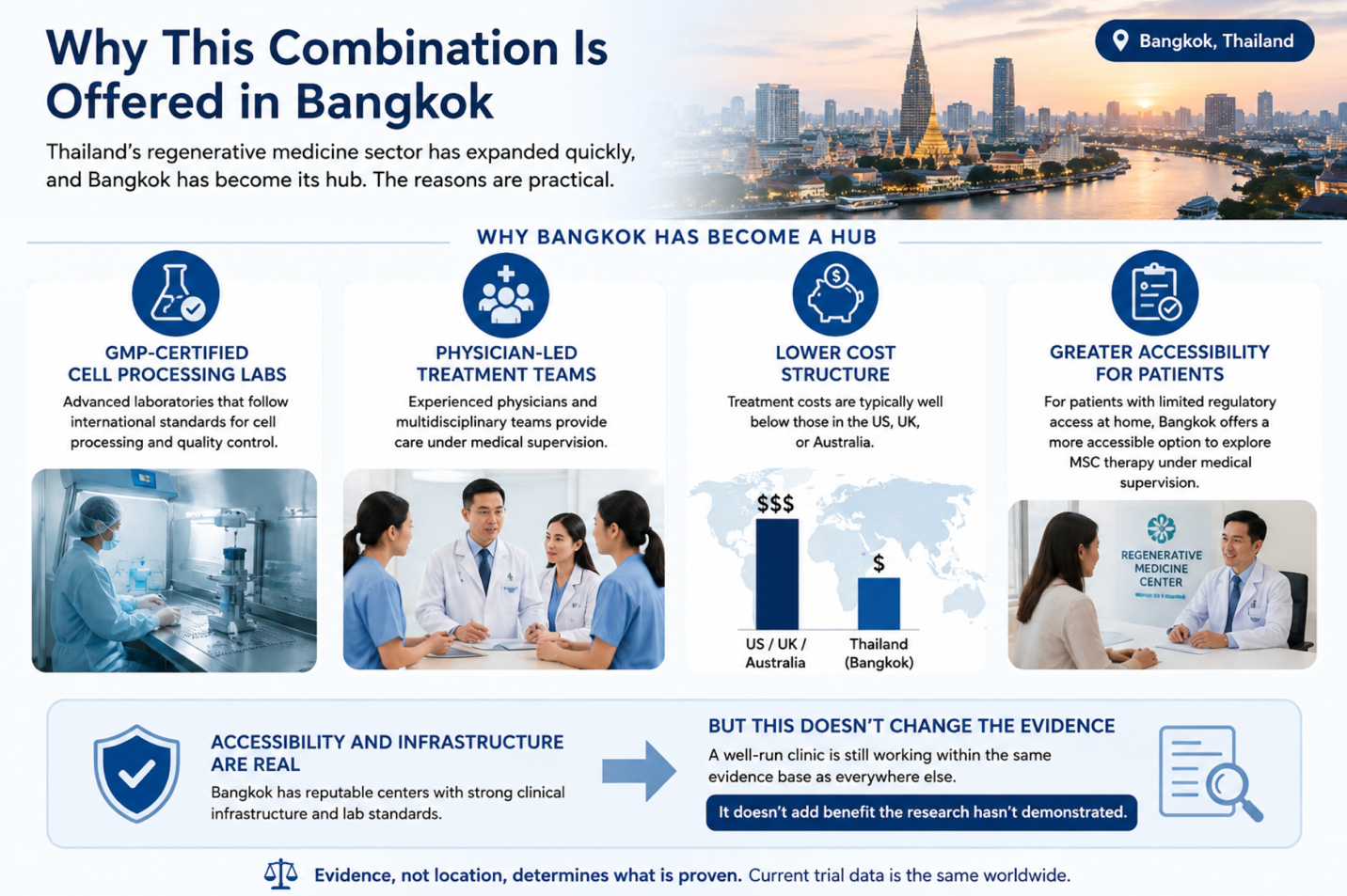
Thailand’s regenerative medicine sector has expanded quickly, and Bangkok has become its hub. The reasons are fairly practical: GMP-certified cell processing labs, physician-led treatment teams, and a cost structure well below what similar procedures run in the US, UK, or Australia. For patients who face limited regulatory access to MSC therapy at home, Stem Cell IV Therapy Bangkok Thailand clinics represent one of the more accessible ways to explore this research area under medical supervision.
That accessibility is real, and so is the clinical infrastructure behind it in reputable centers. But neither one changes what the trial data currently shows. A well-run clinic with good lab standards is still working within the same evidence base as everywhere else it doesn’t add benefit the research hasn’t demonstrated.
Questions Worth Asking Before You Book Anything
What outcome data exists specifically for Parkinson’s patients, from the clinic or from published trials?
How is progress measured, and over what timeframe?
What does combining DFPP with MSC infusion add, specifically, beyond either treatment alone?
Can this be pursued alongside standard Parkinson’s care rather than instead of it?
Is there peer-reviewed data available, separate from patient testimonials?
Any legitimate provider of Stem Cell IV Therapy Bangkok Thailand offers should be able to answer these directly, with real data rather than general reassurance.
The Bottom Line
MSC-based stem cell therapy for Parkinson’s disease is a genuinely active, reasonably safe area of clinical research, but it’s not yet a proven treatment, and it isn’t FDA-approved. DFPP is well-established, just not specifically for Parkinson’s. Combining the two remains a theoretical protocol more than a validated one. None of that erases the value of exploring these options, especially for patients who feel standard medication has hit its limits. It just means that decision deserves the same rigor anywhere else: real data, a qualified neurologist’s input, and clear eyes about what’s proven versus what’s still being studied.
This article is for general informational purposes only and is not medical advice. It does not recommend for or against any specific treatment, dosage, or provider. Anyone considering stem cell therapy or DFPP for Parkinson’s disease should consult a qualified neurologist and review current peer-reviewed evidence before making treatment decisions.
For more infomation you can reach me directly on WhatsApp or Email. Here’s our official link:
WhatsApp :+66982509599
Email : vegastemcell@gmail.com