Our Services
Others
- DFPP
- Shockwave
- IV Drip

Back pain is one of the most common reasons people search for advanced medical care. For some patients, it is a short-term muscle strain. For others, it becomes a long-term condition linked to disc degeneration, facet joint arthritis, nerve irritation, spinal stenosis, inflammation, posture, previous injury, or age-related tissue changes.
This is why many international patients search for stem cell therapy Bangkok and ask whether stem cell therapy is safe for back pain. The question is understandable. Chronic back pain can affect sleep, walking, sitting, work, exercise, travel, and emotional well-being. When medication, physical therapy, steroid injections, or even surgery discussions do not feel like the right answer, patients often begin looking for regenerative medicine options.
The honest answer is careful: stem cell therapy is not a guaranteed cure for back pain. It should not be described as a way to rebuild the spine, reverse disc degeneration, or permanently remove the need for standard spine care. However, mesenchymal stem cells, especially umbilical cord-derived MSCs, or UC-MSC stem cell therapy, are being studied for their potential role in inflammation balance, paracrine signaling, tissue microenvironment support, and pain-related biological pathways.
Back pain is not one condition. It is a symptom with many possible causes. A patient with degenerative disc disease may need a different plan from someone with facet joint arthritis, sacroiliac joint pain, spinal stenosis, muscle imbalance, or nerve root compression.
Common contributors include:
This is why a responsible clinic should review MRI or X-ray findings together with symptoms. Imaging alone does not always explain pain. Some patients have severe-looking MRI changes but mild symptoms. Others have significant pain with only moderate structural findings. The best treatment plan should connect the image, the physical exam, and the patient’s real function.
A common misunderstanding is that stem cell therapy for back pain means cells will become a new disc, new cartilage, or a new spine. That is not the most accurate way to explain UC-MSC stem cell therapy.
UC-MSC stem cell therapy are studied because they release bioactive signals, including cytokines, growth factors, extracellular vesicles, and other paracrine mediators. These signals may influence inflammatory pathways, tissue stress, immune activity, and repair-related communication.
For chronic back pain, stem cell therapy is better described as supportive biological signaling. The goal is to support the tissue environment around irritated joints, discs, ligaments, muscles, and nerves. It is not the same as surgically removing a herniated disc, decompressing a nerve, or correcting spinal instability.
4.How Stem Cell Therapy May Support Spine-Related Pain
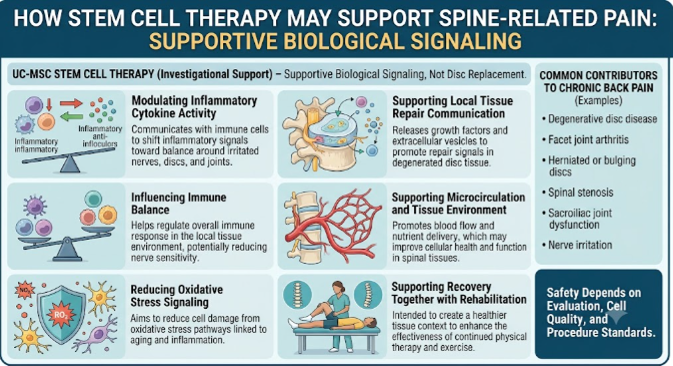
Many spine-related pain conditions involve inflammation. Facet joints can become irritated. Disc degeneration may trigger inflammatory signaling. Nerve roots may become sensitive when compressed or inflamed. Soft tissues around the spine may remain tense and reactive after long periods of pain.
UC-MSC stem cell therapy is being investigated because MSC stem cell therapy may help modulate inflammatory signaling and support a healthier tissue microenvironment. This may be relevant for selected patients with chronic degenerative or inflammatory spine-related pain.
Potential supportive roles under investigation include:
These mechanisms are promising, but they should be explained responsibly. Stem cell therapy should not be marketed as guaranteed disc regeneration or permanent pain removal.
The safer question is not simply, “Are stem cells safe?” A better question is, “Is this treatment appropriate for this patient, using properly screened cells, under medical supervision, with the correct route and follow-up?”
For back pain, safety depends on several factors:
Patients should be cautious of clinics that promise a cure, offer treatment without reviewing imaging, or describe stem cells as risk-free. Regenerative medicine may be minimally invasive, but it is still a medical procedure.
Bangkok is a major destination for international medical care because of experienced physicians, private hospitals, diagnostic imaging access, international patient coordination, and regenerative medicine programs. For patients with chronic back pain, Bangkok may offer coordinated evaluation, blood testing, imaging review, treatment planning, and follow-up communication.
However, location alone is not enough. Patients should choose a clinic based on medical standards, not marketing language.
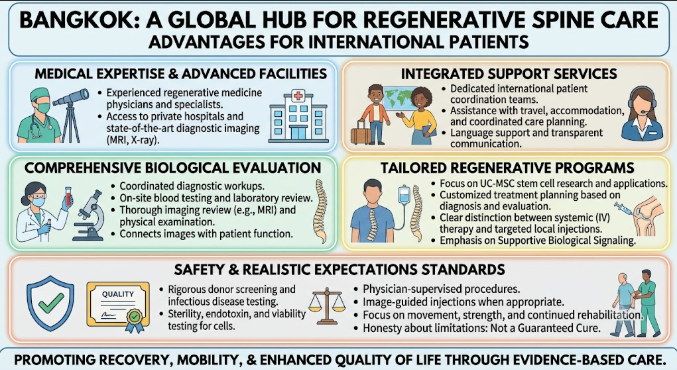
A responsible stem cell therapy Bangkok program should explain:
Some patients receive IV UC-MSC stem cell therapy, while others may be considered for targeted local injections. The route should depend on the condition, symptoms, imaging, safety profile, and physician evaluation.
IV therapy is generally discussed as systemic support. It may be considered when inflammation, immune signaling, or multi-site symptoms are part of the broader treatment discussion.
Local injection is more targeted. It may be considered when a specific joint, disc-related region, facet joint, sacroiliac joint, or soft tissue area is contributing to symptoms. In spine care, local procedures should be performed carefully and, when appropriate, with image guidance.
Neither route should be described as automatically better. The best option depends on the patient.
Before treatment, patients should prepare MRI or X-ray reports, medication history, previous injection history, surgery history, pain pattern, neurological symptoms, and current functional limitations.
Important questions include:
After treatment, progress should be tracked with practical markers such as pain scores, sitting tolerance, walking distance, sleep quality, mobility, medication use, daily activity, and rehabilitation progress.
Back pain recovery is rarely about one procedure alone. Even when regenerative medicine is considered, patients still need posture support, core strengthening, mobility work, ergonomic changes, weight management when relevant, sleep optimization, and guided rehabilitation.
The most realistic goal is not “one injection and the spine is fixed.” A better goal is to support the tissue environment while helping the patient rebuild movement confidence and daily function.
Conclusion: A Better Way to Discuss Stem Cell Therapy Bangkok for Back Pain
Stem cell therapy in Bangkok may be considered by selected patients with chronic back pain, spine degeneration, or inflammatory spine-related symptoms. UC-MSC stem cell therapy are being studied for their potential role in inflammation balance, paracrine signaling, tissue microenvironment support, and recovery communication.
But the treatment should be presented honestly. It is not a guaranteed cure, not a replacement for urgent spine care, and not a promise to rebuild discs or reverse structural narrowing. The most responsible approach is physician-led evaluation, imaging review, safety screening, transparent cell quality standards, realistic expectations, and continued rehabilitation.
For patients asking whether stem cell therapy is safe for back pain, the best answer is this: safety depends on the right patient, the right diagnosis, the right medical team, and the right standards.
FAQ: Stem Cell Therapy Bangkok and Back Pain Safety
No. Stem cell therapy should not be presented as a cure for back pain. It may be explored as supportive care for selected patients, but results vary and depend on diagnosis, severity, imaging findings, and overall health.
Safety depends on proper medical evaluation, cell quality, donor screening, sterility testing, physician supervision, and correct procedure technique. Patients should avoid clinics that promise risk-free or guaranteed results.
UC-MSC stem cell therapy should not be described as guaranteed disc regrowth. They are being studied for supportive signaling, inflammation modulation, and tissue microenvironment support, not simple disc replacement.
Neither is automatically better. IV therapy is generally discussed as systemic support, while local injection is more targeted. The correct route depends on symptoms, imaging, safety profile, and physician review.
Yes. Rehabilitation, strength work, posture training, mobility exercises, and lifestyle adjustments remain important parts of back pain recovery. Stem cell therapy should not replace movement-based care.