Our Services
Others
- DFPP
- Shockwave
- IV Drip

A growing body of research now frames Autism Spectrum Disorder (ASD) as more than a purely behavioral condition many researchers describe it as having neuro-immune dimensions, involving inflammation, oxidative stress, and atypical neural connectivity. That reframing is part of what has pushed mesenchymal stem cell (MSC) research, and specifically umbilical cord–derived MSC (UC-MSC) research, into the autism conversation over the past decade.
This piece walks through what the current literature actually says: the proposed biological mechanisms, what’s been observed in animal models, what early human studies show, and just as importantly where the evidence still falls short of proof.
The Underlying Rationale
The working hypothesis is that if neuroinflammation and immune dysregulation contribute to some ASD symptoms, then a therapy capable of modulating immune activity at a cellular level might offer something conventional symptom-targeted medications don’t. UC-MSC stem cell therapy bangkok thailand is being studied with that goal in mind not to replace behavioral or developmental care, but to explore whether it can influence the underlying biological environment.
It’s worth being direct about where this stands: this is an active, evolving research question, not an established or approved treatment for autism.
Proposed Mechanisms of Action
UC-MSC stem cell therapy bangkok thailand are multipotent cells known for strong paracrine activity they secrete growth factors, cytokines, and extracellular vesicles that can influence nearby cells without necessarily becoming those cells themselves. In the context of autism research, the proposed effects include:
Reducing neuroinflammation and oxidative stress in brain tissue
Supporting neuron protection and new synaptic connections
Shifting immune activity away from a pro-inflammatory state
Supporting microcirculation and oxygen delivery to neural tissue
Researchers theorize that these combined effects could help stabilize neural network function and improve communication between brain regions a mechanism some believe may underlie the behavioral, social, and cognitive changes reported anecdotally after treatment. It’s important to note this remains a proposed mechanism rather than a confirmed one in humans.
What Preclinical (Animal) Studies Show
Animal studies using MSC and UC-MSCs in autism-like models have reported improvements in social behavior, repetitive movement patterns, and learning tasks, alongside normalized brain inflammation markers, reduced microglial overactivation, and more balanced neurotransmitter activity.
These findings offer biological plausibility a reason to keep investigating but animal models of autism are imperfect proxies for the human condition, and results in animal studies don’t reliably predict human outcomes. This is a common and important gap across regenerative medicine research generally, not specific to this therapy.
What Early Human Studies Show
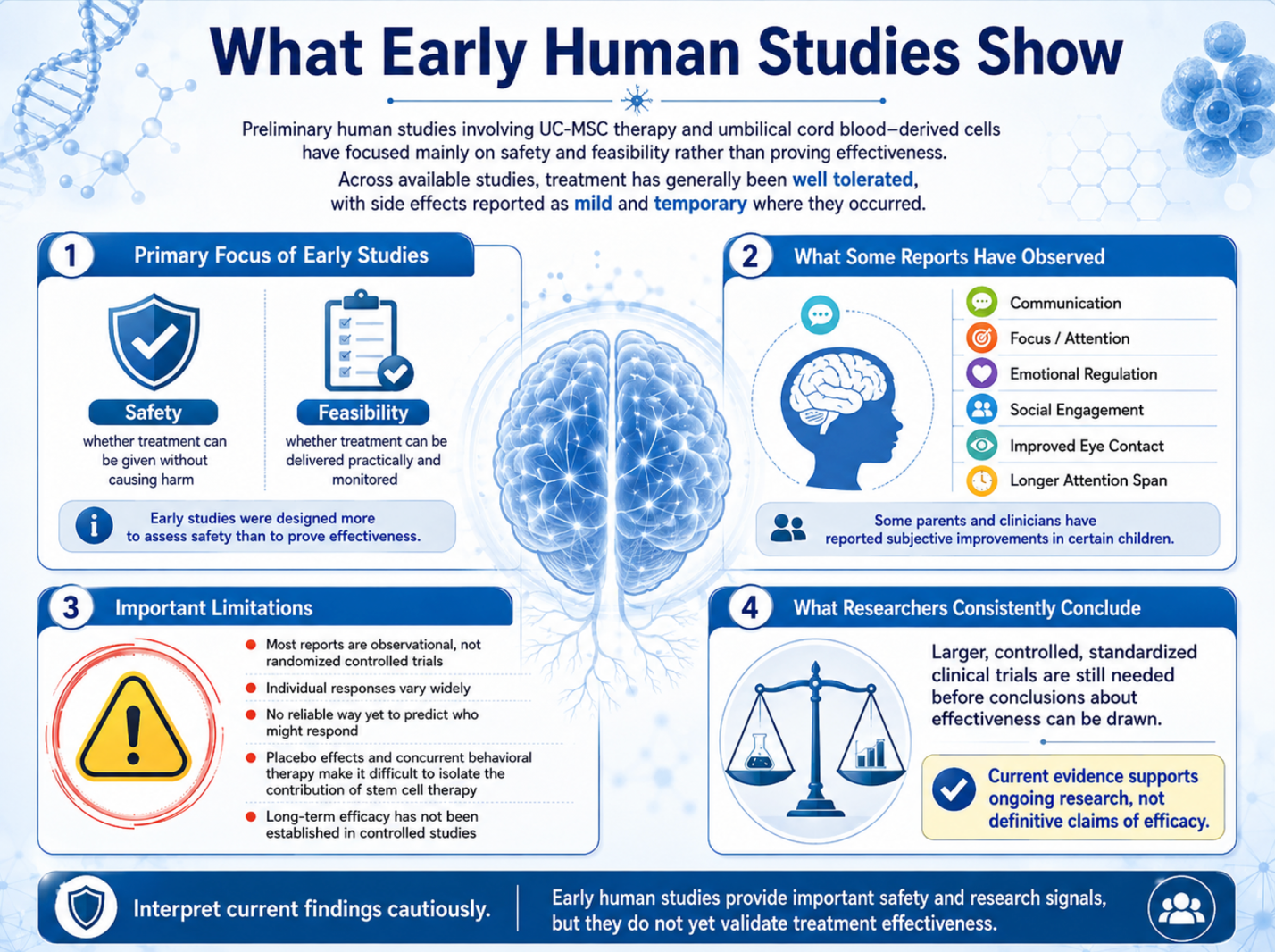
Preliminary human studies involving UC-MSC stem cell therapy bangkok thailand and umbilical cord blood–derived cells have focused mainly on safety and feasibility that is, whether the treatment can be given without causing harm rather than on proving effectiveness. Across the available studies, treatment has generally been well tolerated, with side effects reported as mild and temporary where they occurred.
Some parents and treating clinicians have reported subjective improvements in communication, focus, emotional regulation, and social engagement, along with observations like improved eye contact or longer attention span in some children. These reports are worth taking seriously as signals for further research, but they come with real limitations:
Most reports are observational, not from randomized controlled trials
Individual responses vary widely, and there’s no reliable way yet to predict who might respond
Placebo effects and concurrent behavioral therapy make it difficult to isolate what the stem cell therapy itself contributed
Long-term efficacy has not been established in controlled studies
Researchers in this field are consistent on one point: larger, controlled, standardized clinical trials are still needed before any conclusions about effectiveness can be drawn.
Reported Areas of Interest
When UC-MSC stem cell therapy bangkok thailand has been used alongside not instead of rehabilitation and behavioral programs, some of the areas researchers and families have reported watching for include:
Speech and language comprehension
Mood stability and emotional regulation
Adaptability in social settings
Fine motor coordination
These are areas of ongoing observation and study, not confirmed or guaranteed outcomes of treatment.
Where This Stands Today
No regenerative or stem cell therapy bangkok thailand is currently FDA-approved specifically for the treatment of autism. UC-MSC therapy for ASD remains an investigational approach one with a genuinely interesting scientific rationale and encouraging early observations, but not yet the kind of large-scale, controlled clinical evidence needed to call it an established treatment.
For families evaluating this option, that distinction matters. Established, evidence-based interventions behavioral therapy, speech-language support, and early developmental intervention remain the foundation of autism care today. Regenerative approaches like UC-MSC stem cell therapy bangkok thailand are best understood as a developing area of research to watch, discussed openly with a qualified physician, rather than a replacement for care that already has a strong evidence base.
This article is for general informational purposes and is not medical advice. It does not constitute a recommendation for or against any specific treatment. Anyone considering stem cell therapy for autism should consult a qualified physician and review current peer-reviewed evidence before making decisions.
For more infomation you can reach me directly on WhatsApp or Email. Here’s our official link:
WhatsApp :+66982509599
Email : vegastemcell@gmail.com