Our Services
Others
- DFPP
- Shockwave
- IV Drip

Chronic kidney failure is one of the health conditions that most severely impacts a patient’s quality of life, and it’s also a major contributor to death from cardiovascular complications. While dialysis and kidney transplantation remain the primary treatments that keep patients alive, both approaches come with limitations that simply can’t be ignored. In recent years, the medical field has increasingly turned its attention toward stem cell therapy for kidney failure as a new direction that may help restore kidney function and meaningfully improve quality of life for patients with end-stage kidney disease.
This article walks through the mechanics of chronic kidney disease (CKD), the limitations of conventional treatment, and the growing body of research into mesenchymal stem cells (MSCs) a regenerative approach being studied as a potential new option for kidney patients.
End-Stage Kidney Disease (ESKD) represents the most severe stage of Chronic Kidney Disease (CKD), a point at which the kidneys lose nearly all ability to filter waste and regulate the body’s fluid balance. This condition significantly shortens life expectancy, and in many cases, patients die from cardiovascular complications rather than kidney failure itself.
While dialysis and kidney transplantation are genuinely life-sustaining, both come with real challenges, including:
These limitations are exactly why doctors and researchers have been searching for new approaches that could improve quality of life for patients with chronic kidney failure, without relying solely on dialysis or transplantation.
Mesenchymal Stem Cells (MSCs) are a specialized type of stem cell with strong tissue-regenerating properties. They carry immunomodulatory and anti-inflammatory qualities, and they’re capable of differentiating into a wide range of cell types including kidney cells which makes them one of the most promising candidates for repairing and regenerating damaged kidney tissue.
Stem cell therapy for kidney disease operates through four main mechanisms:
Both preclinical and clinical studies have pointed to the potential of stem cell therapy for kidney disease across several different contexts.
In models of Acute Kidney Injury (AKI), MSCs have shown potential to support tissue regeneration and reduce inflammation, which in turn improves kidney function and survival rates in experimental settings.
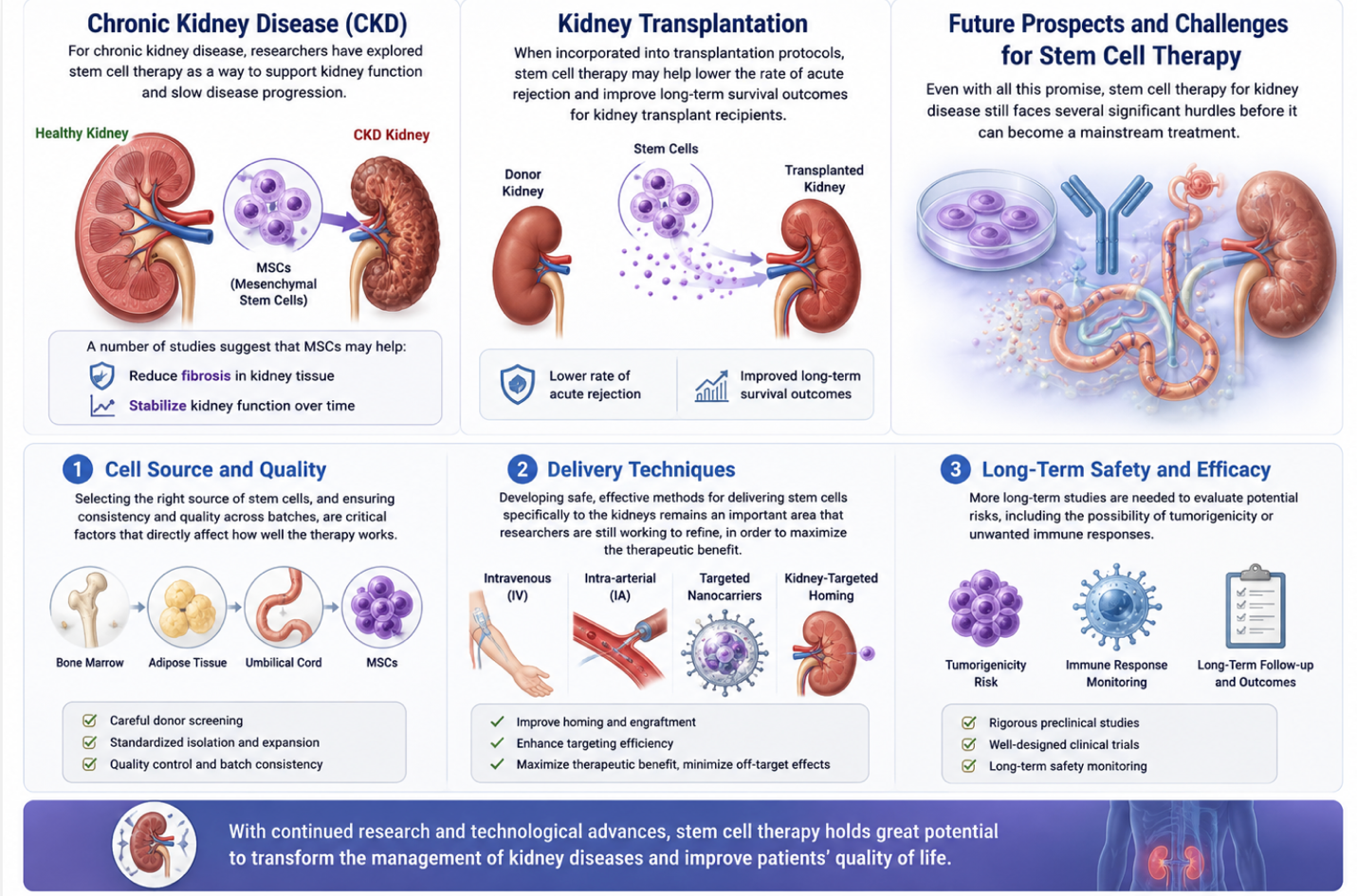
For chronic kidney disease, researchers have explored stem cell therapy as a way to support kidney function and slow disease progression. A number of studies suggest that MSCs may help reduce fibrosis in kidney tissue and help stabilize kidney function over time.
When incorporated into transplantation protocols, stem cell therapy may help lower the rate of acute rejection and improve long-term survival outcomes for kidney transplant recipients.
Even with all this promise, stem cell therapy for kidney disease still faces several significant hurdles before it can become a mainstream treatment.
Selecting the right source of stem cells, and ensuring consistency and quality across batches, are critical factors that directly affect how well the therapy works.
Developing safe, effective methods for delivering stem cells specifically to the kidneys remains an important area that researchers are still working to refine, in order to maximize the therapeutic benefit.
More long-term studies are needed to evaluate potential risks, including the possibility of tumorigenicity or unwanted immune responses.
Stem cell therapy also raises a range of complex ethical and regulatory questions that need to be carefully addressed before it can be adopted more widely in clinical settings for kidney patients.
Treatment for kidney failure without dialysis is a major goal the medical field is actively working toward, and mesenchymal stem cell therapy stands out as one promising direction with the potential to support organ function and slow disease progression.
Researchers are also exploring new drug therapies alongside this. For example, bardoxolone methyl has shown potential to improve eGFR-measured kidney function in clinical trials. That said, this medication is still undergoing clinical testing and has not yet been made widely available. Anyone interested should keep an eye on updates from the relevant clinical trials.
Kidney failure can result from a range of conditions that place ongoing strain on the kidneys over time. The two most common causes are diabetes and high blood pressure. Other contributing factors include heart disease, liver disease, and certain urinary tract infections all of which can also lead to kidney failure over time.
In the early stages of kidney disease, symptoms can be subtle and easy to overlook things like fatigue, nausea, more frequent urination, and shortness of breath.
As the disease progresses, symptoms become more severe, including chest pain, seizures, and a noticeable drop in urine output warning signs that call for immediate medical attention.
Currently, kidney disease has no known cure. The main goals of treatment are to manage symptoms and slow disease progression in order to improve quality of life. Controlling blood pressure and managing related conditions that can accelerate kidney decline — such as diabetes and cardiovascular disease are essential parts of managing kidney disease. Medications like angiotensin receptor blockers are another tool that can help protect the kidneys while also lowering blood pressure.
A substantial body of research supports the potential of MSC-based therapy as a viable treatment approach for kidney disease. MSCs are multipotent cells that can be sourced from a variety of tissues, and compared to dialysis, they may meaningfully improve a patient’s health-related quality of life. MSCs can also be delivered to the kidneys through multiple different methods, which makes this a notably flexible therapeutic approach.
Beyond that, stem cell therapy has also shown promise in improving post-surgical outcomes and increasing survival rates for patients with End-Stage Renal Disease (ESRD) undergoing kidney transplantation. In one trial, MSCs were administered intravenously alongside immunosuppressive medications in patients with end-stage kidney disease, and the results showed encouraging safety and feasibility.
Chronic kidney failure remains a complex medical challenge. While dialysis and kidney transplantation continue to be the primary treatments keeping patients alive, the limitations that come with both approaches are exactly what’s driving research into new alternatives like stem cell therapy. This approach shows real potential for repairing kidney tissue, reducing inflammation, and rebalancing the immune system. That said, it’s still very much in the research phase, and more long-term data on safety and effectiveness is needed. Patients living with kidney failure or chronic kidney disease should consult a nephrology specialist to determine the treatment approach best suited to their individual situation.
This article is provided for general informational purposes only and is not a substitute for professional medical advice. If you’re experiencing symptoms that may be related to kidney disease, please consult a physician for proper diagnosis before choosing any course of treatment.