Our Services
Others
- DFPP
- Shockwave
- IV Drip

Stem cell therapy for hair loss in Thailand is increasingly marketed as a non-surgical way to improve thinning hair, especially in Bangkok. The science is promising, but the marketing often runs ahead of the evidence. “Stem cell” can refer to very different approaches: autologous tissue micrografts, isolated cells, cell-derived conditioned media, or products sold as exosomes. These are not interchangeable, and they do not all have the same evidence, regulation, or risk profile.
For someone comparing a stem cell clinic Bangkok option with conventional hair-loss treatment or surgery, the most useful first question is not “Which treatment grows the most hair?” It is “What exactly is being injected, what evidence supports it, and is it appropriate for my type of hair loss?” That distinction matters because early androgenetic alopecia, alopecia areata, telogen effluvium, and scarring alopecia require very different treatment plans.
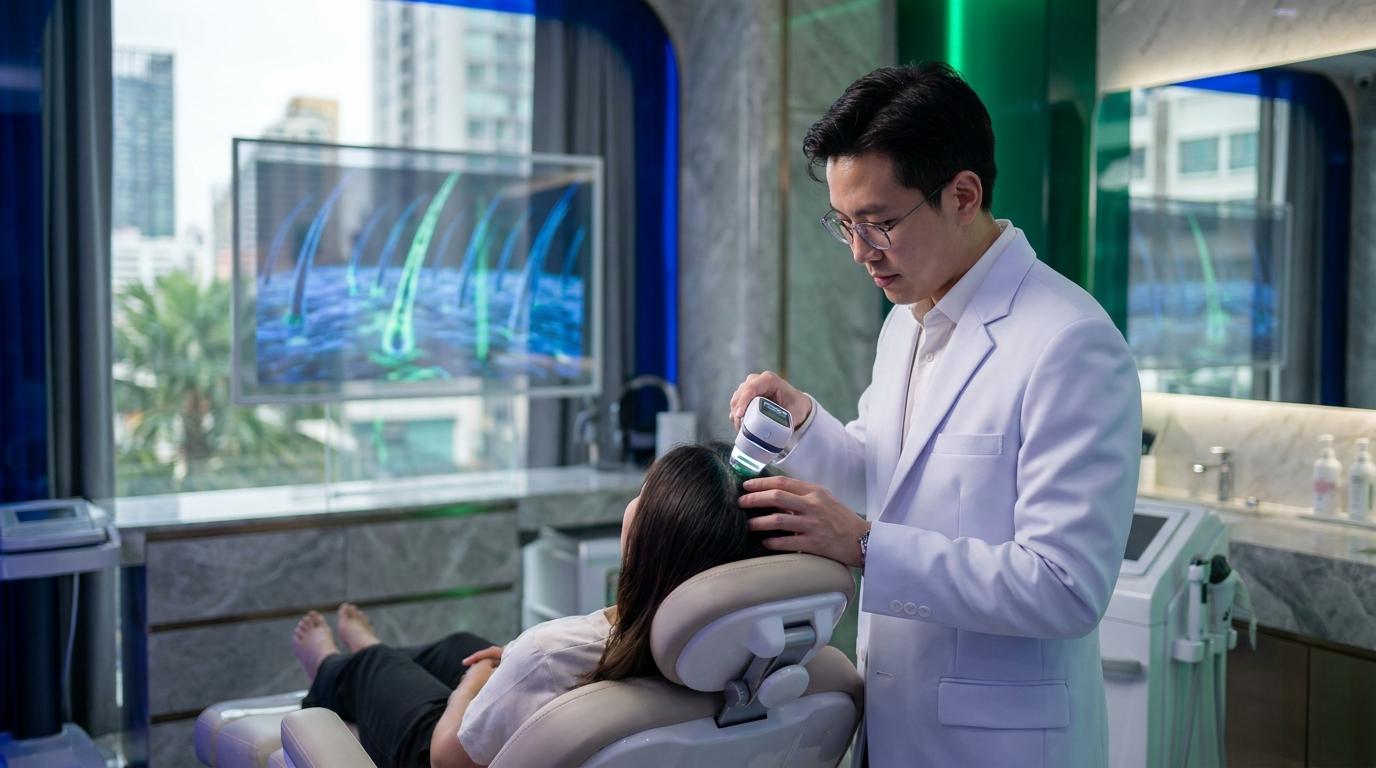
The phrase stem cell therapy for hair loss Thailand can describe several very different procedures. Some clinics use a small sample of the patient’s own scalp tissue and mechanically process it into micrografts that contain cells and growth-signaling components from the hair-follicle environment. Other clinics advertise mesenchymal stem cells, adipose-derived products, conditioned media, or exosomes. A patient should never assume that these treatments are equivalent simply because they are grouped under the same regenerative label.
This distinction is important for both safety and evidence. A 2024 systematic review of randomized controlled trials found that cellular and stem-cell-derived approaches can improve hair regeneration and density in androgenetic alopecia, but the included studies used different cell sources, preparation methods, doses, and follow-up periods. The authors also noted that outcomes may be temporary and that better standardized, longer-term studies are needed.
Sources: 2024 systematic review – autologous stem-cell-derived therapies for androgenetic alopecia | ISSCR Guide to Stem Cell Treatments
Researchers are studying several mechanisms. Hair follicles naturally contain stem and progenitor-cell populations that help regulate the hair cycle. In androgenetic alopecia, follicles progressively miniaturize: the hairs become finer, the growth phase shortens, and scalp coverage declines. Regenerative approaches are designed to influence this local environment through cellular signaling, growth factors, inflammation control, tissue remodeling, and blood-vessel support.
One randomized, evaluator-blinded study of autologous scalp-tissue micrografts reported increased hair count and density in treated areas compared with placebo at 58 weeks. That result is encouraging, but it does not establish that every product marketed as a “stem cell hair treatment Thailand” will behave the same way. The exact tissue source, processing method, cell composition, injection technique, and patient selection all matter.
Sources: Autologous scalp micrograft study – PubMed | Systematic review of human stem-cell use in androgenetic alopecia
Androgenetic alopecia male or female pattern hair loss is the condition most often discussed in research on regenerative hair therapy. The best candidates in published studies generally still have existing follicles that are thinning or miniaturized. A smooth, scarred, long-bald area is less likely to respond because regenerative treatment cannot simply create a new supply of transplantable follicles where they are no longer present.
A dermatologist should first confirm the diagnosis with history, scalp examination, dermoscopy, and, when needed, laboratory testing or biopsy. Conventional treatments remain important. The American Academy of Dermatology lists options such as minoxidil, prescription medications in suitable patients, PRP, and hair transplantation. Regenerative therapy should therefore be considered as a possible adjunct or alternative in selected cases—not as a reason to skip diagnosis or proven treatment.
Sources: American Academy of Dermatology – hair loss diagnosis and treatment | AAD – male pattern hair loss treatment
Alopecia areata is different from pattern hair loss. It is an autoimmune disease in which the immune system attacks the hair follicle, often producing sharply defined patches of hair loss. Stem cell-based approaches are being researched for alopecia areata, but they are not established first-line therapy. A 2026 review described early clinical signals as promising while emphasizing that long-term safety and efficacy still require much stronger evaluation.
Anyone searching for stem cell treatment for alopecia areata Thailand should therefore be especially cautious about promises of a cure. Patchy loss, eyebrow loss, sudden shedding, scalp inflammation, or scarring should trigger a proper dermatology work-up because approved or guideline-supported immune-directed treatments may be more appropriate.
Sources: 2026 review – stem cell-based therapies for alopecia areata | American Academy of Dermatology – hair loss diagnosis and treatment
No stem cell therapy is FDA-approved in the United States specifically for hair loss. The U.S. FDA states that the stem cell products it has approved are blood-forming stem cells derived from umbilical cord blood for disorders affecting the hematopoietic system. The agency also states that there are currently no FDA-approved exosome products.
This point is often blurred in advertising. A clinic may say that a processing device is FDA-cleared, that a company is FDA-registered, or that a procedure uses “FDA-compliant” equipment. None of those statements automatically means the biological treatment itself is FDA-approved for hair restoration. If a Bangkok clinic uses the phrase “FDA approved,” ask the doctor to identify exactly what is approved: the device, the laboratory, the product, or the hair-loss indication.
Sources: U.S. FDA – Consumer Alert on Regenerative Medicine Products | U.S. FDA – Important Patient and Consumer Information on Regenerative Medicine Therapies
Thailand is actively developing its regulatory and manufacturing framework for Advanced Therapy Medicinal Products, or ATMPs. The Thai FDA publishes guidance for cell-therapy products, approved research, manufacturing requirements, and related ATMP pathways. In 2026, the agency also described ongoing efforts to strengthen domestic ATMP research, registration, and manufacturing to international standards.
That is a positive sign for regenerative medicine hair loss Thailand patients, but it should not be interpreted as blanket approval of every clinic treatment advertised as stem cell therapy. The relevant question is the status of the exact cell or tissue product and how it is prepared and used. Before treatment, ask the clinic for the scientific name and source of the material, whether it is autologous or donor-derived, where it is processed, and what Thai regulatory or ethics approvals apply to that specific procedure.
Sources: Thai FDA – ATMP regulatory portal | Thai FDA – Road to ATMPs, March 2026
| Question | Stem cell / regenerative therapy | Hair transplant |
| What it does | Attempts to support or stimulate existing follicles through regenerative signaling | Moves healthy follicular units from a donor area to thinning or bald areas |
| Best suited to | Selected patients with existing miniaturized follicles; evidence still evolving | Patients with stable pattern hair loss and an adequate donor area |
| Creates new follicles? | Not proven to create an unlimited new supply of follicles | No; it redistributes existing follicles |
| Downtime | Usually limited, depending on technique | More recovery than injections; varies by FUE/FUT and case size |
| Evidence status | Promising but heterogeneous and not standardized | Established surgical approach for appropriate candidates |
| Long-term issue | Results may fade and the underlying hair-loss process can continue | Transplanted follicles can be durable, but native non-transplanted hair may continue thinning |
The search phrase “stem cell hair transplant Thailand” can be misleading because regenerative injections and hair transplantation are not the same procedure. A transplant physically relocates follicular units. Stem cell or cell-derived therapy attempts to improve the function of follicles that are already present. In some patients, regenerative treatment may be considered before surgery or as an adjunct around a broader medical plan, but it should not be presented as a guaranteed substitute for transplantation when a bald area lacks usable follicles.
Sources: American Academy of Dermatology – hair transplant and other procedures | 2024 systematic review – stem-cell-derived therapies for androgenetic alopecia
The side effects of stem cell hair therapy depend on what is actually being administered. Autologous scalp procedures can involve temporary pain, tenderness, swelling, pinpoint bleeding, bruising, or irritation at donor and injection sites. Any procedure that breaks the skin also carries infection risk. If cells or cell-derived products are processed outside the body, sterility, contamination control, traceability, and handling become more important.
The risk profile becomes less predictable when a clinic uses unapproved donor cells, poorly characterized cell products, or exosomes. The U.S. FDA has reported serious harms associated with unapproved regenerative medicine products, including infections, inflammatory or immune reactions, tumor formation, and other complications. Those warnings are not specific to scalp injections, but they illustrate why the exact product and its manufacturing controls matter more than the word “regenerative” on a brochure.
Sources: U.S. FDA – regenerative medicine safety information | U.S. FDA – 2026 warning on unapproved human cell/tissue products
There is no good evidence that current stem cell therapy permanently cures androgenetic alopecia. Some studies report improvements in hair count or density after treatment, but follow-up is limited and protocols are not standardized. The underlying genetic and hormonal drivers of pattern hair loss do not disappear simply because the scalp receives a regenerative procedure.
This is why a responsible clinic should discuss maintenance rather than promise permanence. Depending on the diagnosis, that may include topical or oral therapy, treatment of nutritional or endocrine problems, PRP, repeat regenerative sessions, or eventually hair transplantation. A claim such as “one stem cell session permanently stops baldness” should be treated as a red flag.
Sources: 2024 systematic review – long-term outcomes remain an area for further research | AAD – genetic hair loss requires ongoing management
There is no official national price for stem cell hair treatment in Thailand, and advertised fees are difficult to compare because clinics may be selling completely different products under similar names. Publicly listed Bangkok examples in 2026 include a clinic advertising “stem cell for hair” at 100,000 THB, while a Bangkok hair-loss listing on What Clinic shows autologous micrografting at roughly 39,990 to 59,990 THB. These figures are examples of advertised pricing—not a market average, recommendation, or evidence that either treatment is regulator-approved for hair loss.
When comparing stem cell therapy Bangkok cost, ask for a written quote that separates the consultation, scalp imaging, blood tests, tissue collection, cell or tissue processing, injections, medications, follow-up, and any repeat sessions. A cheaper quote may simply be a different treatment. The cost is only comparable once you know the source and quantity of the biological material and the exact protocol being offered.
Sources: Public Bangkok clinic price list – advertised “stem cell for hair” price | What Clinic Bangkok listing – autologous micrografting price example
The “best stem cell clinic Thailand” is not necessarily the clinic with the most dramatic before-and-after gallery. A better test is whether the medical team can explain the treatment in precise, verifiable terms. This is especially important when comparing a stem cell clinic Bangkok hair program with conventional dermatology or transplant centers.
Sources: ISSCR – patient guidance for evaluating stem cell treatments | Thai FDA – ATMP information and regulatory pathways
Thailand attracts international patients because Bangkok combines dermatology, cosmetic medicine, hair transplantation, private hospitals, and a growing regenerative-medicine sector in one city. The country is also investing in ATMP infrastructure and regulatory capacity. For patients already considering medical travel, that can make consultation and treatment logistics relatively convenient.
The advantage, however, is choice not a guarantee that every regenerative procedure is validated. The safest way to approach hair restoration stem cell therapy Thailand is to use the same standard you would use in the United States, Europe, Japan, or elsewhere: verify the diagnosis, the exact biological product, the clinician’s credentials, the evidence, the regulatory status, and the plan for complications before paying a deposit.
Sources: Thai FDA – development of Thailand’s ATMP framework | Thai FDA – ATMP portal
No. The U.S. FDA has not approved a stem cell therapy specifically for hair loss. Be careful with wording such as “FDA registered,” “FDA-cleared device,” or “FDA-compliant,” because those claims do not mean the stem cell treatment itself is approved for alopecia.
Sources: U.S. FDA – Consumer Alert on Regenerative Medicine Products
The goal is to support existing follicles through regenerative signaling, growth factors, tissue remodeling, inflammation control, and blood-vessel support. Small clinical studies have reported improvements in hair density, particularly in androgenetic alopecia, but the methods are not standardized and results cannot be assumed for every product.
Sources: Autologous scalp micrograft study – PubMed
Neither is automatically “better.” A hair transplant is an established surgical method that moves follicles from a donor area. Regenerative therapy is less invasive and may be considered when miniaturized follicles are still present, but the evidence is less mature. Advanced bald areas may require transplantation because injections cannot reliably create a new donor supply.
Possible effects include temporary soreness, swelling, bruising, bleeding, and infection at injection or donor sites. Risks can be greater or less predictable with poorly characterized, unapproved, or donor-derived biological products. Ask exactly what is being used and how it is processed.
Permanent regrowth has not been established. Pattern hair loss is progressive, and published regenerative studies do not prove a lifelong cure. Even when density improves, ongoing medical management or repeat treatment may be needed.
Public Bangkok prices vary by technique. Current advertised examples range from roughly 40,000–60,000 THB for autologous micrografting listings to around 100,000 THB for a clinic-marketed stem cell hair service. Treat these as examples only and compare the actual protocol, not just the price.
Stem cell therapy for hair loss in Thailand is a legitimate area of clinical research, but it is still a field where terminology can be more confident than the evidence. The most credible approach is to separate established facts from marketing: regenerative treatments may improve hair density in selected patients with living, miniaturized follicles; they are not proven to create unlimited new follicles, permanently cure genetic baldness, or replace a hair transplant in every case.
If you are considering a stem cell clinic Bangkok consultation, arrive with a clear diagnosis and ask about the exact product, regulatory status, processing method, published evidence, total cost, and follow-up. A credible clinic should answer those questions clearly and document claims such as “FDA approved.” For international patients, the decision should remain medical first and travel second: choose the treatment because it fits your diagnosis, not simply because it is available.