Our Services
Others
- DFPP
- Shockwave
- IV Drip

Chronic wounds are those that do not heal within the expected healing time. These wounds can remain open for weeks or months and are often associated with insufficient blood flow, diabetes, inflammation, increased risk of infection, compromised tissue oxygenation, and diminished capacity for flash repair.
These include diabetic foot ulcers, pressure ulcers, vascular ulcers, and soft-tissue wounds with delayed healing. Chronic wounds are seldom attributed to a single problem. These frequently involve a combination of poor perfusion, chronic inflammation, immune disruption, metabolic imbalance, increased infection risk, and tissue damage.
The care of chronic wounds is therefore normally multidisciplinary because of this complexity. Standard wound care is fundamental and is composed of the following interventions: cleansing the wound, debridement (removal of nonviable tissue) or surgical intervention if needed, infection control, offloading pressures from diabetic ulcers through foot orthotics (special shoe inserts) as well as treating metabolic disorders (health conditions like diabetes that impact metabolism) affecting proper healing, vascular assessment and blood volume maintenance, dressing management (moisture retention as needed) to ensure nutrition support in line with the patient needs, followed by regular medical visits depending on an evaluation plan.
Healthy angiogenesis is essential for wound healing, as it provides blood supply and oxygen delivery to the tissue while maintaining immune homeostasis and controlling inflammation. Inflammation is required at an early stage of wound healing to protect the wound and initiate repair processes.
In contrast, chronic or excessive inflammation may delay tissue recovery. Chronic inflammation-induced damage to the wound microenvironment can establish a vicious cycle of impaired neovascularization and collagen deposition, and perpetuates oxidative stress and mechanical stress, which disrupt positive healing signals.
Another big obstacle is circulation problems. When blood flow is restricted, the wound is starved of oxygen and nutrients. This can limit tissue repair capacity, hinder infection control, and alter the timing of wound closure. This is one of the reasons why DFPP and stem cell therapy for chronic wounds may be part of a supportive regenerative medicine treatment discussion.
Doubly Filtered Plasma-Pheresis (DFPP) is an enhanced blood purification process. It isolates plasma from blood cells and filters larger and selected plasma components before returning the filtered plasma, along with blood cells, to the body.
DFPP may contribute by minimizing some circulating elements, such as inflammatory mediators, immune complexes, abnormal plasma proteins, some lipid-associated particles, and other high-molecular-weight matter. In chronic wound care, the aim of DFPP is not to directly heal the wound. Instead, DFPP might eliminate systemic loads that worsen inflammation, vascular burden, microcirculatory dysfunction, and an adverse internal environment.
Aulogenic mesenchymal stem cell (MSC) therapies are a promising area of investigational research with several such therapies currently in advanced clinical trials for the treatment of chronic wounds and ulcers. With these, DFPP may be useful, as it collects many other cell types and, interestingly, even hematopoietic stem cells, which express CD34 (see below) and are known to regenerate damaged tissues.
Chronic inflammation can create an environment less favorable for wound healing. Select inflammatory and immune-related plasma factors may benefit from DFPP, which could help stabilize the internal environment before or during regenerative treatment.
Deficient blood supply and low tissue oxygenation are common in cases of chronic wounds. DFPP might promote adequate circulation in select patients by filtering specific plasma components that may contribute to vascular stress or plasma viscosity.
Inflammation, dyslipidemia, oxidative stress, and immune-related burden can disturb endothelial function. Maintaining a more even vascular environment may support the conditions for oxygen delivery and tissue repair.
Stem Cell Therapies in Chronic Wounds. Mesenchymal stem cells (MSCs), including umbilical cord-derived MSCs, are the most widely studied tissue source for stem cell therapy in chronic wounds. What is driving this interest in these alternative sources of cells, as opposed to just using them for pure tissue replacement, is their signaling effects – and ligands released by stem cells or stem cell-like progenitor cells.
MSCs may secrete a variety of bioactive molecules that modulate both inflammation and immune responses by interacting with multiple pathways, particularly those involving blood vessels and the wound microenvironment. Stem cell-associated signaling in wound support would likely modulate inflammatory balance, angiogenesis-related crosstalk, tissue repair signaling, and ECM remodeling.
The danger is that one does not promote stem cell therapy as a potential miracle cure for wounds. Wound healing response (severity and infection control – magnitudes of blood supply, control of diabetes, availability of nutrition and mobility, status of other co-morbidities), immune status, and comorbidity status are also important in determining the outcome.
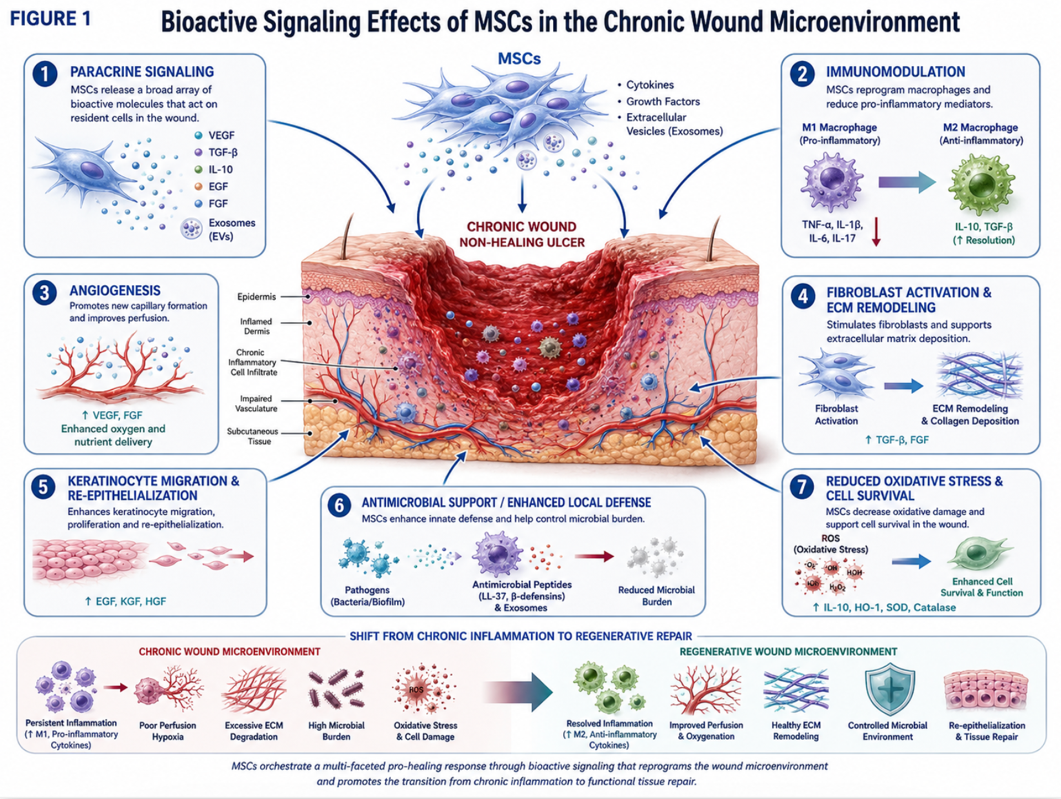
Preparation and biological signaling provide the rationale for integrating DFPP and stem cell therapy in chronic wound management. DFPP may reduce certain plasma levels of inflammatory, immune-related, and lipid markers, helping the body prepare. Stem cell therapy might then elicit reparative signaling, thereby enhancing tissue repair communication, promoting angiogenesis, and providing an improved wound microenvironment.
A simple observation is that DFPP may help prime the microenvironment (prepare the local wound scene for treatment), while stem cell therapy can modulate repair-associated signaling (influence the signals that trigger repair processes). This joint method must be utilized only in affected individuals under clinical supervision.
In selected patients, DFPP and stem cell therapy for chronic wounds may help balance inflammation and promote circulation. By modulating factors associated with inflammation, immune burden, stress on lipid metabolism, and strain on vascular beds, DFPP may ameliorate specific plasma components. Stem cell therapy may assist in signaling to support repair, angiogenesis communication, and the local wound microenvironment.
In combination, they may be used as part of a medically directed regenerative care plan encompassing chronic wounds, diabetic foot ulcers, and soft-tissue problems associated with vascular insufficiency. Nonetheless, this screening, along with realistic expectations, infection control measures, vascular evaluation, and guidelines for standard wound care, is still essential.