Our Services
Others
- DFPP
- Shockwave
- IV Drip

1.Stem Cell Therapy for Autism in Thailand: A Responsible Guide for Families Exploring Regenerative Medicine
Autism Spectrum Disorder, or ASD, is not one single pattern of behavior. It is a lifelong neurodevelopmental condition that can affect communication, social interaction, sensory processing, emotional regulation, learning style, sleep, feeding, attention, and daily routines. Some children need only light support. Others require long-term speech therapy, occupational therapy, behavioral intervention, school support, and family-centered care.
This is why many parents search for stem cell therapy for autism in Thailand. They are often not looking for a miracle. They are looking for another possible layer of support when progress feels slow, daily routines are difficult, or conventional therapies alone do not seem to address the biological questions behind autism.
A responsible discussion must begin with honesty. Stem cell therapy is not a cure for autism. It should not replace speech therapy, occupational therapy, behavioral therapy, educational planning, developmental care, or pediatric neurology support. At the same time, umbilical cord-derived mesenchymal stem cells, also known as UC-MSC Stem cell therapy, are being studied because of their potential effects on immune signaling, inflammation balance, and cell-to-cell communication.
Autism care is often focused on communication, learning, behavior, sensory needs, and independence. These areas remain essential. Evidence-based interventions such as behavioral therapy, speech therapy, occupational therapy, parent coaching, and structured educational support are still the foundation of care.
However, research has also explored biological patterns in some individuals with ASD, including immune dysregulation, neuroinflammation, oxidative stress, mitochondrial differences, gut-immune interaction, and altered neural connectivity. These findings do not apply equally to every child, but they help explain why families are interested in regenerative medicine.
The goal is not to “change who the child is.” The more appropriate goal is to ask whether supportive biological care may help selected children function more comfortably, participate more consistently in therapy, and improve quality of life.
3.What UC-MSC Stem Cell Are and Why They Are Being Studied
Stem cell therapy are mesenchymal stem cells derived from donated umbilical cord tissue after healthy childbirth. In regenerative medicine, these cells are studied because they can release bioactive signals, including cytokines, growth factors, extracellular vesicles, and other paracrine mediators.
For autism, the most responsible explanation is not that Stem cell therapy “become new brain cells” or “rewire the brain.” That type of language is misleading.
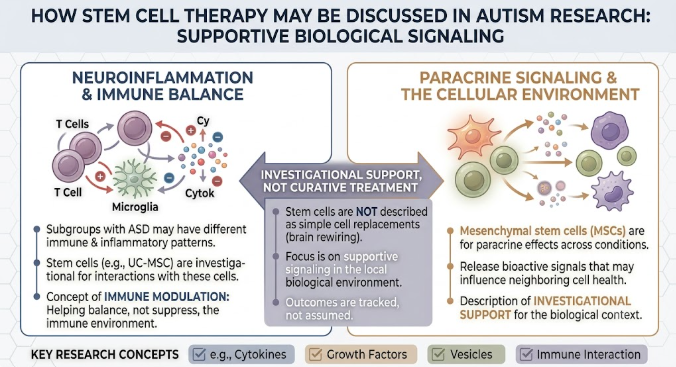
A more accurate explanation is supportive biological signaling. Researchers are studying whether stem cell therapy may influence inflammatory pathways, immune balance, oxidative stress, and the cellular environment that may affect neurological function in selected patients.
Some autism research has reported immune and inflammatory differences in certain subgroups of individuals with ASD. This does not mean autism is simply an inflammatory disease. It means immune signaling may be one part of a much larger picture.
Stem cell therapy therapies are being investigated because Stem cell therapy may interact with immune cells and inflammatory cytokines. The aim is not immune suppression. The concept is immune modulation, or helping the immune environment become more balanced.
Stem cell therapy may release signaling molecules that influence surrounding cells. These paracrine effects are one reason Stem cell therapy are being studied across neurological, autoimmune, and inflammatory conditions.
In autism, this is still an evolving area. The best way to describe it is as investigational support for the biological environment, not as a guaranteed treatment for speech, behavior, eye contact, attention, or social interaction.
5.Thailand as a Destination for Regenerative Medicine
Thailand has become a destination for medical travel because of its healthcare infrastructure, international patient services, experienced physicians, and access to regenerative medicine programs. For families considering autism support, Thailand may also offer coordinated care planning, treatment scheduling, laboratory review, and follow-up communication.
However, choosing a clinic should never be based only on travel convenience or price. Families should ask how the cells are sourced, how donors are screened, how sterility and viability are tested, who supervises treatment, and how expectations are explained before therapy.
Before considering stem cell therapy for autism, parents should ask:
A responsible clinic should be willing to explain limitations clearly. Families should be cautious of any provider that promises a cure, guaranteed speech improvement, permanent behavioral change, or a specific success rate.
If a family proceeds with supportive regenerative care, outcomes should be tracked carefully over time. Useful areas to monitor may include:
These should be evaluated alongside ongoing therapy, education, and home support. Autism progress is rarely explained by one intervention alone.
The strongest autism care plans are built around consistency. Speech therapy, occupational therapy, behavioral intervention, parent training, school planning, sensory support, nutrition when needed, sleep support, and medical review should continue.
Stem cell therapy, if considered, should be positioned as an additional investigational support option. It should not be used as a reason to stop proven developmental therapies.
Stem cell therapy for autism in Thailand should be discussed with both openness and caution. Stem cell therapy is being studied because of its possible role in immune signaling, inflammation balance, and paracrine communication. But it is not a cure for autism and should not be presented as a guaranteed developmental breakthrough.
For families, the best approach is not to chase dramatic promises. It is to choose a clinic that reviews the child carefully, communicates honestly, explains safety standards, respects standard autism care, and focuses on realistic goals.
Autism support should protect the child’s dignity, comfort, development, and long-term quality of life. Regenerative medicine may become one supportive area of research, but responsible care still begins with evidence, transparency, and the child’s individual needs.
FAQ: Stem Cell Therapy for Autism in Thailand
No. Stem cell therapy should not be presented as a cure for autism. Current research is still developing, and outcomes can vary between children.
Stem cell therapy are studied because they may release signaling molecules that influence immune balance, inflammation, oxidative stress, and the cellular environment. This is investigational and not the same as replacing brain cells.
No. Speech therapy, occupational therapy, behavioral therapy, school support, and family-centered care should continue. Stem cell therapy should not replace standard autism interventions.
Parents should ask about cell source, donor screening, sterility testing, viability, endotoxin testing, physician supervision, treatment route, safety monitoring, and realistic expectations.
Progress should be tracked through practical daily-life measures such as sleep, attention, sensory tolerance, communication attempts, emotional regulation, therapy participation, and family-reported quality of life.