Our Services
Others
- DFPP
- Shockwave
- IV Drip

Somewhere around your 30s, nearly every system in your body starts quietly downshifting and one of the most important ones barely gets talked about: your own stem cells. Stem cell aging shapes how fast you heal, how well you bounce back from inflammation, and how your joints, brain, skin, and organs hold up over the decades. It’s a big part of why so many adults start looking into stem cell therapy in Thailand, and specifically Umbilical Cord–Derived Mesenchymal Stem Cell (UC-MSC) treatment, once their own regenerative system starts falling behind.
This guide walks through what actually happens to your stem cells as you age, why UC-MSC stem cell therapy behave so differently from your own aging cells, and how Vega Medical Services approaches this with patients who want real repair, not just marketing language.
Stem cells handle three big jobs in the body: repairing damaged tissue, keeping inflammation in check, and maintaining overall cellular health. Starting in your 30s, several things start working against all three.
The decline in raw numbers is honestly a little startling once you see it laid out. At birth, roughly 1 in every 10,000 bone marrow cells is a stem cell. By age 30, that ratio has already fallen to about 1 in 250,000. By 60, it’s closer to 1 in 2,000,000. That’s not a gradual slope it’s a steep drop, and it means your body’s repair crew keeps shrinking every single year, whether you notice it or not.
Aging stem cells pick up damage the same way the rest of your cells do: shortened telomeres, accumulated DNA damage, senescent markers, and reduced mitochondrial activity. Put together, this leaves you with a repair system that’s slower and less efficient at exactly the point in life when you need it working well.
Young stem cells are genuinely good at regulating inflammation. Older ones often aren’t they struggle to control chronic inflammation, produce weaker anti-inflammatory signals, and end up contributing to what researchers now call inflammaging, the low-grade, persistent inflammation that tracks with age and touches the brain, joints, metabolism, and recovery speed all at once.
Exosomes are tiny particles that carry repair instructions between cells, and aging stem cells simply produce fewer of them along with weaker growth factors and lower regeneration signaling overall. This is a big part of why healing slows down so noticeably as people get older.
Younger stem cells can transform into bone, cartilage, nerve, or vascular tissue as needed. Aging cells lose a lot of that flexibility they respond more slowly to damage signals and struggle more to regenerate cartilage or nerve tissue specifically.
Umbilical cord–derived MSC stem cell come from Wharton’s Jelly in donated umbilical cords one of the richest natural sources of genuinely young stem cells available. That youth translates into some real, measurable advantages.
UC-MSC stem cell bring longer telomeres, high metabolic activity, strong proliferation rates, and minimal senescence to the table, which lets them divide and produce therapeutic molecules far more efficiently than older cells can manage.
These cells release cytokines and exosomes that meaningfully reduce inflammatory markers like TNF-α, IL-6, and CRP relevant for a wide range of conditions including long COVID recovery, neurological decline, autoimmune activity, joint degeneration, and general accelerated aging.
UC-MSCs simply produce more exosomes, higher growth factor concentration, stronger angiogenic signaling, and better immunomodulatory activity than aging autologous cells typically manage.
Because UC-MSC stem cell lack major HLA class II markers, they’re well tolerated for IV infusion, local joint injection, and multi-dose protocols, without triggering rejection even when donor and recipient are unrelated.
Cells cultivated under GMP conditions with proper certification maintain stable potency, high viability, and clinical-grade purity batch after batch a sharp contrast to autologous cells harvested from bone marrow or fat, which vary enormously depending on the donor’s own age and health status.
Fat-derived or bone-marrow-derived stem cells from adults over 40 tend to show lower potency, fewer regenerative signals, more oxidative stress, slower proliferation, and a higher likelihood of senescence. That effect compounds for patients dealing with diabetes, autoimmune conditions, obesity, chronic stress, or long-term inflammation their own cells are working with an even weaker starting point. It’s exactly why so many orthopedic and anti-aging clinics worldwide have shifted toward allogeneic UC-MSC stem cell, particularly for adults over 35.
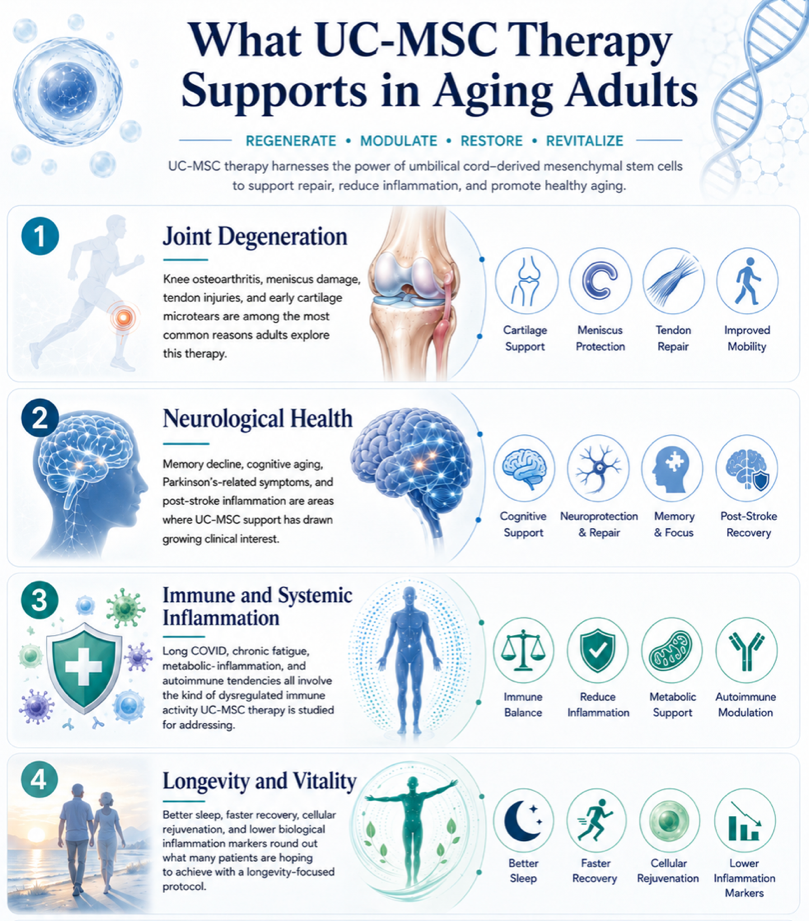
Joint Degeneration
Knee osteoarthritis, meniscus damage, tendon injuries, and early cartilage microtears are among the most common reasons adults explore this therapy.
Neurological Health
Memory decline, cognitive aging, Parkinson’s-related symptoms, and post-stroke inflammation are areas where UC-MSC support has drawn growing clinical interest.
Immune and Systemic Inflammation
Long COVID, chronic fatigue, metabolic inflammation, and autoimmune tendencies all involve the kind of dysregulated immune activity UC-MSC stem cell are studied for addressing.
Longevity and Vitality
Better sleep, faster recovery, cellular rejuvenation, and lower biological inflammation markers round out what many patients are hoping to achieve with a longevity-focused protocol.
Stem cell therapy in Thailand has grown quickly for reasons that go well beyond price. Certified cell laboratories, accessible costs relative to Singapore, Korea, or Japan, advanced imaging guidance for joint injections, and high-standard IV infusion facilities have combined to make Bangkok a genuine destination for regenerative wellness travelers, executives, and patients from across Asia and the Middle East is not just a budget alternative to care elsewhere.
Vega Medical Services builds UC-MSC stem cell protocols around published clinical research, not marketing claims. Depending on what a patient actually needs, that typically looks like one of three approaches.
IV Infusion for Whole-Body Support
Systemic infusion is designed to support immune balance, reduce inflammation, and contribute to anti-aging pathways, brain health, and mitochondrial function across the whole body rather than one specific site.
Targeted injection focuses on cartilage support, tendon healing, joint stability, and pain reduction where degeneration is localized.
For many patients, addressing both systemic aging and localized joint degeneration together produces the most complete picture of support combining IV infusion with targeted injection based on individual assessment.
All UC-MSC stem cell used follow GMP-certified sourcing with documented potency, sterility, and clinical-grade quality control.
Adults over 35 : natural stem cell decline is already well underway by this point
Active individuals noticing slower recovery : UC-MSCs help restore repair signaling that’s started to fade
People managing chronic inflammation : UC-MSCs help modulate ongoing immune dysregulation
Patients with early joint degeneration : supports cartilage preservation and reduces pain before things progress further
Anyone pursuing longevity-focused care : supports cellular and metabolic health as a preventive strategy, not just a reactive one
Frequently Asked Questions
At what age do stem cells start declining?
Meaningful decline is already measurable by your 30s, and it accelerates from there by 60, stem cell density in bone marrow is roughly 800 times lower than at birth.
Your own (autologous) cells age along with you, carrying the same senescence, reduced potency, and weaker signaling that affects the rest of your body. UC-MSCs come from young donor tissue and don’t carry that biological baggage, which is why they’re consistently more potent in lab and clinical comparisons.
UC-MSCs lack the markers that typically trigger immune rejection, and when sourced under GMP-certified conditions with proper sterility testing, they’ve shown a strong safety profile across IV and local injection use. Individual risk factors should always be reviewed with a physician first.
The combination of certified laboratories, doctor-designed protocols, advanced imaging-guided injection technique, and significantly lower cost relative to Singapore, Korea, or Japan has made Thailand a genuine hub for this kind of care, not just a cheaper alternative.
Adults over 35 dealing with slower recovery, chronic inflammation, early joint degeneration, or general interest in longevity-focused care tend to be the best fit though the right protocol depends on individual assessment.
Stem cell aging isn’t something you can see in the mirror the way you can see wrinkles or grey hair, but it’s driving a lot of what changes about how your body heals and recovers. If you’re curious what that looks like for you specifically, and whether stem cell therapy in Thailand through Vega Medical Services makes sense for your situation, book a consultation for a personalized assessment.
This article is for general informational purposes and is not medical advice. Individual results vary, and any treatment decision should follow a proper medical assessment with a qualified physician.
References
Pittenger, M.F., et al. (2019). MSC aging and potency decline. Cell Stem Cell.
Li, Y., et al. (2017). UC-MSC proliferation and telomere characteristics. Stem Cell Research & Therapy.
Xu, L., et al. (2020). UC-MSC anti-inflammatory superiority. Stem Cell Research & Therapy.
Kern, S., et al. (2006). Comparative MSC analysis (bone marrow, adipose, umbilical cord). Stem Cells.
Fafian-Labora, J., et al. (2019). Aging MSC mitochondrial dysfunction. Aging Cell.
Mendicino, M., et al. (2014). Allogeneic MSC safety regulatory review. Cytotherapy.