Our Services
Others
- DFPP
- Shockwave
- IV Drip

If you search for stem cell therapy for autism, you’ll see a mix of hopeful headlines, clinic advertisements, and confusing science. Some families have spent thousands of dollars on a treatment they discovered in a Facebook group. Others may be hearing about it for the first time and are now wondering if it’s worth exploring for their child. Both responses are understandable, since the research is real, but it’s still far from complete.
This guide explains what stem cell treatment for autism spectrum disorder (ASD) really involves, what the current science supports, and what you should know before investing your money or hopes in it.
Before we begin, it’s important to note that stem cell therapy for autism is still experimental. The FDA has not approved it as a standard treatment, and this article is not medical advice. Please consult a licensed physician or developmental pediatrician before making any decisions.
Autism spectrum disorder shows up differently in every person, but it typically involves differences in social communication, repetitive behaviors, and how the brain processes sensory input. Researchers have linked some of these patterns to atypical brain development and, in certain cases, immune or inflammatory activity which is part of why regenerative medicine researchers got curious about stem cells in the first place.
The theory behind stem cell therapy for autism symptoms goes something like this: if inflammation or abnormal neural wiring plays a role in some autism cases, then cells capable of calming inflammation or supporting healthier brain connections might help. It’s a reasonable hypothesis. It’s also, so far, mostly unproven in large human trials. Worth sitting with that gap for a second before reading further.
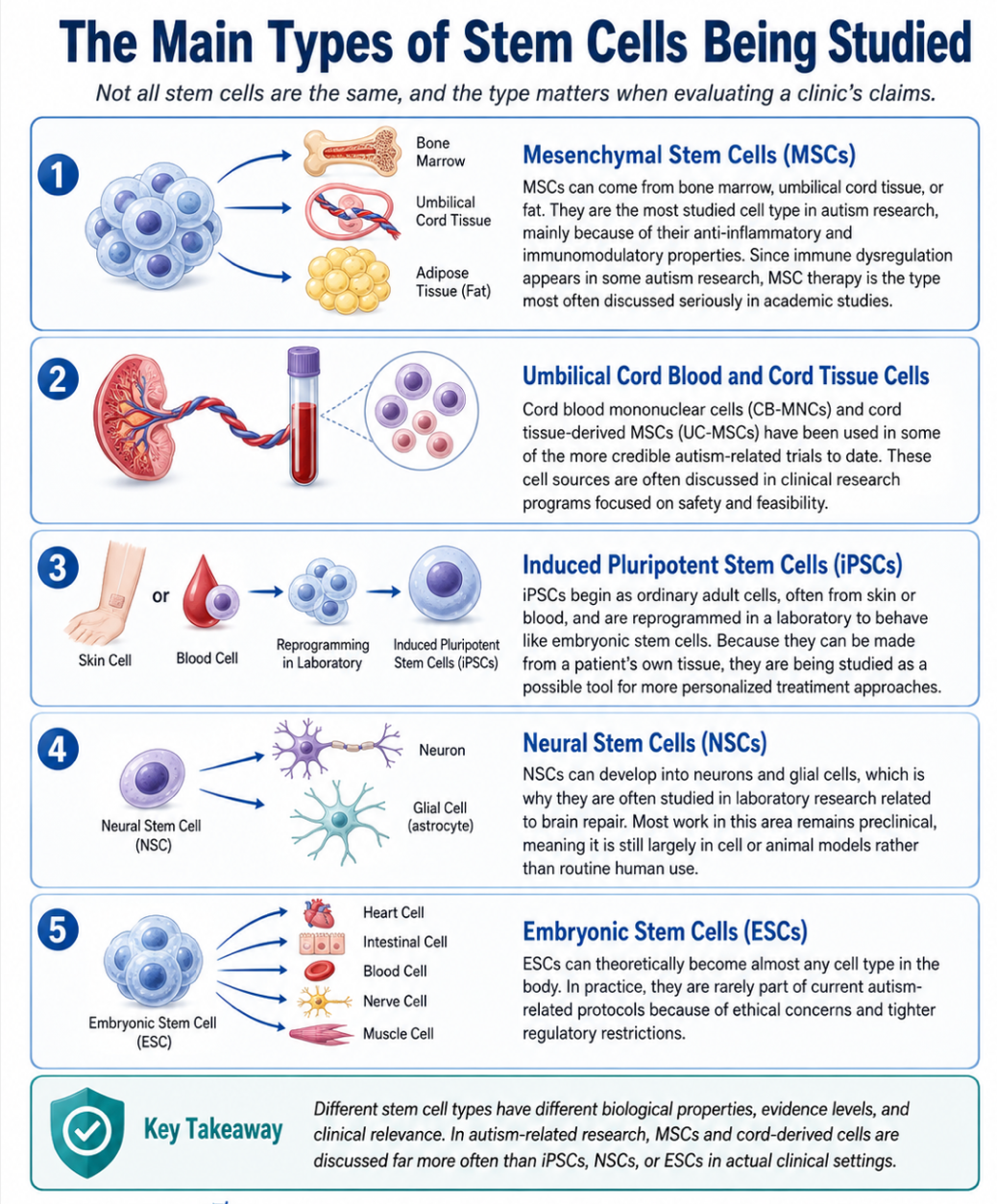
Not all stem cells are the same, and the type matters a lot when you’re evaluating a clinic’s claims.
Mesenchymal stem cells (MSCs) come from bone marrow, umbilical cord tissue, or fat. They’re the most studied cell type in autism research right now, mainly because of their anti-inflammatory properties. Since immune dysregulation shows up in some autism research, MSC therapy for autism tends to be the version you’ll see discussed most seriously in academic papers rather than just marketing pages.
Cord blood mononuclear cells (CB-MNC) and cord tissue-derived MSCs (UC-MSC) have been used in some of the more credible trials to date, Duke University’s program being the best-known example in North America.
iPSCs start as ordinary adult cells, often from skin or blood, and get reprogrammed in a lab to act like embryonic stem cells. Because they can be made from a patient’s own tissue, there’s interest in using them for more personalized autism treatment approaches, partly because the immune rejection risk drops.
These can turn into neurons and glial cells, which is exactly why they show up so often in lab studies about autism brain repair. That said, most of this work is still preclinical — meaning it’s happening in cells or animal models, not routinely in people yet.
ESCs can, in theory, become almost any cell type in the body. In practice, they’re rarely part of current autism protocols, partly for ethical reasons and partly because regulation around them is tighter.
Nobody has this fully figured out, but a few mechanisms keep coming up in the literature.
Neurogenesis and neuroplasticity Stem cells may support new neuron growth and stronger neural connections, which could theoretically help with cognitive flexibility and learning.
Calming neuroinflammation MSCs in particular seem to modulate an overactive immune response relevant if inflammation is part of what’s driving symptoms in a given individual.
Balancing brain activity Some regions of the brain in autistic individuals show unusual activity levels, either too high or too low. Researchers are exploring whether stem cells could nudge that toward a more typical pattern.
Supporting tissue repair Where certain brain regions appear underdeveloped, there’s a hypothesis that stem cells could help though “hypothesis” is the operative word here, not “established fact.”
What Could Go Wrong
Because this is still experimental, a few risks are worth naming plainly:
Unregulated clinics, particularly overseas, that offer infusions with no peer-reviewed evidence behind them
Unknown long-term effects, especially in children, where data is thin
Real financial cost since insurance won’t cover it, stem cell therapy for autism cost often runs into the tens of thousands of dollars, with no guaranteed outcome
The emotional weight of chasing a cure that hasn’t been proven, which can be exhausting for families already stretched thin
Before committing to anything, ask whether the program is a registered trial listed on ClinicalTrials.gov, and get a second opinion from a neurologist or developmental pediatrician about realistic expectations and stem cell therapy for autism side effects.
While stem cell research continues, these approaches currently have more solid clinical backing:
Applied Behavior Analysis (ABA) therapy
Speech and language therapy
Occupational therapy for sensory processing
Early intervention programs for young children
Social skills training
None of these carry the same financial risk or uncertainty as an experimental cell therapy, and autism specialists generally recommend them as the first line of support.
Is stem cell therapy safe for kids with autism? Safety data outside of registered trials is limited. If you’re considering it, look for a program tied to an academic medical center rather than a standalone clinic.
What does stem cell therapy for autism cost? It varies a lot by clinic and country often thousands to tens of thousands of dollars and it’s typically not insurance-covered since it isn’t FDA-approved.
Does it cure autism? No. Autism isn’t generally framed as something with a “cure,” and no solid evidence supports stem cells as one. The research question is narrower: whether it might ease certain symptoms for some people.
Where can I find real autism stem cell trials? ClinicalTrials.gov lists registered studies, including eligibility criteria and oversight details a much safer starting point than a clinic’s landing page.
Stem cell therapy for autism is a legitimate area of ongoing research, and mesenchymal and cord-derived cells currently have the most scientific momentum behind them. But as of 2026, it’s still investigational not an approved treatment so the safest path is prioritizing registered, FDA-supervised trials over private clinics, and treating any new therapy as a complement to evidence-based interventions, not a replacement for them.