Our Services
Others
- DFPP
- Shockwave
- IV Drip

Most wounds heal on their own. Give the body time, keep things clean, and the skin closes back up. But some don’t. Burns, surgical incisions, traumatic injuries and especially wounds complicated by diabetes can stall for months, sometimes years, leaving patients cycling through dressings, antibiotics, and skin grafts that only get them partway there. This is the exact gap stem cell therapy for wound healing is trying to fill. Instead of just covering the wound, it works on the biology underneath it. Here’s what that actually means, which cell types are being used, how treatment is delivered, and just as importantly what the research does and doesn’t support yet.
A wound typically moves through three overlapping stages: inflammation, tissue formation, and remodeling. When something interrupts that sequence poor circulation, a persistent infection, nerve damage, or a metabolic condition like diabetes the wound can get stuck. Usually it’s stuck in that first stage, inflammation, unable to move forward. Dressings and antibiotics manage the surface, but they don’t necessarily fix what’s keeping the wound from progressing. That’s the opening regenerative wound therapy is built to address.
Stem cells have two properties that make them useful here: they can copy themselves, and depending on the type, they can turn into other specialized cells. That combination means they can contribute to tissue regeneration directly, while also releasing signals that make the wound environment more favorable for healing overall reducing inflammation, recruiting other repair cells, and generally nudging things back on track.
Of everything studied for wound repair, mesenchymal stem cells (MSCs) are used the most, by a wide margin. They’re multipotent meaning they can develop into several of the specific cell types actually involved in repair, including keratinocytes, fibroblasts, and endothelial cells. Those three cell types alone cover most of what a wound needs: new skin, structural collagen, and the blood vessels to support it.
MSCs can transform into skin and connective tissue cells, contributing directly to rebuilding the structures a wound has lost.
MSCs secrete cytokines and growth factors vascular endothelial growth factor (VEGF), epidermal growth factor (EGF), fibroblast growth factor (FGF) among them that push cell proliferation, collagen production, and tissue remodeling forward.
By helping regulate the local immune response, MSCs support a shift away from the prolonged inflammation that, in chronic wounds, is often the exact thing keeping the wound from closing in the first place.
MSCs encourage angiogenesis, improving how much oxygen and nutrients actually reach the tissue that’s trying to regenerate. This matters most in chronic or ischemic wounds, where poor blood flow is usually the root problem, not just a symptom.
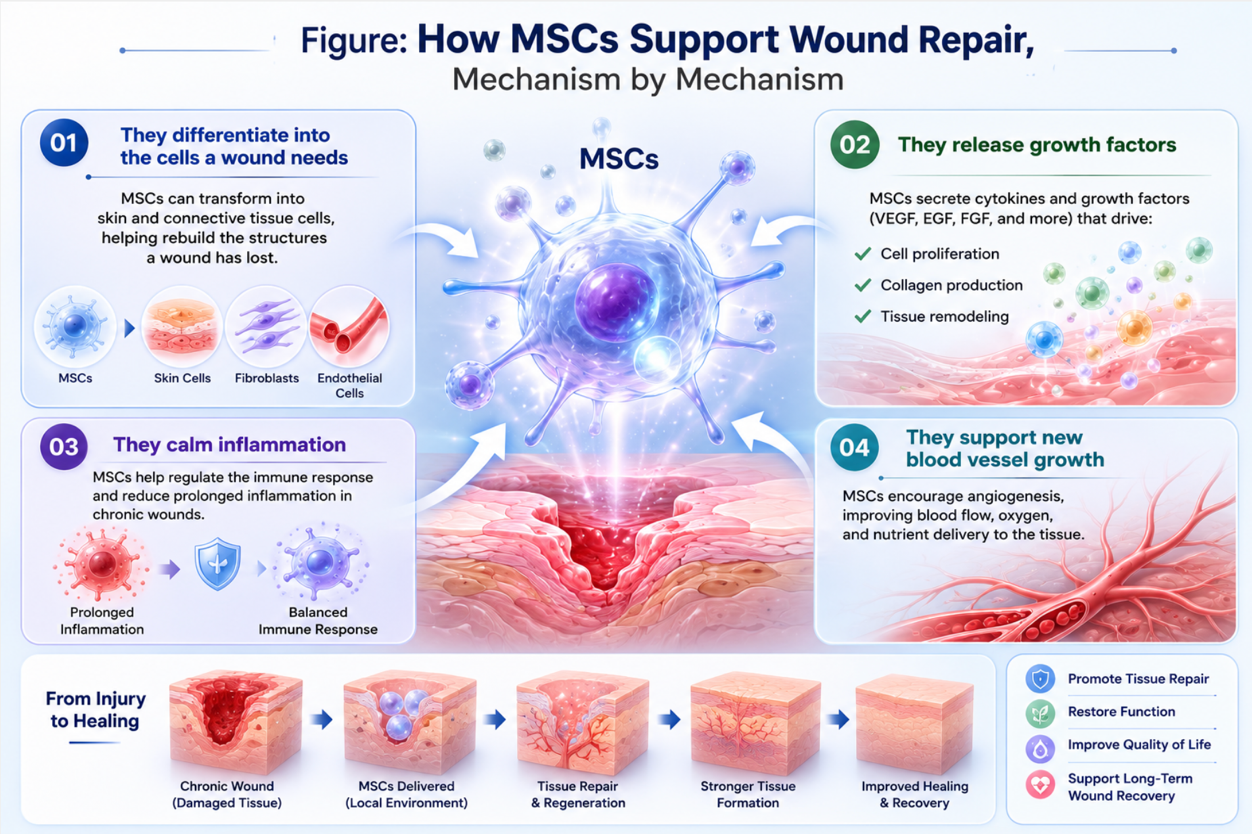
Figure 1: Proposed Mechanisms by Which Mesenchymal Stem Cells Support Chronic Wound Repair
Not all cell sources are interchangeable. Each has trade-offs in terms of how easily it’s collected, how potent it is, and what wound types it tends to suit best.
Harvested from fat tissue via liposuction, adipose-derived stem cells are relatively easy to obtain and carry a strong supply of regenerative factors one reason they’re a common choice for skin regeneration work.
This was one of the earliest cell sources used clinically, and it still holds up. Bone marrow-derived MSCs have a long track record across a range of wound types, which counts for something in a field where newer isn’t always better.
Collected from donated umbilical cord tissue after birth, with donor consent, UC-MSCs are comparatively “young” cells. They’re immunoprivileged, proliferate efficiently in the lab, and have become a frequent focus of clinical research on more severe or chronic wounds.
This is where some of the more interesting recent research is happening. Amniotic fluid stem cells (AFSCs) and placental-derived MSCs are being studied specifically for their anti-inflammatory and anti-scarring properties. In one study, exosomes derived from amniotic fluid stem cells accelerated wound healing and improved regeneration of skin structures hair follicles, nerves, vessels while also suppressing the kind of excessive tissue buildup that leads to visible scarring. Separately, research on placenta-derived amniotic epithelial cells found faster healing and less scar formation specifically in pressure ulcer models. It’s promising work, particularly for wounds prone to heavy scarring though a lot of it is still preclinical, meaning it hasn’t yet been confirmed in large human trials.
The delivery method comes down to how deep and how severe the wound is.
Stem cells get worked into gels, creams, or dressings and applied straight onto the wound surface. This tends to be the go-to for superficial injuries or post-surgical recovery.
For deeper or chronic wounds, cells may be injected around or directly into the wound bed, which allows for more targeted delivery and support deeper in the tissue.
Sometimes a biocompatible scaffold seeded with stem cells is placed over the wound. It gives the cells something to hold onto and organizes the regeneration process, roughly mimicking the skin’s natural extracellular matrix.
Stem cells are sometimes paired with platelet-rich plasma (PRP), skin grafts, or bioengineered tissue rather than used alone the idea being that combined approaches can outperform any single method on its own.
This is worth being honest about, because claims online range from cautious to wildly overstated. Research on MSC-based wound therapy has grown substantially over the last decade, and systematic reviews generally describe it as reasonably safe, with efficacy signals that are encouraging but uneven depending on the wound type and cell source in question.
The strongest evidence right now sits with knee osteoarthritis and select chronic wound applications. Amniotic, placental, and combination approaches are earlier-stage mostly preclinical or small early-phase studies. None of this makes stem cell therapy a guaranteed fix. It’s a genuinely promising, scientifically grounded field that’s still maturing, and outcomes will keep varying by patient, wound severity, and cell source until larger trials narrow that down.
Faster healing, potentially : better cell proliferation, blood vessel growth, and immune regulation can add up to quicker closure, though how much faster varies case by case
Less scarring : more organized tissue repair tends to mean less visible, less disruptive scar tissue
Better skin quality afterward : some studies report improved hydration, elasticity, and function in the regenerated skin compared to conventional healing
A real option for the wounds that resist everything else : diabetic foot ulcers, venous leg ulcers, and pressure sores are exactly the wound types driving most of the current research interest
Generally, stem cell-based treatment gets considered when a wound:
Hasn’t responded to standard wound care after a reasonable trial period
Shows signs of poor circulation, ongoing inflammation, or nerve involvement that’s blocking healing
Carries a real risk of complications infection, tissue loss if left on standard management alone
It still comes down to a full medical evaluation. Wound type, depth, infection status, and any underlying conditions all factor into whether this is the right call. You can look through the conditions we treat on our stem cell therapy page, or see actual patient outcomes on our results page.
Honestly, there’s no single answer. Adipose-derived, bone marrow-derived, umbilical cord–derived, and amniotic/placental cells each bring something different to the table depending on the wound and the goal, it’s a decision made with the treating physician, not a one-size-fits-all pick.
Depends heavily on the wound, the cell source, and how it’s delivered. Some patients notice change within weeks; more complex or long-standing wounds take longer.
No, nothing can promise scar-free healing. Amniotic and placental-derived cells in particular have shown genuinely promising anti-scarring results in early research, but “promising” isn’t the same as guaranteed.
Yes, Thailand has a growing base of licensed clinics and lab infrastructure supporting regenerative medicine, with cell-based therapies falling under Thai FDA and Ministry of Public Health oversight.
As delivery methods improve and more clinical data accumulates, stem cell therapy for wound healing looks set to take on a bigger role in treating the wounds that don’t respond to anything else diabetic ulcers, difficult surgical sites, traumatic injuries. The goal isn’t just closing wounds faster. It’s getting the regenerated skin to actually function like skin again.
Human Amniotic Fluid Stem Cell-Derived Exosomes as a Novel Cell-Free Therapy for Cutaneous Regeneration. NCBI/PMC. https://www.ncbi.nlm.nih.gov/pmc/articles/PMC8255501/
Applications of human amniotic fluid stem cells in wound healing. PubMed. https://pubmed.ncbi.nlm.nih.gov/36535008/
Effects of Placenta-Derived Human Amniotic Epithelial Cells on the Wound Healing Process and TGF-β Induced Scar Formation in an Ischemic-Reperfusion Injury Model. Stem Cell Reviews and Reports. https://link.springer.com/article/10.1007/s12015-022-10355-7
Pittenger MF, Discher DE, Peault BM, et al. Mesenchymal stem cell perspective: cell biology to clinical progress. NPJ Regenerative Medicine, 2019. https://www.nature.com/articles/s41536-019-0083-6