Our Services
Others
- DFPP
- Shockwave
- IV Drip

Chronic Kidney Disease (CKD) and End-Stage Renal Disease (ESRD) are growing health problems worldwide, affecting millions of people and significantly reducing quality of life. Thailand is no exception the burden of kidney disease here keeps climbing alongside rising rates of diabetes, hypertension, and an aging population.
For a long time, treatment options for advanced kidney disease were limited to just two paths: dialysis or a kidney transplant. Both come with real risks, complications, and limitations that patients have had to live with. More recently, though, regenerative medicine has opened up a new avenue UC-MSC therapy (Umbilical Cord-derived Mesenchymal Stem Cell therapy), which uses mesenchymal stem cells sourced from umbilical cord tissue. This approach is now being studied in Thailand as a possible adjunctive treatment that could help repair damaged kidney tissue, rebalance the immune system, and slow disease progression over the long term.
Mesenchymal Stem Cells (MSCs) are a type of adult stem cell with the ability to transform into several different cell types, including bone, cartilage, and muscle cells. UC-MSCs specifically come from Wharton’s jelly in the umbilical cord a rich source of regenerative cells that can be collected without invasive procedures and without the ethical concerns tied to some other stem cell sources.
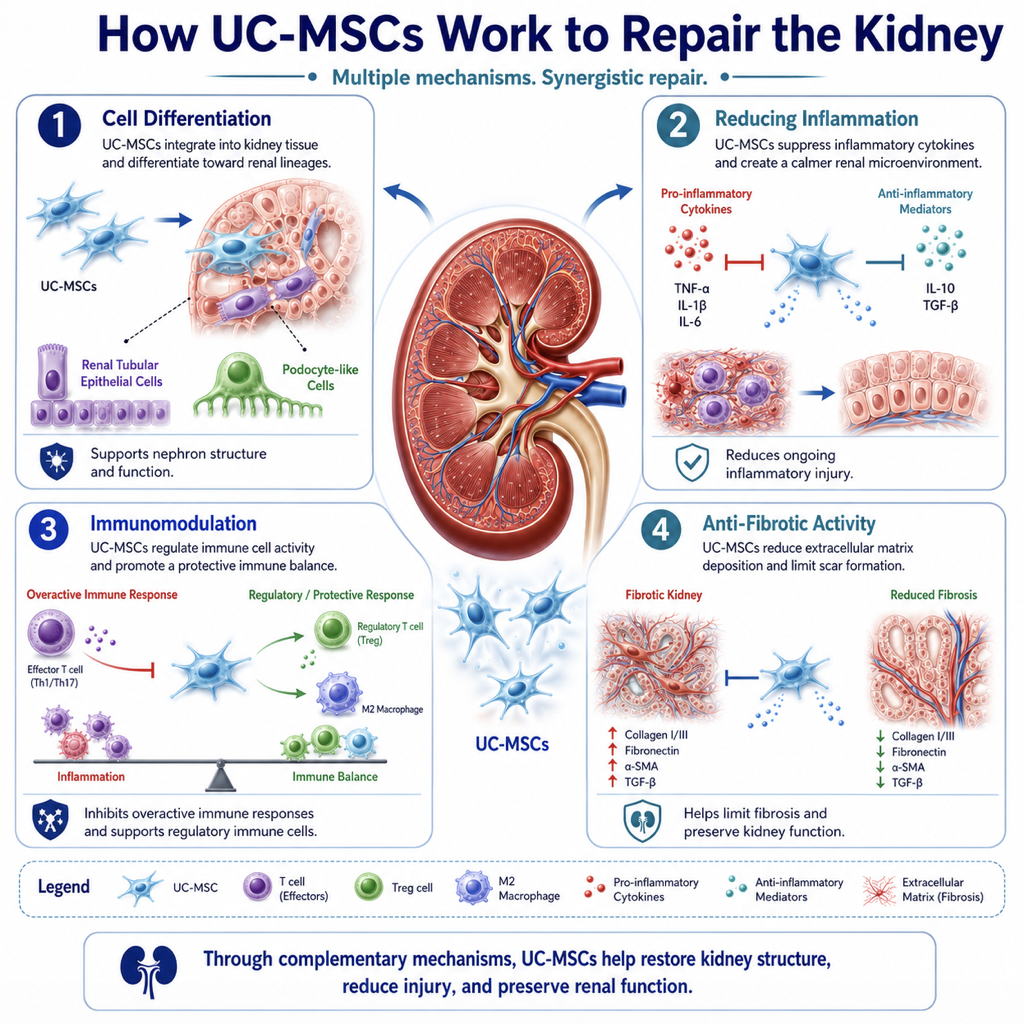
Several properties make UC-MSCs stand out in kidney research: their anti-inflammatory effects, immune-modulating properties, ability to transform into kidney-like cells, and their secretion of growth factors and cytokines that support healing. Combined, these traits give UC-MSCs the potential to support tissue repair, reduce fibrosis, and rebalance the immune response all of which matter a great deal when it comes to slowing or reversing kidney damage.
Some research suggests UC-MSCs can transform into renal tubular epithelial cells, podocytes, and other key kidney structures. These new cells may integrate into damaged areas and help restore the function of nephrons the kidney’s basic filtering units.
Inflammation is one of the primary drivers of kidney damage. MSCs secrete bioactive molecules such as Interleukin-10 (IL-10) and Transforming Growth Factor-beta (TGF-β), which help suppress pro-inflammatory cytokines and reduce ongoing injury to kidney tissue.
In some patient groups for example, those with lupus nephritis an overactive immune response can accelerate kidney failure. UC-MSCs play a role in inhibiting T-cell proliferation, promoting regulatory immune cells, and reducing immune-mediated damage directly.
MSCs can interfere with fibrotic pathways by reducing the buildup of extracellular matrix components, which may help prevent or reduce the kind of scarring that leads to loss of function in CKD patients.
Dialysis genuinely saves lives, but it isn’t a cure. It performs some of the kidney’s functions filtering waste, balancing fluids but it can’t repair the kidney or halt the disease from progressing.
Stem cell therapy for kidney disease takes a fundamentally different approach. The goal is to restore the kidney’s natural function, improve patients’ quality of life, reduce how often (or whether) dialysis is needed, and lower the risk of cardiovascular events a leading cause of death among kidney patients.
This approach tends to show the most promise in patients at early to mid-stage CKD, where early intervention may delay or even prevent progression to ESRD.
Patients with ESRD, the final stage of kidney failure, are often left with very limited options. Kidney transplantation remains the gold standard, but it comes with real constraints organ donor shortages, high costs, the risk of rejection, and the need for lifelong immunosuppressive medication.
UC-MSC therapy for end-stage renal disease is being explored as a supportive treatment. Some studies suggest stem cells may help improve residual kidney function, reduce inflammation and fibrosis, improve the success rate and longevity of kidney transplants, and help manage complications like anemia and fluid retention.
Research efforts both globally and within Thailand are underway to confirm the safety and effectiveness of stem cell therapy for kidney disease. Thailand itself is emerging as a regional hub for regenerative medicine, with specialized clinics and clinical trials focused specifically on using UC-MSCs for kidney care.
Acute Kidney Injury (AKI) Preclinical models suggest MSCs may reduce damage, speed up recovery, and improve survival rates in patients with sudden kidney injury.
Chronic Kidney Disease (CKD) Early-phase clinical trials have reported more stable kidney function, slower disease progression, and improved biomarker levels in some treated patients.
Post-Transplant Management Administering UC-MSCs alongside immunosuppressive medication may help reduce rates of acute rejection and promote immune tolerance, which could potentially lower the long-term medication dose patients need.
UC-MSC therapy is typically delivered through intravenous infusion, without the need for surgery or invasive procedures. Most clinical trials report an acceptable safety profile.
Many patients report increased energy, improved appetite, reduced swelling and discomfort, and an overall sense of feeling better after treatment.
UC-MSCs may improve transplant tolerance, making them a valuable option for patients who are awaiting or recovering from a kidney transplant.
By directly targeting inflammation and fibrosis, stem cell therapy may help extend the time before dialysis becomes necessary and help preserve native kidney function for longer.
Thailand’s medical sector is advancing quickly in regenerative medicine. With modern facilities, internationally trained specialists, and treatment costs that are more accessible than in many other countries, Thailand is positioning itself as a regional leader in UC-MSC therapy for kidney disease.
Future developments in this space may include gene-edited stem cells designed for enhanced function, 3D bioprinting of kidney tissue, combination therapies that pair stem cells with pharmaceuticals or immunotherapy, and personalized stem cell protocols built around each patient’s individual biomarkers.
UC-MSC stem cell therapy represents a genuinely new frontier in kidney disease treatment — one that goes beyond managing symptoms and holds real potential to repair kidney tissue and slow the progression of chronic disease. For patients in Thailand and around the world, this approach could reshape how kidney care is delivered, offering hope, healing, and a better quality of life for those living with CKD or ESRD.
That said, it bears repeating: stem cell therapy is still investigational. It’s not a guaranteed cure, and it doesn’t replace standard care entirely. Patients should consult a nephrologist before making any treatment decisions, so their individual situation can be properly evaluated.
This article is for informational purposes only and does not constitute medical advice. Anyone considering cellular therapy for kidney disease should consult both a nephrologist and the treating clinic directly regarding candidacy, risks, and expected outcomes.