Our Services
Others
- DFPP
- Shockwave
- IV Drip

Chronic neck pain and cervical spine degeneration represent a substantial burden on global musculoskeletal health, affecting individuals across age groups and occupational backgrounds. Conventional interventions analgesics, physiotherapy, corticosteroid injections, and surgery remain the standard of care but are frequently limited to symptomatic relief rather than tissue-level repair. This article examines the biological rationale, proposed mechanisms of action, and clinical relevance of umbilical cord-derived mesenchymal stem cell (UC-MSC) therapy as an emerging regenerative approach to cervical spine disorders, and situates Thailand’s role within the broader landscape of regenerative medical tourism. Throughout, the discussion draws a clear distinction between mechanistic plausibility demonstrated in preclinical models and the comparatively limited body of controlled clinical evidence currently available in humans.
Neck pain is among the most prevalent musculoskeletal complaints worldwide, with lifetime prevalence estimates in the general population commonly cited between 30 and 50 percent. Its aetiology is multifactorial, encompassing age-related intervertebral disc degeneration, repetitive mechanical strain, postural dysfunction associated with sedentary occupations, and acute trauma such as whiplash injury. When neck pain becomes chronic, it is associated with measurable reductions in occupational productivity, sleep quality, and overall health-related quality of life.
Standard management pathways pharmacological analgesia, structured physiotherapy, image-guided corticosteroid injection, and, in advanced cases, surgical decompression or fusion are effective in a substantial proportion of patients. However, a meaningful subset experiences incomplete symptom resolution or recurrence, particularly where the underlying pathology involves progressive disc degeneration or facet joint arthropathy that conventional therapies do not directly reverse. This therapeutic gap has motivated interest in regenerative approaches, of which mesenchymal stem cell (MSC) therapy and UC-MSC therapy in particular has attracted growing clinical and scientific attention over the past decade.
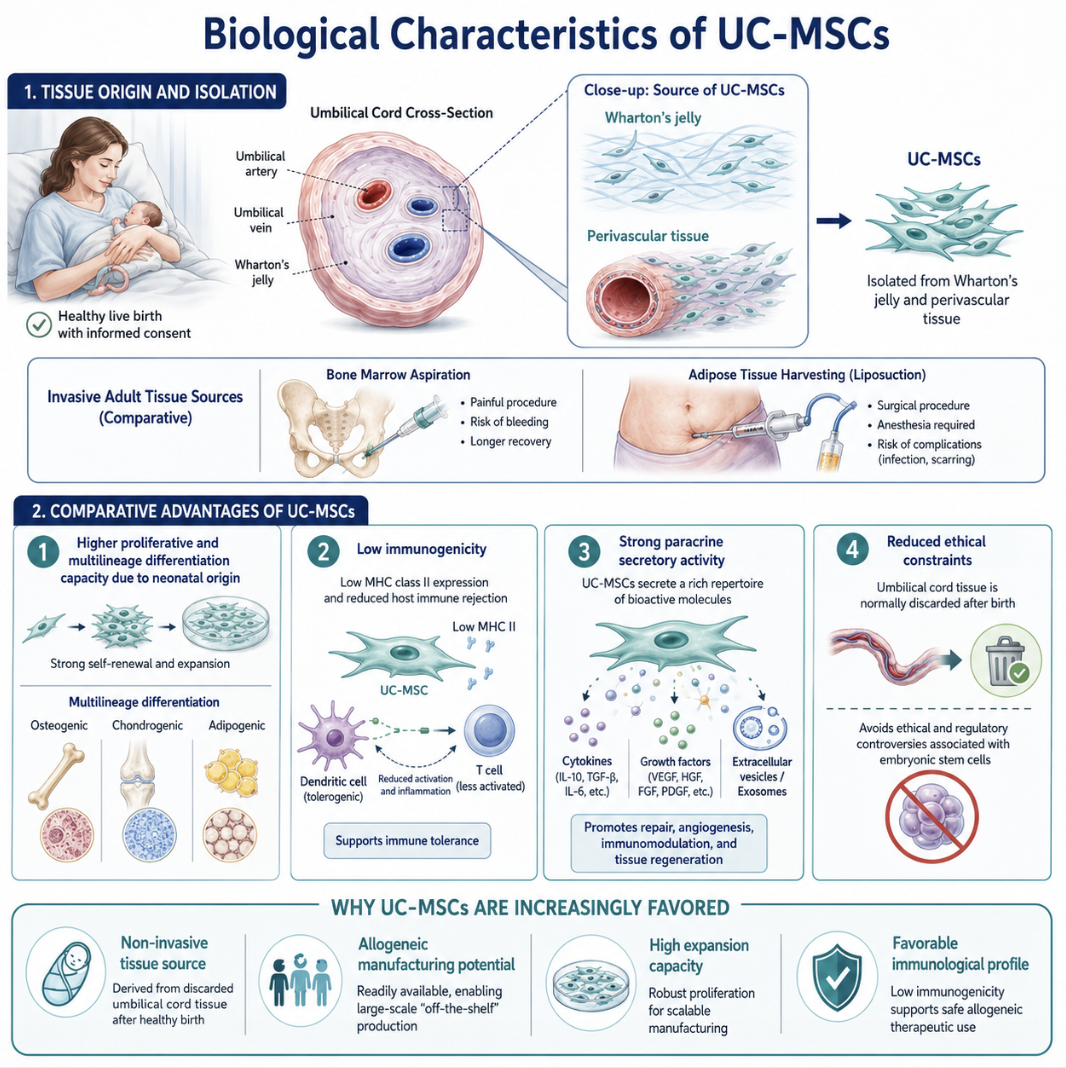
UC-MSCs are isolated from Wharton’s jelly and perivascular tissue of the umbilical cord following consented, healthy live births. Unlike bone marrow or adipose-derived MSCs, which require an invasive harvesting procedure from the patient or a matched donor, umbilical cord tissue is obtained as a by-product of a routine, ethically uncomplicated clinical event, which has made it an increasingly favoured source for allogeneic cell manufacturing.
Several biological properties distinguish UC-MSCs from MSCs derived from adult tissue sources:
A 2023 narrative review published in Frontiers in Cell and Developmental Biology notes that umbilical cord-derived mesenchymal stem cells combine favourable tissue accessibility, differentiation potential, and immunological and ethical profiles, positioning them as a potential alternative to bone marrow- and adipose-derived MSCs in disc regeneration research (Huang et al., 2023).
Several categories of cervical pathology have been proposed as candidates for MSC-based intervention, largely on the basis of shared underlying mechanisms disc dehydration, extracellular matrix degradation, and low-grade chronic inflammation.
Progressive loss of proteoglycan content and hydration within the nucleus pulposus reduces the disc’s capacity to distribute axial load, contributing to stiffness, height loss, and localized pain.
Age-associated degeneration of the vertebral bodies and facet joints can produce osteophyte formation, joint space narrowing, and secondary nerve root irritation.
Displacement of nucleus pulposus material through a compromised annulus fibrosus may compress adjacent nerve roots, producing radicular pain, paraesthesia, or motor weakness in the upper limb.
A subset of patients continues to report pain following cervical spine surgery, which has been attributed variably to epidural fibrosis, adjacent segment degeneration, or incompletely resolved inflammatory processes.
Traumatic hyperflexion-hyperextension injury to the cervical spine can damage ligamentous, muscular, and discal structures, with a proportion of patients developing persistent symptoms beyond the expected soft-tissue healing window.
In vitro and animal studies indicate that UC-MSCs can be induced along a chondrogenic lineage, expressing markers such as SOX9, TGF-β1, and type II collagen. In a rat tail intervertebral disc model, chondroprogenitor cells derived from UC-MSCs demonstrated improved survival, homing, and distribution within the disc compared with undifferentiated MSCs, suggesting a plausible route toward partial structural regeneration (Human umbilical cord-derived mesenchymal stem cells and their chondrogenic differentiation potential, n.d.).
Chronic low-grade inflammation is considered a central driver of disc degeneration and associated nerve root irritation. MSCs are understood to exert immunomodulatory effects by releasing anti-inflammatory mediators and modulating local macrophage and lymphocyte activity, thereby reducing secondary tissue injury.
A growing body of literature attributes much of the therapeutic effect of MSC-based therapies to paracrine signalling rather than direct cell engraftment and differentiation. In a 2024 study, exosomes derived from hypoxia-preconditioned UC-MSCs, delivered via a hyaluronic acid methacryloyl hydrogel sustained-release system, were shown to repair extracellular matrix degradation, reverse nucleus pulposus cell senescence, and slow disc degeneration progression in a rat model (Injectable hydrogel loaded with exosomes from hypoxic umbilical cord-derived mesenchymal stem cells, 2024). Related work has also implicated specific microRNA cargo such as miR-26a-5p transferred via UC-MSC-derived exosomes in the suppression of nucleus pulposus cell pyroptosis, an inflammation-associated form of programmed cell death relevant to disc degeneration.
Beyond repair of existing damage, UC-MSC-derived factors may exert a protective effect on residual healthy tissue by limiting oxidative stress and reducing the rate of cell senescence and apoptosis within the disc and surrounding structures.
| Treatment Modality | Primary Objective | Principal Limitation |
| Analgesics / NSAIDs | Symptomatic relief | Does not address tissue pathology; risk of dependence with long-term use |
| Physiotherapy | Improve muscular support and biomechanics | Requires sustained adherence; slower symptomatic gains |
| Corticosteroid injection | Reduce localized inflammation | Effect is typically transient; repeated use carries tissue-level risk |
| Surgical decompression/fusion | Correct significant structural pathology | Invasive; recovery time and procedural risk are non-trivial |
| UC-MSC therapy (investigational) | Tissue repair and inflammation modulation | Evidence base remains largely preclinical; individual response variability; long-term outcome data limited |
The comparative appeal of UC-MSC therapy lies in its minimally invasive delivery (typically image-guided injection), its mechanistic focus on the underlying pathological process rather than symptom suppression alone, and an overall favourable short-term safety profile reported across existing studies. These features must, however, be weighed against the relative immaturity of the clinical evidence base compared with established interventions.
It is important to state plainly that the majority of mechanistic findings described above derive from in vitro and animal model studies rather than large, controlled human trials specific to the cervical spine. Registered human trials such as a Phase I/II study of UC-MSC administration for lumbar (rather than cervical) disc degeneration listed on ClinicalTrials.gov (Shanghai General Hospital, Shanghai Jiao Tong University School of Medicine, Identifier NCT04414592) illustrate that clinical translation is actively underway, but such studies are limited in number, sample size, and, in some cases, completion status. Cervical-specific human trial data remain particularly sparse relative to lumbar spine research.
Consequently, reported clinical outcomes improved range of motion, reduced radicular symptoms, and enhanced functional capacity over a period of weeks to months should be interpreted as preliminary and heterogeneous across the existing literature rather than as an established standard of efficacy. Patients considering this therapy should be counselled accordingly, and treatment decisions should involve a qualified spine specialist or physician trained in regenerative medicine.
Thailand has developed a substantial regenerative medicine sector, supported by several structural factors:
These structural strengths do not, in themselves, resolve the underlying evidentiary limitations discussed in Section 6; rather, they describe the operating environment in which such treatments are currently delivered.
UC-MSC therapy represents a biologically plausible and mechanistically well-motivated candidate for the regenerative management of cervical spine and neck disorders, supported by an expanding preclinical literature on tissue repair, immunomodulation, and exosome-mediated paracrine signalling. At present, however, the clinical evidence base particularly for cervical (as opposed to lumbar) indications remains at an early stage, characterised by small studies, heterogeneous protocols, and limited long-term follow-up. Prospective patients and clinicians alike should treat UC-MSC therapy as a promising but still investigational adjunct to, rather than a validated replacement for, established conservative and surgical management, and decisions to pursue treatment should be made in consultation with an appropriately qualified specialist.
Disclaimer: This article is intended for general informational and academic purposes only and does not constitute individualised medical advice. Readers considering UC-MSC therapy should consult a qualified physician or spine specialist to evaluate the suitability, risks, and expected outcomes of treatment for their specific condition.