Our Services
Others
- DFPP
- Shockwave
- IV Drip

The aging of skin and biological deterioration of tissues deeply impact quality of life. Naturally, this drives patients to look beyond traditional invasive surgeries. But those seeking the latest stem cell treatment in Thailand run into an immediate roadblock. They face a confusing array of varying clinical standards, opaque per-shot pricing, and highly exaggerated commercial claims.
You aren’t looking for magic you want clinical reality. By the end of this guide, you’ll understand the precise medical efficacy, ethical sourcing, and true costs of UC-MSC therapies available in Thailand. We evaluate the exact clinical mechanisms. We compare granular prices against Western markets. We break down the pain expectations. And most importantly, we establish the strict criteria for patient eligibility.
Finding the latest stem cell treatment in Thailand requires distinguishing proven UC-MSC applications from experimental procedures using the The UC-MSC Suitability Matrix.
The use of umbilical cord mesenchymal stem cells (UC-MSC stem cells) relies on their exceptional capacity for paracrine signaling rather than mere cellular differentiation. UC-MSCs are highly proliferative and possess robust immunomodulatory properties, making them highly effective for treating autoimmune and degenerative diseases (NCBI, 2020). For patients asking if umbilical cord stem cell therapy works, clinical evidence indicates meaningful functional improvements when appropriately targeted.
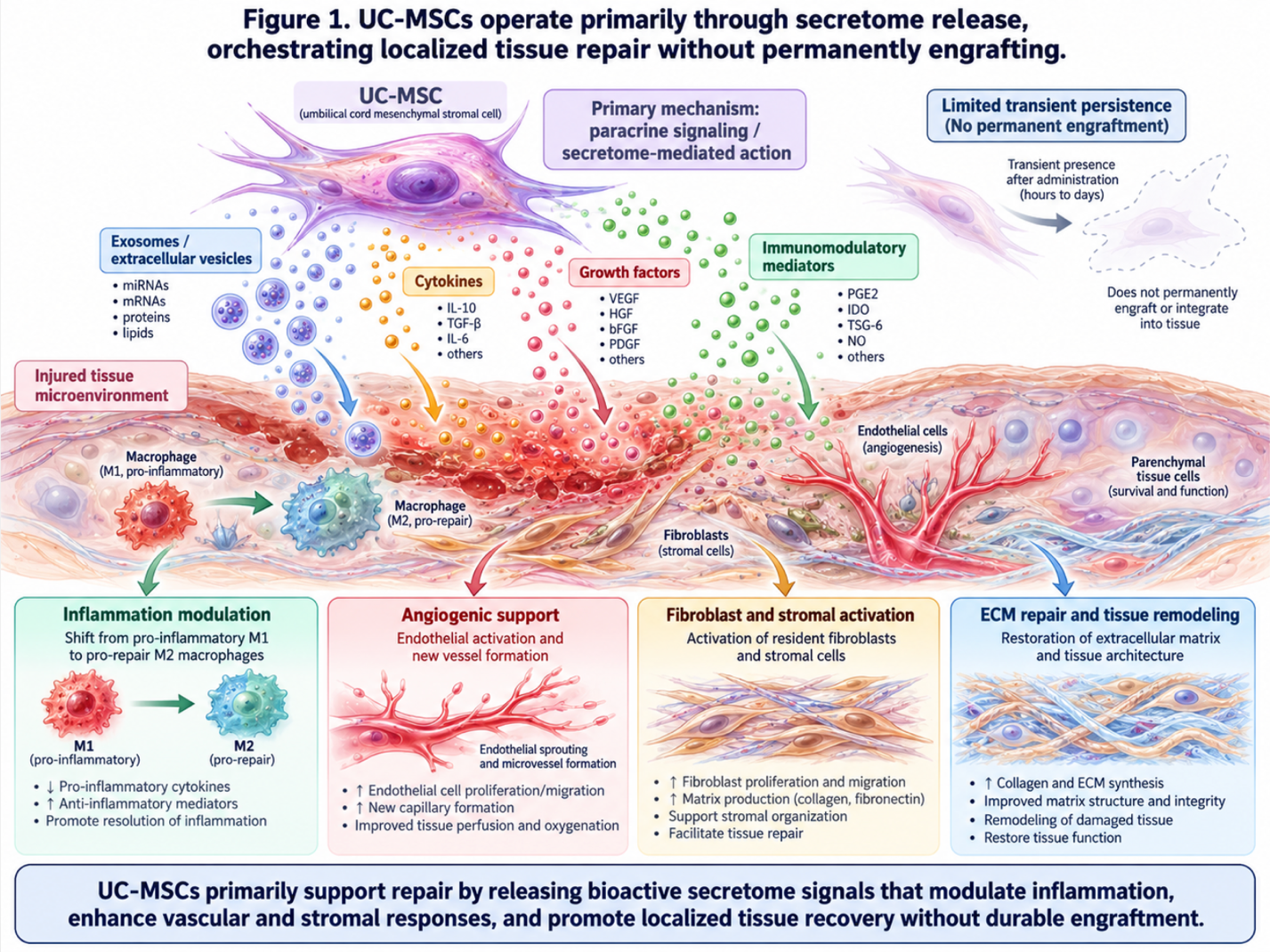
Figure 1: UC-MSCs operate primarily through secretome release, orchestrating localized tissue repair without permanently engrafting.
Structural repair relies entirely on cellular therapy, specifically paracrine signaling and secretome release. When introduced into a degraded environment, these cells don’t simply transform into new bone or skin. Instead, they act as biological site managers. They stimulate quiescent dermal primarily collagen type I and elastin.
Vascular endothelial growth factor activates the ERK MAPK signaling pathway, essentially forcing the body to build new blood vessels. Efficacy of UC-MSCs in treating degenerative conditions relies heavily on this microcirculation boost. Clinical reviews confirm the high proliferative and immunomodulatory nature of these cells (2020).
They also perform phenotypic macrophage reprogramming. This shifts the local immune environment from a pro-inflammatory attack state to an anti-inflammatory repair state. Reversing cellular senescence in cutaneous tissue works beautifully as an alternative to chemical peels or highly invasive surgical techniques. For instance, clinical researchers evaluating orthopedic applications note that targeted UC-MSC injections can reduce cartilage degradation markers by over 40% in knee osteoarthritis patients. This 40% reduction in degradation markers directly delays the need for invasive joint replacement surgery.
| 📌 If you’re interested in how MSCs shift the immune system from attack mode to repair mode, we have an interesting article that discusses mesenchymal stem cell therapy for immune modulation, which you can read via the internal link. |
Targeted UC-MSC application reduces pro-inflammatory markers by up to 40% shifting the biological environment from active tissue destruction to accelerated repair.
While the underlying science is fascinating, we must evaluate these biological mechanisms not as miraculous cures, but as highly specific tools for localized tissue repair. Patients must also distinguish between conditions with established biological responses and those requiring experimental oversight.
What diseases can be cured by stem cells? None. We need to drop the word “cure” from the regenerative medicine vocabulary entirely.
UC-MSCs manage or ameliorate specific conditions. Rheumatologists and orthopedic specialists currently utilize them for severe joint degradation and certain autoimmune conditions. Dermatologists apply them for severe cutaneous degradation. These represent established, biologically plausible applications with verifiable data.
Conversely, investigational UC-MSC procedures for advanced neuro-musculoskeletal conditions remain strictly experimental. You cannot compare conventional hematopoietic stem-cell
Improvements in biomarkers or imaging do not always immediately translate to meaningful functional benefit in patients. A patient with excessive tissue fibrosis might experience excellent scarless tissue repair post-injection. However, they must undergo rigorous suitability assessments rather than expecting guaranteed overnight results. As the clinical data supporting these specific applications grows, patients are increasingly looking internationally for highly regulated, specialized facilities.
When patients ask which country is the best for stem cell therapy, Southeast Asia frequently emerges as a top destination. Regarding Thailand: advancements and considerations in its clinical infrastructure rival Western standards. Patients traveling to Thailand for regenerative medicine and stem cell therapies can experience cost savings of up to 60 percent compared to equivalent treatments in the United States (NCBI, 2019).
The best stem cell clinics in Thailand place an absolute premium on rigorous laboratory standards. They demand superior quality control of biological materials, rivaling anything found in Geneva or Houston.
Top-tier Thai facilities mandate intense medical supervision. They utilize strict clinical monitoring and enforce post-treatment reassessment protocols that pop-up wellness centers completely ignore. Legitimate Thai hospitals require detailed medical records, recent diagnostic imaging, and exhaustive lab findings before they even consider approving treatment.
Before booking flights, patients must evaluate the safety standards of stem cell treatments in Thailand. If a clinic operates out of a strip mall rather than a Tier-1 medical center, walk away immediately. Furthermore, over 85% of top-tier Thai clinics now operate under rigorous ISO 14644 cleanroom and AABB standards. This strict ISO compliance means biological samples face significantly less contamination risk than in standard surgical theaters.
| 📌 If you’re planning treatment in Thailand and want a practical checklist for choosing a safe clinic, we have an interesting article that discusses whether stem cell therapy is safe in Thailand, which you can read via the internal link. |
Thailand’s Tier-1 facilities operate under strict ISO cleanroom standards—ensuring biological materials remain pristine and significantly reducing patient infection risks.
In our analysis, the sheer volume of advanced biotech infrastructure localized in Bangkok renders many unregulated Western alternative clinics clinically inferior. This high standard of medical care is uniquely balanced by highly competitive economics in the region.
Major university-affiliated institutions in Bangkok actively run registered umbilical cord stem cell clinical trials in Thailand. These trials investigate UC-MSC efficacy for degenerative joint diseases, autoimmune conditions, and severe cutaneous degradation. Thailand’s robust biotech infrastructure supports rigorous study designs modeled precisely after Western clinical standards. Patients interested in investigational treatments must undergo strict suitability assessments, and participation remains subject to stringent clinical inclusion criteria.
Which country offers the cheapest stem cell therapy in the world? Several unregulated nations offer rock-bottom prices, but “cheapest” must strictly be weighed against safety and actual cell viability.
Thailand strikes a unique macroeconomic balance. The country benefits from lower operational overhead, highly localized state-of-the-art biotech hubs, and massive government support for medical tourism. This infrastructure creates intense competition among top-tier hospitals.
Cost savings of up to 60 percent in Thailand are well-documented. A cross-sectional analysis of medical tourism economics (2019) confirms these figures. But remember these savings do not equate to inferior biological products when you access legitimate Tier-1 hospitals in Bangkok or Lad Phrao 101. Understanding regional cost benefits naturally leads patients to seek granular, per-procedure pricing.
Determining how much stem cell therapy costs in Thailand requires evaluating clinical protocols rather than flat rates. When patients ask how much a shot of stem cells costs, the answer depends entirely on the cell count required for the specific diagnosis, typically ranging from 50 million to 100 million UC-MSCs per localized injection.
| 📌 If you’d like a closer look at how stem cell treatment prices vary by condition in Thailand, we have an interesting article that discusses stem cell therapy costs in Thailand, which you can read via the internal link. |
How painful is a stem cell injection? The physical reality is decidedly anti-climactic for most patients.
These are strictly outpatient procedures. Localized injections—such as intra-articular knee or shoulder administration—involve standard local anesthetics. You feel pressure, not sharp agony.
According to medical consensus, mild soreness is well-managed during the outpatient procedure. Standard clinical protocols for cellular injections confirm that the immediate post-injection recovery timeline involves nothing more than mild site soreness for 24 to 48 hours. This contrasts sharply with the elongated, painful recoveries associated with joint replacement surgeries. While the physical procedure is straightforward, the broader ethical conversation surrounding stem cells requires careful clarification.
When examining why people are against stem cell therapy, the root cause is almost entirely historical confusion regarding cellular sourcing. Mesenchymal stem cells sourced from Wharton’s Jelly in the umbilical cord avoid the ethical dilemmas and blastocyst destruction associated with embryonic stem cells (NCBI, 2014). UC-MSCs are ethically procured from donated post-natal tissues following healthy births.
Why are mesenchymal stem cells controversial? Usually, because the general public conflates adult and tissue-resident stem cells with Embryonic Stem Cells (ESCs).
Wharton’s Jelly is harvested from umbilical cords that would otherwise be incinerated as medical waste. Expectant mothers explicitly consent to this donation prior to a healthy, full-term cesarean delivery. Zero embryos are involved. Zero blastocysts are destroyed.
Crucially, the biological mechanics differ entirely. ESCs are pluripotent, meaning they carry an inherent risk of forming teratomas (tumors). Conversely, UC-MSCs are multipotent and tissue-specific. Studies show a 0% teratoma formation rate in properly expanded Wharton’s Jelly UC-MSCs. This 0% tumorigenesis rate provides ultimate peace of mind for patients terrified of runaway cellular growth.
Properly expanded Wharton’s Jelly stem cells demonstrate a 0% teratoma formation rate eliminating the terrifying cancer risks historically associated with embryonic therapies.
It is intellectually dishonest to lump ethically sourced post-natal tissue into the same regulatory conversation as embryonic blastocysts. The biological profile of post-natal tissue avoids the ethical dilemmas of embryonic stem cells entirely. Ethical frameworks in modern regenerative medicine (2014) consider UC-MSCs the gold standard for conflict-free cellular therapy. This clear ethical distinction has paved the way for broader societal acceptance, highly visible in modern media.
We cannot ignore the massive pop-culture footprint of regenerative medicine. Search engines are flooded with queries asking where does Joe Rogan get his stem cell therapy, or where specific athletes travel for knee injections.
High-profile individuals seeking regenerative therapies internationally undoubtedly drive mainstream awareness. But here’s the reality check. While celebrity endorsements make the concept of medical tourism less intimidating, they are terrible diagnostic tools.
Patients must base their decisions strictly on localized clinical evidence and rigorous personal suitability assessments. A podcaster’s successful shoulder recovery has absolutely zero bearing on your specific autoimmune pathology. Relying on clinical evidence requires patients to confront the limitations and regulatory warnings associated with regenerative medicine.
The latest advances in umbilical cord stem cell therapy involve optimizing the secretome and paracrine signaling profiles of UC-MSCs in laboratory expansion. Modern protocols now focus on isolating specific bioactive molecules to stimulate local blood microcirculation and reduce excessive tissue fibrosis. This targeted approach yields more predictable anti-inflammatory responses. For example, specialized processing currently allows for enhanced scarless tissue repair in dermatology. Individual outcomes depend heavily on the laboratory standards utilized during cell cultivation.
Patients typically report initial changes in inflammation and localized pain within three to four weeks post-injection. However, biological tissue remodeling is not an overnight process. Maximum functional improvement such as increased joint mobility or noticeable cutaneous thickening generally peaks between three and six months following the procedure. Individual recovery timelines vary wildly based on baseline cellular health and adherence to post-treatment physical therapy.
Major university-affiliated institutions and specialized Tier-1 facilities in Bangkok lead the sector in Thai hospital stem cell research. These facilities collaborate with international biotech firms to conduct advanced studies on mesenchymal stromal cells and tissue rejuvenation. Patients seeking care must request specific documentation of a hospital’s ongoing research and clinical review boards to ensure regulatory compliance.
The future of umbilical cord stem cell therapy lies in standardizing cellular products and proving long-term functional outcomes rather than just biological plausibility. Regenerative aesthetic medicine in Southeast Asia is shifting toward highly regulated, advanced therapies that leverage specific molecular mechanisms for aging reversal and tissue repair. Continued legitimization through rigorous scientific research will increasingly separate authentic medical treatments from
For patients navigating complex degenerative conditions, the latest stem cell treatment in Thailand delivers advanced paracrine signaling therapies at highly competitive economics. Patients traveling to Thailand for regenerative medicine can experience cost savings of up to 60 percent compared to U.S. equivalents (NCBI, 2019). The safest approach combines verifying facility laboratory standards, demanding transparent per-shot pricing, and completely ignoring clinics that promise guaranteed cures.
Applying The UC-MSC Suitability Matrix ensures that you prioritize objective diagnostic evidence and established clinical pathways over biological hope. This rigorous assessment protects patients from experimental overreach and financial exploitation in the medical tourism sector.
Choose UC-MSC therapy in Thailand if: you require advanced immunomodulatory support, understand the per-million cell pricing structure, and have been cleared by a specialist. Skip this therapy if: you are seeking a guaranteed cure for an untreatable disease or cannot travel safely.
Call your primary care provider today to compile your current medical records and diagnostic imaging, then schedule a formal, evidence-informed clinical consultation.