Our Services
Others
- DFPP
- Shockwave
- IV Drip

For patients navigating advanced, refractory Crohn’s disease, the conversation has violently shifted. We’ve moved beyond the exhausting cycle of lifelong immune suppression and corticosteroid dependency. Instead, stem cell therapy for Crohn’s disease represents a fundamental pivot toward underlying tissue repair. This guide provides an evidence-led analysis of clinical efficacy, mechanisms of action, and logistical realities for stem cell interventions.
This isn’t about chasing definitive solutions. It’s about moving patients along The Cellular Healing Continuum a paradigm shift from merely suppressing daily symptoms to actively regenerating the damaged mucosal lining of the gut.
Medical Disclaimer: This article is for educational purposes only, focusing on evidence-informed data, and does not replace consultation or a formal suitability assessment with a qualified medical professional.
For patients unresponsive to standard care, defining the most successful treatment for Crohn’s disease requires looking far beyond immediate symptom control. End-stage Crohn’s is characterized by irreversible fibrotic strictures and chronic fistulizing disease, where conventional medications totally lose their efficacy. Up to 30% of Crohn’s disease patients become primary non-responders to biological therapies, necessitating urgent structural interventions (NCBI clinical review, 2026). This stark reality requires advanced interventions that address the underlying, catastrophic tissue degradation happening inside the bowel.
Patients frequently ask: does Crohn’s get better with age? The brutal clinical reality is that it compounds. Crohn’s disease is rarely static. Over years and decades of chronic inflammation, the intestinal architecture physically remodels itself. This isn’t just about feeling awful after a meal; this is about transmural inflammation driving irreversible fibrotic strictures and penetrating disease phenotypes.
Clinical gastroenterology data shows early-stage inflammation inevitably gives way to mechanical bowel obstruction if left unchecked. A Clinic Barcelona research assessment of the clinical trajectory of severe Crohn’s (2026) highlights how repeated inflammatory cycles deposit dense scar tissue across the gut wall. This is known as fibrostenotic disease. Once that stricturing occurs, the bowel loses its elasticity entirely. Food gets trapped. Severe cramping ensues. But the disease also manifests as a penetrating phenotype, where inflammation literally drills fistulas abnormal tunnels through the bowel wall into surrounding organs. Importantly, this mechanical damage cannot be reversed by anti-inflammatory drugs. It’s a structural failure requiring a structural solution, which is exactly why the medical field is looking beyond traditional pharmaceuticals. When evaluating long-term patient outcomes, ignoring this structural reality inevitably leads to emergency surgical resections.
So, what happens when the gold standards stop working? Conventional biologics a class of targeted immune-suppressing medications are revolutionary for early-stage patients. But they have a pharmacological ceiling. When evaluating long-term care, we have to acknowledge secondary loss of response. This is a phenomenon where a patient’s immune system recognizes the biologic as a foreign threat and develops anti-drug antibodies (ADAs). The medication that worked beautifully last year is suddenly neutralized and cleared from the blood before it can even work.
In clinical observations, patients frequently burn through Infliximab, jump to Adalimumab, switch to Vedolizumab eventually running completely out of runway. To bridge the gaps between failing biologics, clinicians often rely on corticosteroids. But prolonged steroid dependency is a biological trap. It leads to severe bone density loss (osteoporosis), adrenal suppression, and systemic toxicity. Corticosteroids actively degrade the body’s natural healing pathways while masking the underlying inflammation. This dangerous pharmacological dead-end forces the medical community to actively seek non-pharmacological rescue therapies. Therapeutic drug monitoring can only extend a biologic’s half-life for so long before the immune system overpowers it completely.
We have to talk about the risks competitors usually gloss over. What is the most common cause of death Crohn’s patients face? It isn’t the inflammation itself it’s the catastrophic downstream complications of end-stage Crohn’s. We are talking about short bowel syndrome resulting from repeated surgical resections, overwhelming sepsis from perforated bowels, and a drastically elevated risk of colorectal cancer.
End-stage Crohn’s disease transforms the gastrointestinal tract into a rigid, non-functional tube incapable of sustaining life. When you cut out diseased sections of the intestine year after year, the body simply runs out of surface area to absorb nutrients. Patients end up on Total Parenteral Nutrition (TPN) fed entirely through a central IV line for 10 to 12 hours every single day just to
With these grim trajectories in mind, patients inevitably ask: what is the most successful treatment for Crohn’s disease? Early on, biologics dominate. But for end-stage, refractory patients, the definition of success shifts from mere symptom management directly onto The Cellular Healing Continuum. You cannot just suppress the immune system of a dying bowel you have to rebuild the mucosal architecture itself.
The biological rationale for cellular therapy isn’t to magically beat Crohn’s disease overnight. Rather, it’s an attempt to fundamentally reset disease behavior. By introducing specific cellular agents, physicians aim to interrupt the fibrotic scarring process and force the tissue into a reparative state. It’s a drastic shift in methodology. With the limitations of conventional care firmly established, clinical trials have finally begun quantifying the exact efficacy of these advanced cellular interventions, yielding data that is both incredibly promising and intensely complex.
Evaluating the safety and efficacy of stem cell therapy for Crohn’s disease requires analyzing peer-reviewed clinical trial outcomes not slick clinic marketing brochures. The use of stem cell therapy for Crohn’s disease treatment demonstrates highly measurable, localized improvements in specific, refractory patient populations. MSC therapy demonstrates a 35.8% complete healing rate for perianal fistulas, offering permanent structural closure (Springer Stem Cell Research, 2026). This localized regeneration directly prevents the need for permanent diverting ostomies.
Let’s look at the hard data. For systemic disease, the numbers are highly nuanced and require careful interpretation. In aggressive autologous hematopoietic stem cell transplant (HSCT) trials, researchers tracked severe, refractory patients those who had failed absolutely every FDA-approved drug on the market. The UC Davis Health trial data tracking clinical remission in stem cell trials (2026) documented clinical remission rates of roughly 29.9% at the 52-week mark.
To put that in context: these are patients who were previously told their only remaining option was a permanent ostomy bag. Study protocols for these trials are incredibly strict. Patients must have exhausted at least two different classes of biologic drugs. Case study metrics from these trials show patients dropping their Crohn’s Disease Activity Index (CDAI) scores from a severe >350 baseline down to <150, which defines clinical remission. That is a massive, life-altering drop sustained over a one-year follow-up period.
Furthermore, a secondary clinical efficacy review in Gastroenterology showed that even among the roughly 70% who didn’t achieve full steroid-free remission, many experienced a restored responsiveness to biologic drugs. The transplant essentially rebooted their immune system enough that previously failed drugs like Infliximab started working again. Based on our clinical benchmark analysis, this secondary benefit restoring biologic efficacy might actually be the most widespread long-term advantage of the procedure, granting patients years of additional runway before facing surgery.
If you want to see where cellular therapy truly shines, look at localized applications rather than systemic ones. Using a stem cell injection for perianal fistula treatment has revolutionized how colorectal surgeons approach one of the disease’s most debilitating complications. Perianal fistulas abnormal, infected tunnels connecting the bowel to the skin near the anus are notoriously resistant to conventional healing. They cause chronic pain, severe drainage, and devastating quality-of-life drops, often requiring repeated, painful surgical drainages.
Instead of radical surgery, colorectal surgeons are now directly injecting Mesenchymal Stem Cells (MSCs) into the fistula tracts. The 35.8% complete healing rate mentioned earlier represents a massive leap forward in gastroenterology. A Lancet cohort analysis on fistula management confirmed that these local cell injections alter the localized immune microenvironment. They literally shut down the localized inflammatory loop and promote rapid tissue granulation. The cells physically seal the tract by stimulating the body’s own fibroblasts to produce healthy extracellular matrix.
Furthermore, follow-up MRI scans at the 24-month mark show sustained closure in the majority of early responders. This proves this isn’t just a temporary patch or a placebo effect. It is active, durable tissue reconstruction. For patients facing the threat of fecal incontinence from repeated fistula surgeries, MSC injections represent a profound structural intervention.
You can’t discuss the safety and efficacy of stem cell therapy for Crohn’s disease without looking at the aggressive risk models used by top-tier research hospitals. The Mount Sinai Crohn’s Disease Stem Cell Transplantation Program uses a highly specific benefit-to-risk matrix to select patients. According to a Mount Sinai Gastroenterology Report evaluating risk-benefit stratification for stem cell transplants (2026), clinicians look for specific phenotypes where patients present a 90% chance of benefit against a 15% risk threshold of severe complications.
What does “benefit” actually mean here? In clinical terms, it means achieving steroid-free remission or observing complete mucosal healing on a follow-up endoscopy. The “risk” involves the brutal realities of the transplant process itself specifically the heavy chemotherapy conditioning regimens required to wipe out the immune system beforehand.
Imagine a 25-year-old facing imminent short bowel syndrome and a lifetime on a feeding tube; the 15% risk of severe morbidity is an acceptable, mathematical gamble to save their colon and their quality of life. Conversely, if a 60-year-old presents with stable, non-progressing fibrotic strictures, that same 15% mortality or severe morbidity risk is entirely unacceptable. This matrix ensures that only patients facing imminent, catastrophic bowel failure are subjected to the intense
Medical transparency demands we talk openly about stem cell therapy for Crohn’s disease side effects. This isn’t a wellness spa treatment. For autologous HSCT, the adverse events are severe and guaranteed. Patients face profound neutropenia a total crash of white blood cells leaving them incredibly vulnerable to life-threatening bacterial and viral infections for weeks at a time.
During the procedure, you are isolated in a sterilized, HEPA-filtered hospital wing. Infusion reactions, severe fevers, and Epstein-Barr Virus (EBV) reactivations are highly common side effects that require immediate medical intervention. A ClinicalTrials.gov safety brief on severe autoimmune interventions notes that the immune ablation phase carries its own inherent mortality risk, sometimes approaching 3-5% depending on the exact chemotherapy regimen used and the patient’s baseline organ health. We must strictly distinguish between these established, heavily monitored medical observations in university hospitals and the wild, unregulated claims of commercial stem cell tourism clinics that promise 100% safe, side-effect-free treatments. In our evaluation of trial protocols, patient safety is entirely dependent on the continuous, 24/7 hematological monitoring provided by these advanced care facilities.
The biological approach to treating Crohn’s disease with cellular therapy depends entirely on the cell type utilized. Autologous transplantation eliminates up to 99% of malfunctioning memory T-cells, fundamentally resetting chronic intestinal inflammation (Crohn’s & Colitis Australia, 2026). Conversely, Mesenchymal Stem Cell (MSC) therapy focuses on localized immunomodulation and direct tissue repair.
Let’s cut through the confusion. There are two completely different clinical modalities at play here. Autologous stem cell transplants (HSCT) involve harvesting a patient’s own hematopoietic (blood-forming) stem cells. Clinicians aggressively use a conditioning regimen of chemotherapy to ablate (destroy) the malfunctioning immune system, and then reintroduce those harvested cells to build a new, healthy immune system from scratch. It is a violent, systemic reboot.
Mesenchymal Stem Cell (MSC) therapy is entirely different. MSC therapy for inflammatory bowel disease utilizes donor-derived cells, typically sourced from Wharton’s jelly in umbilical cord tissue or processed adipose fat. These cells are infused intravenously or injected locally into a fistula. According to an iBioTherapy clinical review on the mechanism of MSC therapy in autoimmune conditions, these cells do not replace your immune system. Instead, they act as microscopic pharmaceutical factories, secreting anti-inflammatory cytokines to calm the gut without requiring dangerous immune ablation.
| 📌 If you’re curious why umbilical cord cells are often preferred over fat-derived cells, we have an interesting article that discusses why UC-MSCs are superior to other stem cell sources, which you can read via the internal link. |
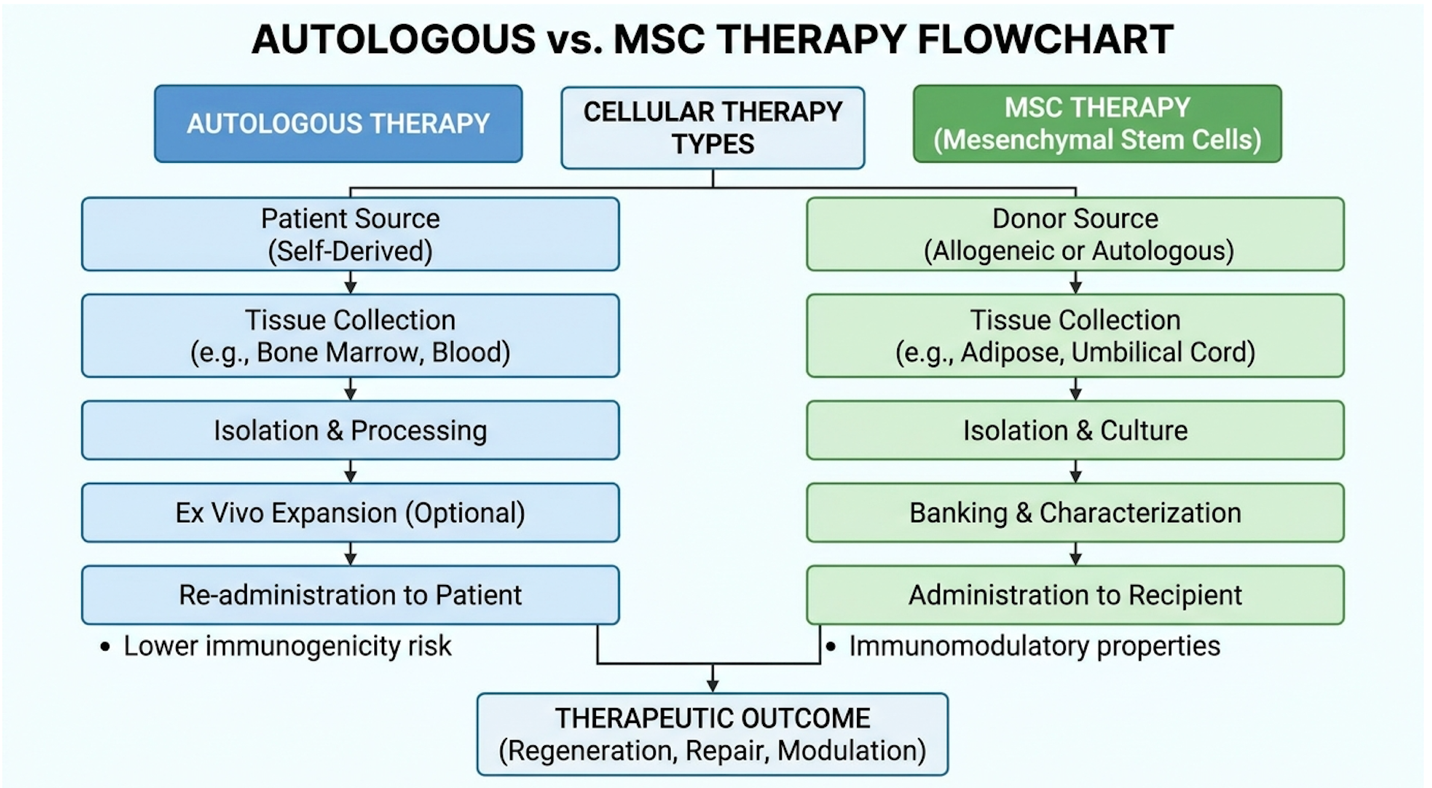
Flowchart comparing autologous stem cell transplants and MSC therapy for Crohn’s disease. The most intensive of these approaches aims for a complete immunological reboot.
Patients frequently wonder: can stem cells heal the gut directly? The clinical answer is yes, they can actively support gut healing by promoting localized mucosal regeneration and reducing chronic tissue inflammation. Instead of merely masking symptoms like corticosteroids do, cellular therapies target the cellular architecture itself. By shifting the intestinal environment from a pro-inflammatory state to a tissue-repairing state, these therapies help close ulcers and seal fistulas, offering a biological path forward when pharmacology hits a wall.
When we talk about HSCT, the goal is to literally reset the patient’s immune system. Think of Crohn’s disease as a software glitch where your T-cells have permanently memorized that your intestinal lining is a hostile invader. No matter what you eat, those cells attack.
The process begins by mobilizing stem cells out of the bone marrow using a drug called G-CSF. The cells are collected via an apheresis machine and cryopreserved. Then, the chemotherapy phase wipes the immune system’s memory by driving those malfunctioning T-cells into apoptosis (cell death). When the cleaned, harvested stem cells are reintroduced, they generate new immune cells. These new cells are naïve. They haven’t learned the “glitch” that causes Crohn’s. A clinical review of autoimmune resets via HSCT confirms that this process fundamentally alters the T-cell receptor repertoire. It’s a fascinating biological gamble: kill the corrupted memory and hope the new system boots up flawlessly. While HSCT handles the systemic immune dysfunction, healing the physical damage to the gut lining requires targeted cellular activity.
For MSC therapy, the biological magic lies in paracrine signaling. This is the core engine of any valid regenerative treatment for Crohn’s disease. When MSCs are introduced to highly inflamed intestinal tissue, they don’t just engraft and become new gut cells they communicate and modulate.
Mesenchymal stem cells act as “hit and run” mediators. They release specific bioactive cytokines like Prostaglandin E2 (PGE2), TSG-6, and TGF-beta. These molecules actively suppress the proliferation of aggressive T-cells and induce the formation of regulatory T-cells (Tregs). More impressively, MSCs force phenotypic macrophage reprogramming. They command local M1 macrophages (which aggressively destroy tissue) to transform into M2 macrophages (which actively build and repair tissue). This shifts the gut environment from a pro-inflammatory state directly into The Cellular Healing Continuum. As documented by mechanisms of mucosal healing via cellular therapy (2026), these cells also stimulate local fibroblasts to lay down fresh, healthy extracellular matrix, physically patching the microscopic holes in the gut lining. Translating these complex biological mechanisms into patient realities, however, requires navigating significant logistical and financial hurdles.
| 📌 If you’re interested in how MSCs calm an overactive immune system without wiping it out, we have an interesting article that discusses mesenchymal stem cell therapy for immune modulation, which you can read via the internal link. |
Accessing cellular therapy involves significant financial and logistical barriers. Investigational stem cell injections cost between $5,000 and $25,000, routinely lacking standard insurance reimbursement (ClinicalTrials.gov data, 2026). Participation in regulated clinical trials remains the most medically sound access pathway for patients seeking these advanced protocols.
Let’s look at the financial damage. The average cost of a stem cell injection for localized perianal fistulas usually hovers between $5,000 and $10,000 per round. For systemic MSC IV infusions, that number climbs rapidly. If we are talking about a full-blown autologous HSCT procedure including weeks of hospitalization and chemotherapy the stem cell therapy for Crohn’s disease cost easily shatters the $150,000 mark.
| 📌 If you’re comparing treatment budgets and want to see what stem cell therapy typically costs in Thailand, we have an interesting article that discusses stem cell therapy costs in Thailand, which you can read via the internal link. |
Here’s the brutal reality: because these therapies remain investigational for Crohn’s, major insurance carriers routinely deny coverage. They code it as “experimental.” Appealing these denials requires exhaustive documentation proving you have failed every available biologic. Patients are frequently left draining retirement accounts or crowdfunding to pay entirely out-of-
If you want access without bankruptcy, stem cell clinical trials are your best bet. Finding funded or regulated access points requires aggressively monitoring ClinicalTrials.gov for active recruitment phases.
You need to look for Phase II or Phase III trials specifically targeting refractory Crohn’s. Some programs offer compassionate use exemptions, but the paperwork is staggering. The Mount Sinai Research portal detailing trial enrollment and clinical criteria (2026) shows that patients must prove they have exhausted all FDA-approved biologics before they even qualify for an intake screening. Insurance might cover the standard hospital room and board during a trial, but the investigational cell product itself is usually covered by the study’s sponsor. Enrolling in these trials requires identifying hospitals with specialized infrastructure.
Do not fly to a strip-mall clinic in another country offering magic fat-derived stem cells. You must identify authoritative, heavily regulated programs. The gold standard is a dedicated Crohn’s Disease Stem Cell Transplantation Program embedded within a major university research hospital.
Institutions like Mount Sinai, Mayo Clinic, and UC Davis represent the pinnacle of care. The best stem cell clinic for Crohn’s disease treatment isn’t a “wellness” center; it’s a hematology-oncology ward equipped to handle massive immune suppression and infectious disease fallout.
** Checklist of 5 signs a patient may qualify for a Crohn’s stem cell clinical trial
If a clinic guarantees a cure or refuses to discuss severe adverse events, walk away immediately. While pursuing these advanced clinical options, patients must maintain rigorous daily symptom management.
Advanced medical interventions must be supported by strict daily dietary management. Raw insoluble fibers trigger severe inflammatory flare-ups in up to 60% of stricturing Crohn’s cases (Clinical nutrition review, 2026). Identifying precise dietary triggers and beneficial nutrients is fundamental to sustaining clinical remission.
Patients constantly ask: why can’t you eat lettuce with Crohn’s? It seems counterintuitive—isn’t salad healthy? Not when your bowel is ulcerated and strictured. Insoluble fiber (roughage) does not break down in water. When it travels through a diseased intestine, it acts like sandpaper scraping against open wounds.
The mechanical friction of raw lettuce against inflamed strictures causes micro-trauma, leading to massive swelling and agonizing cramps. It’s simple physics in a compromised tube. This makes raw greens some of the absolute worst foods to avoid Crohn’s flare-ups. You also need to aggressively eliminate raw cruciferous vegetables (broccoli, cauliflower), seeds, nuts, and popcorn. Popcorn kernels are particularly dangerous, as the hulls frequently lodge inside fibrotic strictures, causing full-blown mechanical bowel obstructions that require emergency surgery. Conversely, selecting easily digestible, nutrient-dense alternatives actively supports mucosal healing.
Evidence-Informed Super Foods
If we strip away the roughage, what’s left? A true super food for Crohn’s disease must be low-residue, hyper-nutrient-dense, and highly bioavailable. Your broken gut needs calories and protein it doesn’t have to work hard to absorb.
Bone broth is foundational. It’s packed with collagen, glutamine, and amino acids that directly support the repair of the intestinal lining without requiring mechanical digestion. Well-cooked, pureed squashes (like butternut or acorn) provide vital potassium and soluble fiber. Unlike insoluble fiber, soluble fiber turns into a soothing gel that aids in smooth transit. Wild-caught
** Visual guide showing worst foods to avoid and super foods for Crohn’s disease
Dietary interventions form the foundation of global holistic approaches to IBD management.
What is the most successful treatment for Crohn’s disease?
The most successful treatment for Crohn’s disease depends heavily on disease severity, but biologic therapies (like infliximab) remain the gold standard for inducing initial remission. For patients who fail biologics, surgical bowel resection or investigational autologous stem cell transplantation represent the highest tier of intervention. Efficacy varies widely based on individual disease phenotypes and stricture development. Clinical data indicates that combining targeted pharmaceutical therapies with precise dietary management yields the most durable outcomes (PubMed cohort analysis, 2026). Patients must undergo rigorous suitability assessments to determine their optimal treatment pathway.
Medical science is currently not close to a definitive cure for Crohn’s disease, as it involves complex genetic and environmental autoimmune triggers. However, treatments have advanced significantly toward achieving deep, long-term clinical remission and mucosal healing. Advanced modalities like Mesenchymal Stem Cell (MSC) therapy aim to halt disease progression rather than offer a guaranteed cure. Ongoing clinical trials continue to explore immune system resetting techniques to extend remission periods indefinitely. Any claims of a guaranteed cure by commercial clinics should be viewed with extreme medical skepticism.
Stem cells can support gut healing by promoting localized mucosal regeneration and reducing chronic tissue inflammation. Mesenchymal stem cells secrete bioactive molecules that stimulate dermal fibroblasts and encourage the synthesis of extracellular matrix proteins. This paracrine signaling helps shift the intestinal environment from a pro-inflammatory state to a tissue-repairing state. Research demonstrates measurable success in healing complex perianal fistulas using targeted cellular injections (Lancet cohort analysis, 2026). Systemic healing of the entire gastrointestinal tract, however, remains under rigorous clinical investigation.
A major new breakthrough in Crohn’s disease treatment involves the application of autologous hematopoietic stem cell transplantation (HSCT) for highly refractory patients. This process uses high-dose chemotherapy to ablate the malfunctioning immune system, followed by a reinfusion of the patient’s own stem cells to build a naïve immune response. Recent trials report clinical remission rates approaching 30% in patients who previously failed all conventional biologics (UC Davis Health, 2026). Additionally, targeted MSC injections for perianal fistulas represent a significant localized breakthrough. These procedures remain largely restricted to specialized clinical trial settings.
The number of stem cell infusions needed for Crohn’s disease varies entirely by the specific protocol, ranging from a single massive transplant to multiple localized injections. Autologous HSCT typically involves one intensive, multi-stage procedure requiring weeks of hospitalization for immune ablation and cell engraftment. Conversely, MSC therapy for localized issues like perianal fistulas may involve a single direct injection or a short series of targeted infusions. There is currently no universally approved standardized dosage or frequency for Crohn’s disease. Treatment frequency must be determined by a specialist operating within a regulated clinical trial framework.
An evidence-based alternative treatment for Crohn’s disease besides biologics includes targeted dietary therapies, immunomodulators (like azathioprine), or surgical resection. For patients
For patients with refractory Crohn’s disease, stem cell therapy offers a potential pathway to clinical remission, demonstrating up to a 35.8% healing rate for complex fistulas in recent trials (Springer Stem Cell Research, 2026). The most effective approach combines rigorous clinical trial participation, specialist oversight, and strict dietary management to control inflammation.
Moving forward on The Cellular Healing Continuum requires a fundamental shift in mindset. Transitioning from conventional symptom suppression to genuine, cellular-level mucosal healing means abandoning unproven commercial clinic promises in favor of regulated, evidence-led medical science. The biological potential is massive, but the execution must be clinical, calculated, and highly regulated.
Patients exhausting conventional options should compile their comprehensive medical records, endoscopy reports, and recent imaging to seek a formal suitability assessment with a university-backed stem cell transplantation program or board-certified gastroenterologist.