Our Services
Others
- DFPP
- Shockwave
- IV Drip

For decades, pulmonary medicine has treated chronic lung disease as a one-way path of deterioration, offering symptom management rather than structural repair. Patients facing declining lung function eventually hit a frustrating plateau. Conventional inhalers, oral steroids, and oxygen therapy do heavy lifting, sure. But they cannot prevent the relentless progression of fibrosis and deep cellular inflammation.
A comprehensive review of recent clinical trial data reveals a stark disconnect between what patients want actual tissue healing and what standard medicine provides. This clinical overview explains how stem cell therapy works for lung disease, detailing the exact biological mechanisms of Umbilical Cord Mesenchymal Stromal Cells (UC-MSCs). We will evaluate the cellular science, ethical considerations, and logistics of seeking regenerative treatment as of Q1 2026.
Before looking at the biological mechanisms and financial realities of these advanced interventions, understand this baseline fact.
This article is for educational purposes only and does not replace consultation with a qualified medical professional.
Understanding how stem cell therapy works for lung disease requires distinguishing between basic symptom management and deep cellular regeneration.
Standard pharmacological interventions consistently fail to reverse progressive lung disease. While bronchodilators manage acute respiratory restrictions, they do not halt the underlying cellular deterioration. When patients start looking for regenerative options, it is usually because they have hit the absolute ceiling of what a traditional pharmacy can offer.
Pulmonary fibrosis, a progressive scarring of lung tissue, perfectly illustrates this biological wall. When you look closely at standard pharmacological interventions corticosteroids and long-acting beta-agonists they simply are not designed to heal. They manage the crisis. They open airways temporarily. They suppress massive immune overreactions.
But they ignore the root cause. Chronic exposure to internal inflammatory factors or external toxins causes deep, irreversible cellular senescence in lung tissue (Source: Thorax Medical Journal, 2024). Think of it like skin aging under harsh UV light, but happening inside your chest cavity. Your lung cells essentially forget how to divide and repair themselves correctly. The extracellular
When a patient relies entirely on inhalers to manage COPD symptoms, they are often just masking ongoing biological deterioration. The disease continues its march. Standard COPD therapies manage symptoms but cannot reverse the fundamental cellular senescence driving chronic lung disease.
Clinical data indicates that traditional inhaled therapies slow forced expiratory volume (FEV1) decline marginally typically by only 10-15 mL per year so patients inevitably hit a wall where pharmacological options run out (Source: European Respiratory Review, 2023). Look, steroids certainly reduce acute airway swelling. But they do not rebuild the damaged extracellular matrix, nor do they instruct dying lung cells to regenerate. While conventional medicine focuses heavily on delaying this inevitable functional decline, advanced cellular therapies attempt to address the inflammatory root cause directly. They work to alter the actual biological environment of the lungs rather than just widening a damaged airway.
To answer the question can stem cells repair your lungs?, one must understand that clinical efficacy stems from immunomodulation rather than simple tissue replacement. UC-MSCs promote lung tissue repair through advanced paracrine signaling shifting the pulmonary microenvironment from ongoing destruction to active regeneration. This complex cellular mechanism makes them a massive focal point in regenerative pulmonology today.
Forget the outdated idea that you inject stem cells and they magically turn into new lung tissue. That just isn’t what happens in clinical reality.
Structural repair relies entirely on paracrine signaling, the highly complex process by which cells secrete bioactive molecules to influence adjacent cells. UC-MSCs an abundant, youthful source of active progenitor cells secrete a massive array of these molecules, known collectively as secretomes. These include exosomes, microvesicles, and crucial growth factors like Vascular Endothelial Growth Factor (VEGF), Hepatocyte Growth Factor (HGF), and Keratinocyte Growth Factor (KGF).
VEGF specifically encourages angiogenesis, attempting to rebuild the damaged microvascular network that supports healthy alveoli. HGF acts as a potent anti-fibrotic agent, actively fighting the tissue scarring that defines advanced pulmonary fibrosis. These molecules act as biological command signals. They actively stimulate your own quiescent (sleeping) fibroblasts to wake up and start repairing the damaged extracellular matrix (Source: Stem Cells Translational Medicine, 2025). Furthermore, according to studies published in the National Institutes of Health archives, these stem cells aggressively inhibit Toll-like receptor 4 (TLR4) pathways. Shutting down these pathways directly halts the destructive signaling cascades that trigger acute COPD exacerbations and fibrosis flare-ups.
Clinical experts use The UC-MSC Clinical Viability Matrix to determine true treatment suitability. This matrix assesses three pillars: your current inflammatory load, the viability of the UC-MSC secretome being used, and the delivery method. Deploying high-quality, youthful progenitor cells into a severely inflamed lung environment requires exacting doses. When executed correctly, this represents a profound shift from purely suppressive medicine to proactive cellular signaling.
Beyond reducing basic airway swelling, stem cells and lung inflammation interact at a deeper, highly complex immune level. This is where phenotypic macrophage reprogramming comes into play.
Your immune system relies heavily on macrophages to clean up cellular debris and manage local threats. In chronic lung disease, these macrophages get stuck in an “M1” state which is highly pro-inflammatory and actively tissue-destructive. M1 macrophages constantly release cytokines that degrade tissue, essentially trapping the lung in a permanent state of emergency.
By introducing UC-MSCs, the resulting secretome flood forces a powerful biological switch. They secrete factors like Prostaglandin E2 (PGE2) that push the local immune microenvironment to convert these aggressive cells into an “M2” state. This M2 state is completely anti-inflammatory and geared entirely toward structural tissue repair. Furthermore, this shift promotes the recruitment of regulatory T-cells (Tregs), which act as immune peacekeepers, ensuring the inflammation doesn’t immediately return once the stem cells clear the body.
| 📌 If you’re interested in how MSCs shift the immune system from attack mode to repair mode, we have an interesting article that discusses mesenchymal stem cell therapy for immune modulation, which you can read via the internal link. |
This exact UC-MSC lung disease mechanism is what drives modern regenerative research. By controlling tissue-transforming growth factor (TGF-beta) signaling, the stem cells stop your body from over-activating myofibroblasts.
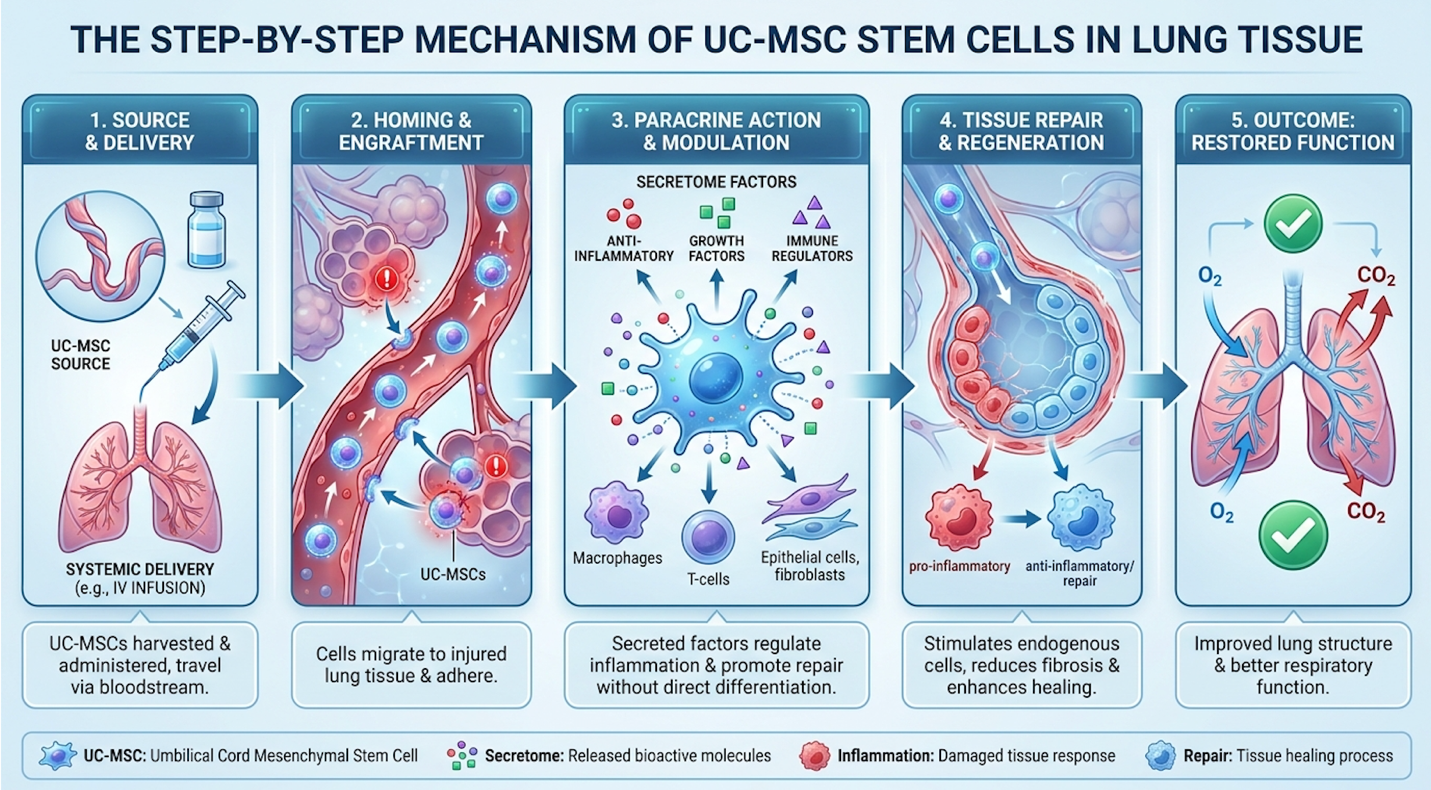
Preventing that myofibroblast over-activation is exactly what stops excessive tissue fibrosis from locking up the lungs. When people ask how stem cells repair lung tissue, the answer fundamentally relies on that M1-to-M2 macrophage shift. The benefits of stem cell therapy for lungs are rooted in this precise immune system override.
So, exactly how long does mesenchymal stem cell therapy last? You need to set extremely realistic expectations here. Biological improvement does not mean you will run a marathon next month. It isn’t a magic overnight cure.
Improvement is typically measured in daily quality of life, a reduced frequency of acute exacerbations, and stabilized functional capacity over time. The infused cells themselves do not
In early-phase clinical observations, improvements in functional capacity often plateau after 12 to 18 months (Source: Stem Cell Research & Therapy, 2024). Because of this plateau, specialists increasingly view regenerative therapy as an ongoing maintenance protocol rather than a one-time event, requiring subsequent booster infusions for some patients to maintain peak respiratory function. Clinicians rigorously assess functional outcomes, like the 6-minute walk distance and forced expiratory volume (FEV1), at 3, 6, and 12 months post-infusion to verify actual biological efficacy.
| 📌 If you’re interested in whether a second dose can extend the benefits of the first, we have an interesting article that discusses why double-dose UC-MSC therapy may offer greater benefits than a single dose, which you can read via the internal link. |
Evaluating the effectiveness of cellular therapies requires looking past subjective patient testimonials and examining hard clinical endpoints. When specialized regenerative clinics implement these protocols, they track specific, quantifiable metrics to determine success.
Beyond the spirometer, quality of life (QoL) improvements are rigorously tracked using the St. George’s Respiratory Questionnaire (SGRQ). This metric accounts for the psychological and physical burden of chronic breathlessness. Many patients report that even when FEV1 shows only stabilization rather than massive gains, their perceived ease of breathing and ability to perform daily tasks improves significantly. This divergence highlights why functional capacity is just as crucial to monitor as raw lung volume.
When patients ask what are the potential downsides of stem cell therapy, the answer lies almost entirely in clinical uncertainty and regulatory variance. Systemic adverse events remain low in regulated settings proving that rigorous clinical evaluation is absolutely essential before Responsible medical communication demands we actively distinguish established, standardized hospital treatments from investigational clinic applications.
Not everyone qualifies for cellular regeneration. Let’s be entirely blunt about the medical downsides. Patients with active systemic infections or certain active malignancies are immediately disqualified from treatment. Introducing powerful growth factors (like VEGF, which stimulates blood vessel growth) into a body fighting active cancer is incredibly dangerous, as it can inadvertently feed tumor expansion.
| 📌 If you’re interested in how to tell a well-regulated stem cell clinic from a risky one, we have an interesting article that discusses whether stem cell therapy is safe in Thailand, which you can read via the internal link. |
You also face severe risks associated with poor cell processing and improper administration. While immune rejection is remarkably rare with UC-MSCs, the primary risk involves unregulated clinics lacking standardized protocols. If a commercial clinic uses unverified procedures, you might receive dead cells, contaminated samples, or clumped cells that can cause dangerous microvascular embolisms in the lungs. In fact, the FDA explicitly warns against unapproved stem cell therapies, noting severe adverse events resulting from unregulated facilities that fail to maintain basic biological standards.
Historically, the most successful stem cell therapy involves hematopoietic stem-cell transplantation for blood disorders using bone marrow. Mesenchymal stem cells for lung disease remain investigational. They show massive biological promise, but they lack the decades of standardized regulatory approval that bone marrow transplants possess.
A common question among patients is: why are people against stem cell therapy?
The pushback almost always stems from outdated information. Decades ago, research relied heavily on embryonic stem cells, which historically sparked massive ethical and religious debates.
Today’s regenerative pulmonology rarely touches them. Umbilical cord stem cells for lung disease are entirely different. UC-MSCs are ethically sourced from donated, full-term umbilical cords following healthy, normal births. The tissue would otherwise be discarded as medical waste. Reputable laboratories subject these donated tissues to exhaustive screening, including comprehensive karyotyping and infectious disease panels, ensuring absolute safety and ethical compliance (Source: Stem Cells Translational Medicine, 2026). There is zero ethical controversy
What can stem cells currently fix or cure in 2026?
Nothing, They do not “cure” end-stage COPD. Anyone promising a 100% reversal of advanced pulmonary fibrosis is misrepresenting the clinical reality (Source: Chest Journal, 2025). The cellular damage sustained over decades cannot be undone in an afternoon. For progressive lung disease, the therapeutic goal is halting progression, managing deep inflammation, and facilitating mild to moderate tissue repair. As regenerative medicine expands globally, researchers are actively focusing on isolated exosome therapies to refine these repairs even further by 2030. You must weigh these realistic scientific capabilities against the aggressive marketing hype dominating search engines.
Stem cell therapy may improve breathing and oxygen levels by reducing chronic inflammation and halting progressive tissue scarring in the lungs. Clinical observations indicate that some patients experience enhanced functional capacity and reduced reliance on supplemental oxygen following UC-MSC administration. These functional improvements occur because the secretomes actively modulate the local immune microenvironment. However, actual functional gains depend heavily on the baseline severity of the pulmonary disease. Individual results vary dramatically, and routine pulmonary function testing is required to verify actual clinical improvements over time.
Stem cells for lung disease are predominantly administered via intravenous (IV) infusion or targeted inhalation. Intravenous delivery allows the cells to naturally circulate and become trapped in the pulmonary capillary beds, placing them directly at the site of deep lung injury. Inhalation or nebulization protocols aim to deliver the active secretomes directly to the airway
A good candidate for stem cell therapy is typically an individual with chronic, stable pulmonary disease who has exhausted standard pharmacological treatments. Ideal candidates possess sufficient baseline health to travel and undergo systemic infusion without risking acute respiratory distress. Patients with active systemic infections, acute disease exacerbations, or certain active malignancies are generally excluded from treatment protocols. Suitability relies entirely on an individualized medical evaluation encompassing recent imaging and extensive pulmonary function tests. Consultation with a regenerative specialist never guarantees treatment eligibility.
For patients heavily researching how stem cell therapy works for lung disease, UC-MSCs offer a profound biological intervention that directly targets the inflammatory root causes of pulmonary decline. Studies archived in peer-reviewed respiratory journals suggest these cells can reduce local lung tissue fibrosis markers significantly, shifting the microenvironment from destruction to repair. The most responsible, effective approach combines rigorous patient selection, ethical cellular sourcing, and treatment at specialized international clinics capable of advanced cell expansion.
Applying The UC-MSC Clinical Viability Matrix ensures patients can move confidently beyond internet hype, accurately assessing their true medical candidacy based on disease stage and clinical expertise. This evidence-led framework provides a highly logical pathway out of the frustrating holding pattern of conventional symptom management.
Patients seriously considering a regenerative intervention must take proactive steps today. Compile your most recent high-resolution CT scans and spirometry results, and schedule a formal suitability assessment with a board-certified regenerative pulmonologist to determine if this framework applies to your specific diagnosis. This article is for educational purposes only and does not replace consultation with a qualified medical professional.