Our Services
Others
- DFPP
- Shockwave
- IV Drip

Most conversations about autism treatment focus on core symptoms communication, social interaction, repetitive behaviors. What gets discussed far less often is everything that tends to travel alongside those core symptoms: disrupted sleep, gastrointestinal distress, anxiety. For many families, these co-occurring conditions aren’t a footnote they’re a daily reality that shapes everything else. Understanding how stem cell therapy in Thailand relates to this fuller picture, not just core ASD symptoms, matters for setting realistic expectations.
Autism Rarely Shows Up Alone
The numbers here are larger than most people expect. Research indicates over 90% of children with ASD have at least one co-occurring medical condition gastrointestinal disorders affecting up to 70%, sleep problems in 50–80%, and movement disorders in a substantial share as well. This isn’t a small subset of cases; it’s closer to the norm.
If GI distress, poor sleep, and anxiety are present in the large majority of autistic children, then a treatment’s effect on those systems matters just as much as its effect on core social-communication symptoms arguably more, day to day, for many families. This is where the discussion around UC-MSC stem cell therapy gets more useful when it moves past core symptoms alone.
The Gut-Immune-Brain Connection in Autism
GI symptoms in ASD aren’t just uncomfortable research has linked them to more pronounced difficulties in cognition and behavior. Studies have specifically connected cytokine levels and endocrine stress response to gastrointestinal symptoms in autism, pointing to inflammation as a shared thread rather than GI issues being an unrelated, parallel problem.
Why This Matters for Systemic Therapies
Because UC-MSC stem cell therapy for autism works through systemic anti-inflammatory and immune-modulating action not a localized, single-symptom target its relevance to GI symptoms is a legitimate extension of the same biological rationale behind its use for core neurological symptoms, not a separate claim requiring separate justification.
1.Sleep Disturbance and Its Ripple Effects
Sleep problems in autism aren’t isolated from everything else. Research using network analysis has found that disturbed sleep interconnects with anxiety, restricted and repetitive behaviors, and broader behavioral difficulties meaning poor sleep doesn’t just cause tiredness, it appears to amplify other symptoms families are already managing.
A 2023 study of preschool-age autistic children found that more severe sleep disorders correlated with higher scores across internalizing, externalizing, and total behavioral problem scales and that the relationship between poor sleep and repetitive behaviors was explained in part by anxiety. Sleep isn’t a side issue; it’s connected to the core presentation in ways that make it a meaningful treatment target in its own right.
2.Anxiety and Emotional Regulation
Anxiety appears frequently alongside ASD, and it interacts with nearly everything else discussed here sleep, GI symptoms, and behavioral regulation all show meaningful connections to anxiety in the research literature. Addressing anxiety specifically has been shown, in some studies, to produce downstream improvement in sleep as well, underscoring how interconnected these systems really are.
Families often describe meaningful changes in terms of calmer emotional regulation and steadier day-to-day functioning fewer meltdowns, more consistent mood, easier transitions rather than only core social-communication metrics. That’s a legitimate and important way to measure whether a treatment approach is actually helping a child’s daily life, not a lesser outcome than core symptom change.
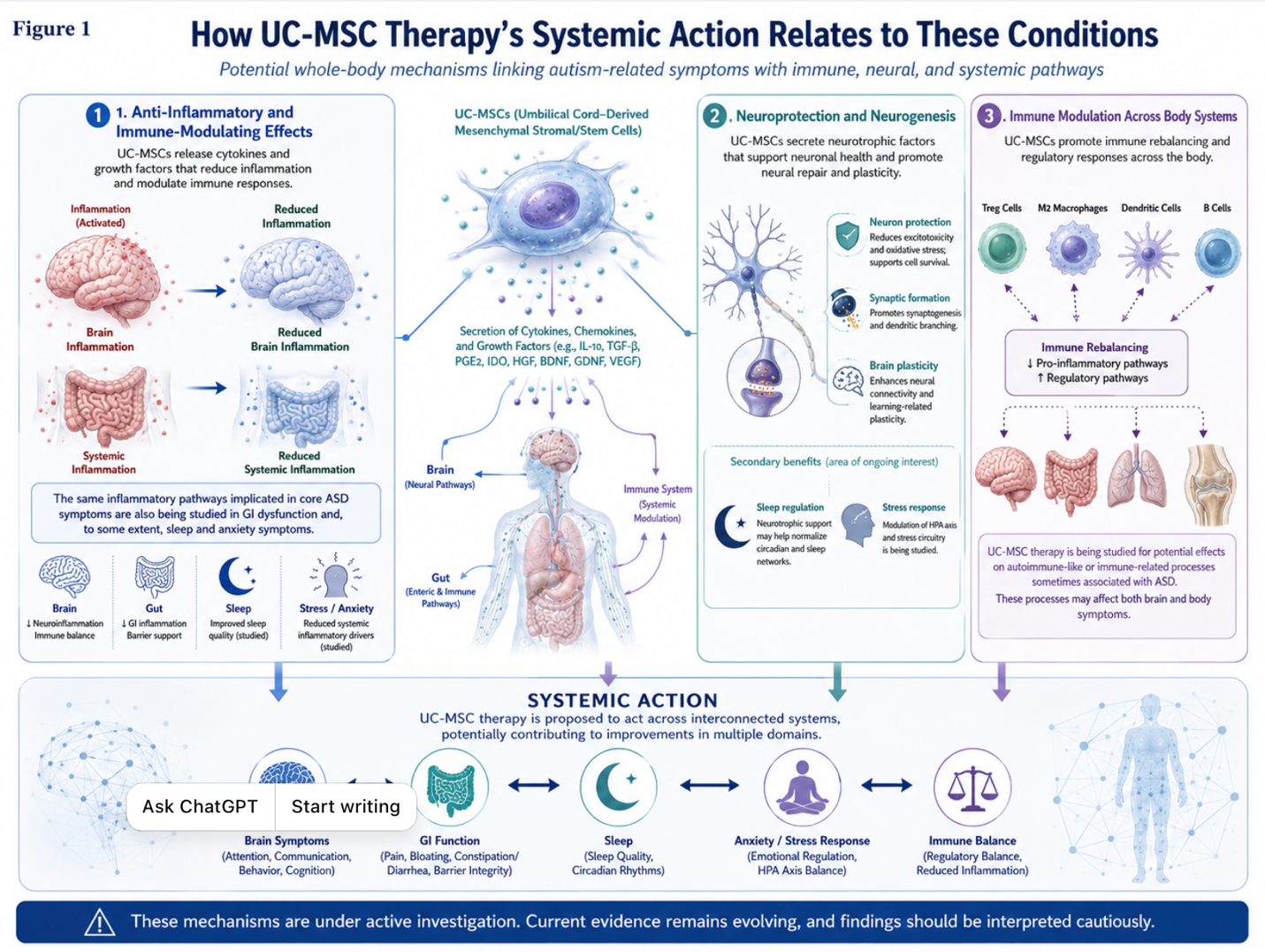
1.Anti-Inflammatory and Immune-Modulating Effects
UC-MSCs release cytokines and growth factors that reduce both brain and systemic inflammation systemic being the operative word, since the same inflammatory pathways implicated in core ASD symptoms are also implicated in GI dysfunction and, to some degree, sleep and anxiety symptoms.
2.Neuroprotection and Neurogenesis
These cells secrete neurotrophic factors that protect neurons, support synaptic formation, and enhance brain plasticity mechanisms studied primarily for their relevance to learning and adaptability, though their broader effect on the nervous system’s regulation of sleep and stress response is a reasonable area of ongoing interest.
3.Immune Modulation Across Body Systems
By helping rebalance immune responses broadly, UC-MSC therapy is studied for its potential to ease autoimmune-like processes sometimes associated with ASD processes that don’t respect the boundary between “brain symptoms” and “body symptoms” the way older treatment models assumed they did.
Treatment typically involves intravenous infusion, delivering cells systemically rather than to one isolated site a meaningful detail given how interconnected core and co-occurring symptoms appear to be. In some cases, intrathecal delivery is used to more directly target the central nervous system. Protocols vary by age, symptom severity, and individual health status, and a series of infusions over several months is often recommended alongside continued behavioral therapy, rather than as a single standalone procedure.
Early-phase clinical trials and observational studies exploring UC-MSC stem cell therapy for autism have reported improvements in language acquisition, eye contact, reduced hyperactivity, and social engagement, along with parent-reported gains in emotional regulation. Research specifically isolating effects on co-occurring GI and sleep symptoms is more limited than research on core symptoms an honest gap worth naming rather than glossing over. The biological rationale connecting systemic anti-inflammatory action to these co-occurring conditions is genuinely reasonable; it isn’t yet backed by the same volume of dedicated clinical data as core symptom research. Large-scale, randomized controlled trials remain necessary before firm conclusions can be drawn across any of these outcome areas.
Stem cell therapy in Thailand has grown around clinics equipped to consider a child’s full clinical picture not just core ASD symptoms in isolation. GMP-certified laboratories, physicians trained in both regenerative medicine and pediatrics, and integrated care models that combine UC-MSC therapy with behavioral, nutritional, and developmental support reflect how interconnected these symptoms actually are in practice. Costs typically run 50–70% below equivalent care in Western countries, which matters for families managing the kind of multi-system, ongoing care that co-occurring conditions often require.
Vegastemcell‘s approach to autism stem cell treatment in Thailand begins with a full assessment that considers a child’s complete clinical picture core symptoms alongside GI, sleep, and emotional regulation concerns rather than treating co-occurring conditions as separate from the main treatment plan. Physician-supervised UC-MSC administration is followed by structured follow-up tracking progress across these interconnected domains, not core symptoms alone.
Are GI and sleep problems actually connected to autism, or just coincidental?
Research points to a real connection rather than coincidence shared inflammatory pathways and interconnected symptom networks link GI distress, sleep disturbance, anxiety, and core autism traits in ways researchers are still actively mapping.
Can UC-MSC therapy help with sleep or GI symptoms specifically, not just core autism symptoms?
The biological rationale is reasonable, since UC-MSC therapy works through systemic anti-inflammatory and immune-modulating action rather than targeting one isolated symptom. Dedicated clinical evidence specifically measuring these outcomes is more limited than research on core symptoms, so this should be understood as a plausible extension of the therapy’s mechanism, not a separately proven claim.
Why do co-occurring conditions matter so much in autism care?
Because they’re extremely common over 90% of children with ASD have at least one co-occurring medical condition and because they interconnect with core symptoms in ways that affect daily functioning as much as, or more than, core symptoms alone.
How is UC-MSC stem cell therapy administered for autism?
Typically through intravenous infusion for systemic effect, sometimes combined with intrathecal delivery for more direct central nervous system targeting, usually across a series of sessions alongside continued behavioral therapy.
Why do families consider stem cell therapy in Thailand for this kind of integrated care?
Stem cell therapy in Thailand offers GMP-certified laboratories, physicians experienced in both regenerative medicine and pediatrics, and integrated treatment models addressing a child’s full clinical picture not just core symptoms at a cost typically 50–70% below Western countries.
Considering the Full Picture
Understanding autism as a condition that rarely travels alone with GI symptoms, sleep disturbance, and anxiety frequently along for the ride changes what “meaningful improvement” should actually look like when evaluating any treatment approach, including UC-MSC therapy. If you’re trying to understand how stem cell therapy in Thailand might address your child’s full clinical picture, not just core symptoms, book a consultation with Vegastemcell for an assessment grounded in your child’s complete situation.
For more infomation you can reach me directly on WhatsApp or Email. Here’s our official link:
WhatsApp :+66982509599
Email : vegastemcell@gmail.com