

Parkinson’s disease is a progressive neurodegenerative condition which mostly affects movement, coordination and motor control. Also it includes symptoms like tremors, stiffness, delayed movement and balance issues which over time will disrupt daily life and cause a loss of independence. Although present drugs and support therapies may ameliorate symptoms, they do not stop the progress of dopamine producing neurons’ degeneration which is at the base of Parkinson’s disease. Also in Thailand we see a growing interest in stem cell therapy which also reports in the field of regenerative medicine to treat this disease.
These new strategies put forth to support the brain’s biology by way of changing inflammation, cellular signals, and neural microenvironment.
Understanding Parkinson’s Disease Mechanisms
For example, Parkinson is a disease that results from the degeneration of dopamine generating neurons which are located in the substantia nigra. Dopamine is key to movement and coordination.
Several of which biological processes do to this degeneration:.
- Destruction of dopamine producing neurons.
- Neuroinflammatory processes which may speed up neuronal injury.
- Oxidative injury causing cell damage.
- Mitochondrial impairment which reduces energy production.
- Alpha accumulation of synuclein (protein aggregation) which in turn disrupts normal cell function.
These issues play out at the very beginning and as the disease progresses we see the introduction of more advanced and harder to manage symptoms.
Illustration of Parkinson’s disease mechanisms, including dopamine neuron loss, neuroinflammation, oxidative stress, and protein aggregation contributing to motor dysfunction.
Limitations of Conventional Treatment
Today, treatment strategies for Parkinson’s disease aim primarily at symptom management rather than changing the course of the disease.
- Common approaches include:
- Dopaminergic medications (e.g., levodopa)
- Physical and occupational therapy
- Deep brain stimulation (in selected cases)
While these treatments can make a huge difference to quality of life, they all have limitations:
- Effects may decrease over time
- Do not halt progressive neuronal loss
- Can be related to chronic side effects
- Never replace damaged nerve loss
These limitations have spurred interest in therapies that potentially support the brain at a more fundamental biological level.
Role of Stem Cell Therapy and Regenerative Medicine
This presents a paradigm shift, where regenerative medicine is not limited to replacing lost cells but also targeting the surrounding neural environment.
The most studied approach involves mesenchymal stem cells (MSCs), including umbilical cord–derived MSCs.
These cells probably exert their effect mainly through paracrine signaling, secreting bioactive molecules to modulate the neighboring tissues.
Potential mechanisms being studied include:
- Immunomodulation, helping regulate neuroinflammation
- Neuroprotection, encouraging the survival of existing neurons
- Decreasing oxidative stress, which in turn reduces cellular damage
- Enabling neural signaling, enhancing communication channels
- Angiogenesis, which increases the perfusion of blood into brain tissue
Instead of differentiating directly into neurons, these cells may serve a more supportive role in promoting neuronal function.
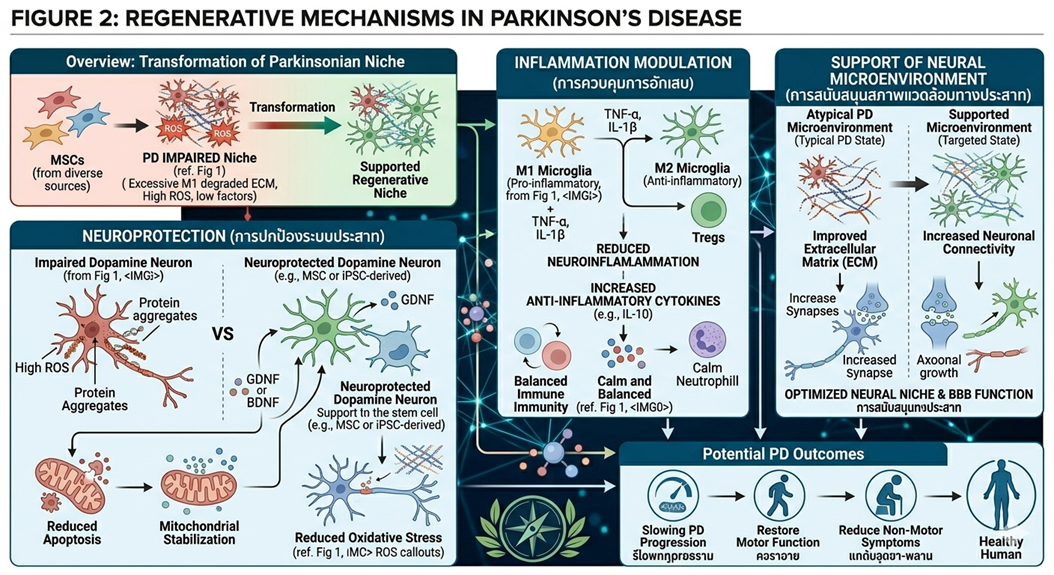
Conceptual illustration of stem cell–mediated mechanisms in Parkinson’s disease, including neuroprotection, inflammation modulation, and support of neural microenvironment.
Why Patients Consider Thailand
Patients seeking options for neurological conditions in the field of regenerative medicine flocked to Thailand.
Key reasons include:
- Advanced clinical and laboratory infrastructure
- Availability of regenerative medicine programs
- Medical/sustaining therapy together with supportive treatment in integrated care
- Experience in treating international patients
- Treated at a fraction of the price than many Western nations
These methods are generally employed in addition to standard treatment, rather than as a substitute.
Conclusion
Parkinson’s disease consists of progressive events that are mediated by complex neurodegenerative pathways. The limitations of current therapies focus on symptomatic management and are not directed at its fundamental cause, namely loss of neuronal function. Stem cell therapy in Thailand for Parkinson’s disease reflects a newfound area of the regenerative medicine field geared towards the support of the brain by way of mitigation between inflammation, cellular signaling and neuroprotective mechanisms.
These therapies, while investigational and with variable outcomes, reflect a broader-derived shift toward biologically informed modalities for managing neurological disorders. For many patients, the objective is maintaining function, improving quality of life and seeking other possibilities alongside standard treatment.