Our Services
Others
- DFPP
- Shockwave
- IV Drip

Autism Is More Than a List of Symptoms
Autism Spectrum Disorder (ASD) is a neurodevelopmental condition that affects communication, social interaction, and behavior. It shows up differently in every individual which is exactly why families researching it tend to end up with more questions than answers. Parents aren’t usually asking one narrow question; they’re asking all of them at once: Why is my child showing these signs? Can communication improve? What’s evidence-based, and what’s marketing dressed up as medicine?
That last question matters more than ever, because terms like regenerative medicine, bioregulatory therapy, and “personalized cellular treatment” now show up constantly in autism-related search results often without much explanation of what they actually involve.
How Autism Is Treated Today
Mainstream autism care is built around function, development, and support not a single biological fix. Behavioral therapy and speech-language intervention remain the most consistently effective tools available, particularly when started early. Public health guidance from bodies like the CDC and NIH continues to emphasize early intervention: identifying developmental delays before age three and connecting children with structured support as soon as possible. Research has repeatedly shown that delaying these interventions tends to correlate with more difficulty later on, which is part of why early screening is emphasized so heavily.
This is also the backdrop against which alternative or regenerative approaches get discussed. Interest in things like stem cell therapy bangkok thailand or acupuncture as adjunct approaches is real and growing, but none of it currently displaces or outweighs the value of established behavioral and developmental care. Any serious discussion of emerging biological approaches should say that plainly, not treat it as an afterthought.
Why Families Look Beyond Standard Therapy
Most families don’t start out looking for experimental options they start with the standard path. Interest in something like stem cell therapy bangkok thailand for autism tends to surface later, usually after progress feels slower than hoped or challenges remain despite years of consistent therapy. That search is rarely idle curiosity; it usually comes from a genuine hope that a more biologically targeted approach might help with behavior, function, or quality of life in a way current therapy hasn’t.
That hope is partly grounded in real, active research. Scientists have been studying neuroinflammation, immune signaling, and developmental biology in ASD for years, and some early studies have asked whether cellular or plant-derived compounds might influence inflammatory pathways relevant to autism. But it’s worth being precise here: this is a live area of investigation, not an established form of care.
What PhytoCellTec Technology Actually Is
PhytoCellTec is a biotechnology platform used to cultivate plant stem cells most notably through products like PhytoCellTec Malus Domestica and PhytoCellTec Exosomes. According to the technology’s own official materials, it’s developed and marketed for cosmetic and skin-related applications: supporting skin vitality and cell communication at a cosmetic level. It is not described, by its own developers, as a neurological therapy or an autism treatment.
That distinction is important. PhytoCellTec is a legitimate and interesting part of the broader plant-stem-cell and cosmetic biotechnology space. It is not, currently, established in any authoritative medical literature as an autism intervention. Any article or search result that blurs that line is stretching past what the technology’s own sourcing supports.
What the Stem Cell Research on Autism Actually Shows
Some early studies and reviews have looked at mesenchymal stem cells, cord-blood-derived cells, and bone-marrow-derived cells in the context of ASD, largely exploring whether they might influence immune regulation or neurodevelopmental signaling. The underlying theory is straightforward: if some features of autism involve altered immune or inflammatory activity in certain individuals, regenerative approaches might eventually be able to influence those processes.
Theory isn’t proof, though. Published reviews of this research consistently flag the same limitations:
Small sample sizes
Inconsistent cell preparation and sourcing between studies
Variable dosing and treatment timing
Enough methodological variation that similar-looking studies can produce different results
Some studies report encouraging early signals on certain measures, and meta-analytic literature has floated the possibility of improvement in specific areas. But nearly all of that literature ends with the same conclusion: larger, controlled, standardized trials are needed before any firm claims can be made. As of 2025, this research area including relevant Phase II trial work referenced in pediatric neurology literature is still best described as a field under development, not a validated treatment pathway.
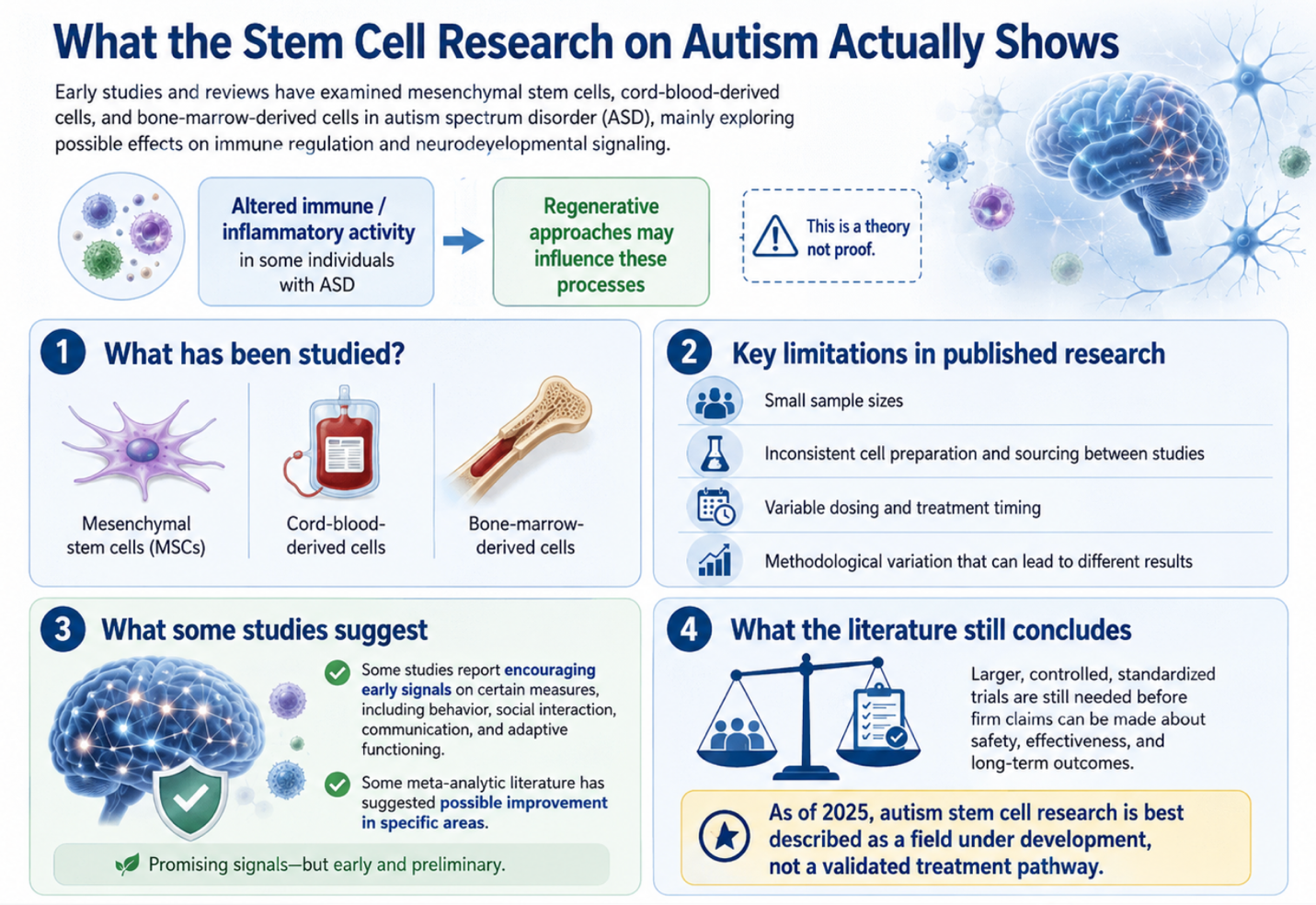
Figure 1: Current Evidence, Limitations, and Research Gaps in Stem Cell Therapy for Autism Spectrum Disorder
How to Think About This Topic Responsibly
Three things are true at the same time:
Autism is complex – It doesn’t have a single cause or a single fix, biological or behavioral.
Standard care remains the foundation. Behavioral therapy, speech-language support, and early intervention are still what the evidence most strongly supports today.
Regenerative medicine is a promising but unproven research direction. Stem cell approaches to autism are worth continued study they are not yet a routine or validated treatment.
Within that framing, PhytoCellTec Technology is best understood as an emerging idea in plant-stem-cell biotechnology, not as a proven or intended autism therapy.
Frequently Asked Questions
Is PhytoCellTec Technology a treatment for autism? No. According to its own official materials, PhytoCellTec is a plant-stem-cell biotechnology platform developed for cosmetic and regenerative skincare applications, not autism treatment.
Why do people search for stem cell therapy bangkok thailand for autism? Usually because standard therapies feel incomplete for their child, and they’re trying to understand whether biologically-targeted approaches might eventually play a role. The current evidence remains investigational rather than definitive.
This article is for general informational purposes and is not medical advice. Anyone considering stem cell therapy or other regenerative approaches for autism should discuss options with a qualified physician and review current, peer-reviewed evidence before making decisions.
For more infomation you can reach me directly on WhatsApp or Email. Here’s our official link:
WhatsApp :+66982509599
Email : vegastemcell@gmail.com