Our Services
Others
- DFPP
- Shockwave
- IV Drip

The long-term management of progressive striated muscle wasting, pathologically categorized within the family of genetic dystrophinopathies and limb-girdle muscular dystrophies, represents an exceptionally demanding structural hurdle in contemporary translational neurology. Characterized by a systemic instability of the skeletal muscle membrane envelope, this group of disorders subjects muscle fibers to continuous mechanical breakdown during normal physical movement.
Affected individuals face a predictable, highly aggressive sequence of musculoskeletal wasting: proximal lower limb weakness leads to characteristic compensatory movement patterns, progressively evolving into widespread muscle mass loss, joint contractures, loss of unassisted mobility, and eventual respiratory insufficiency due to diaphragmatic weakness.
For generations, conventional medical approaches to muscular dystrophy have operated within a reactive, palliative framework. The standard orthopedic and neurological playbook focuses heavily on managing surface-level physical symptoms: using external mobility braces, managing joint contractures through physical stretching, and relying extensively on oral corticosteroid drugs to slow down muscle loss. While these traditional interventions offer brief stabilization periods on paper, their long-term clinical utility is limited.
Long-term dependency on high-dose anti-inflammatory steroids carries well-documented, severe side effects, including metabolic imbalances, weight gain, and severe bone mineral thinning.
More importantly, traditional chemical modifications operate strictly as surface patches; they are incapable of correcting the deep biological failures driving the disease. Conventional drugs cannot stop ongoing muscle cell death, leave fat and fibrotic tissue infiltration untouched, and completely fail to repair the chronic localized tissue inflammation that continuously suffocates surviving muscle fibers.
Translational molecular biology provides a proactive alternative by targeting the microenvironmental conditions of the skeletal muscle niche directly at the source. By leveraging high-potency cellular matrices, advanced clinical protocols utilizing stem cell therapy bangkok thailand shift the treatment framework from superficial symptom suppression to direct microenvironmental modification.
Administered via optimized systemic delivery and target-focused muscle infusions, these fresh allogeneic cell lines function as active signaling hubs. They navigate directly toward injured muscle zones, drop off highly concentrated exosomal messages, suppress chronic auto-inflammatory loops, block the overgrowth of scar tissue, and support the body’s natural cellular pathways to protect surviving muscle fibers from progressive decay.
1. The Myofiber Niche Collapse: Sarcolemmal Tears and Satellite Cell Exhaustion
To see why traditional treatments eventually plateau and how stem cell therapy bangkok thailand alters long-term musculoskeletal health, the biological lens must look past outward physical weakness and examine the deep cellular breakdowns occurring along the muscle fiber border. Healthy skeletal muscle architecture relies on a highly specialized, shock-absorbing structural link that connects the interior cellular skeleton directly to the surrounding tissue support grid.
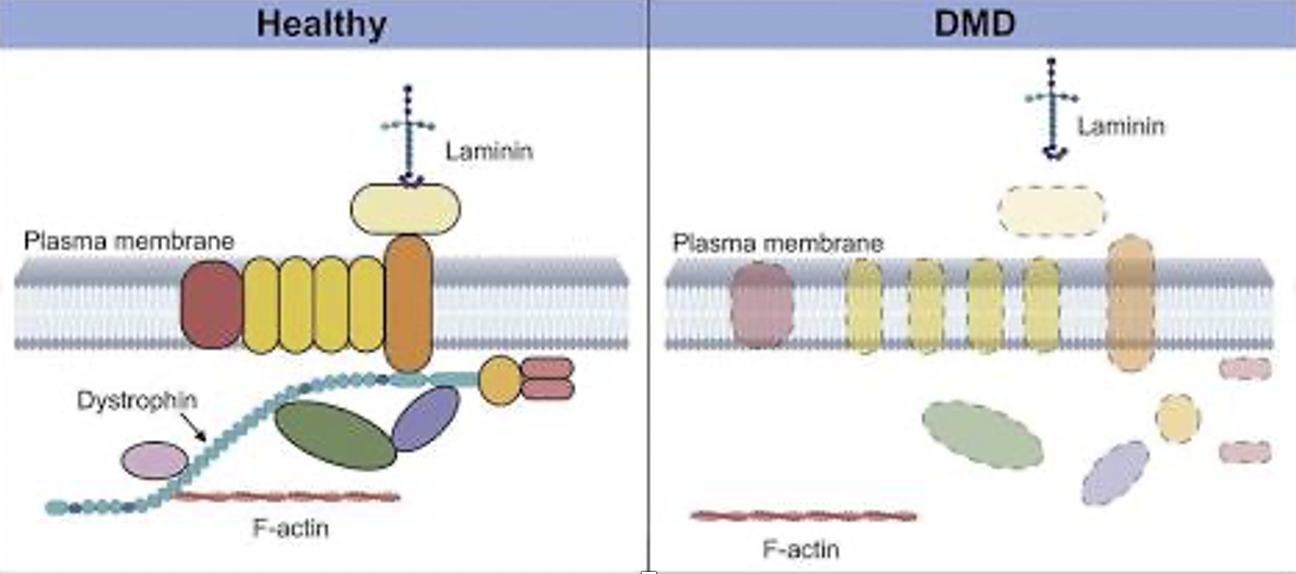
The structural pathomechanisms of sarcolemmal membrane fragility in Muscular Dystrophy.
As shown in the structural comparison above, a healthy muscle membrane relies on a complete, uncompromised anchoring framework to withstand the mechanical loading forces of daily muscle contraction. In the development of advanced muscular dystrophy, the genetic absence or structural defect of this anchoring complex causes the outer membrane, the sarcolemma to become exceptionally fragile. During every contraction cycle, the mechanical tension tears open microscopic sarcolemmal holes, allowing a massive, unchecked influx of extracellular calcium ions directly into the muscle cell cytoplasm.
This calcium overload triggers an immediate cellular emergency. The excess calcium activates destructive internal enzymes called calpains, which aggressively digest structural proteins from within, forcing the myofiber into progressive necrosis. In the early stages of the disease, the body attempts to repair this damage by recruiting its native muscle stem cells, known as satellite cells.
Residing in a quiet state beneath the muscle lining, satellite cells activate upon injury, dividing rapidly to fuse with damaged fibers and restore structural alignment.
However, in a dystrophic muscle, the membrane tearing is constant and relentless. The native satellite cell pool is forced into an ongoing state of hyper-activation, rapidly dividing until they hit their biological replication limit. This leads to complete satellite cell niche exhaustion.
Once the native stem cell supply is depleted, the body completely loses its independent capacity for muscle self-repair, locking the patient in the progressive tissue wasting that defines advanced musculoskeletal decay.
Traditional medications cannot alter this stem cell exhaustion; they merely place temporary volume over a collapsing matrix. Resolving this crisis requires an advanced intervention capable of intervening within this broken niche to completely change the cellular environment. By utilizing stem cell therapy bangkok thailand, pioneering clinical platforms deliver active cellular matrices that migrate directly into these injured zones to reset the microenvironment.
2. Fibro-Adipogenic Progenitors (FAPs) and the Skeletal Scar Matrix
The primary biological roadblock preventing independent muscle recovery once the native satellite cell pool is exhausted is the development of a hostile tissue environment dominated by Fibro-Adipogenic Progenitors (FAPs). When muscle fibers undergo continuous necrosis, the surrounding tissue bed is locked in a state of chronic, low-grade neuroinflammation.
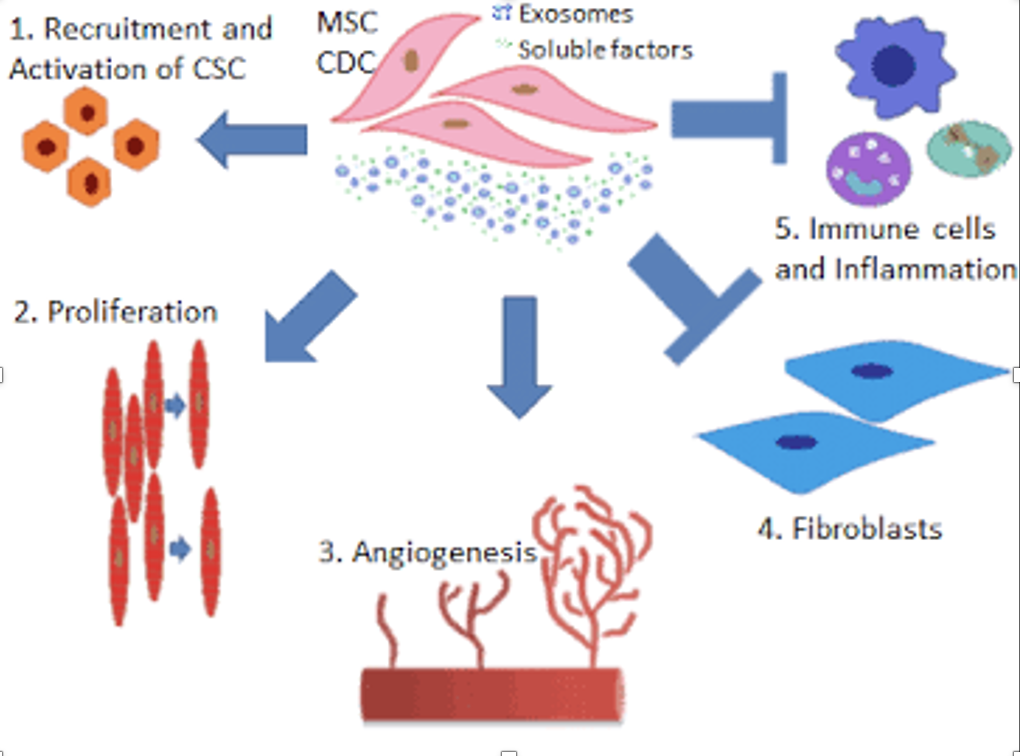
Mesenchymal cell paracrine pathways for immunomodulation and tissue matrix remodeling.
As detailed in the paracrine mechanism map above, the introduction of high-potency cell lines targets this complex network of cell-to-cell signaling lines. In a chronic muscular dystrophy environment left unmanaged, the continuous release of inflammatory signals prevents FAPs from executing their normal supportive roles. Instead, these progenitor cells multiply uncontrollably and undergo a pathological transformation, shifting away from tissue support and turning into fat and scar cells.
This process, known as fibro-fatty infiltration, systematically replaces functional muscle tissue with rigid, non-contractile collagen scars and fat deposits. This skeletal scar matrix suffocates surviving muscle cells, blocks the local vascular network, and alters normal neuromuscular junction stability, making it impossible for nerve signals to coordinate smooth muscle movement. By applying stem cell therapy bangkok thailand, clinical protocols seek to deliver specific paracrine factors that systematically suppress FAP overgrowth, helping the body clear away fibrotic tissue and restore an organized matrix landscape during tissue remodeling.
3. Molecular Signaling Transduction: Re-Programming the Skeletal Muscle Niche
Advanced applications of stem cell therapy bangkok thailand alter this progressive muscle decay by utilizing an elite biological strategy: paracrine transduction. When high-potency cellular formulations are introduced into the body, they utilize natural circulatory highways to migrate directly toward the high concentrations of distress chemokines released by damaged, ischemic muscle groups. Rather than operating as passive physical patches that manually turn into muscle cell-for-cell, their primary therapeutic mechanism is the continuous manufacture and targeted deployment of an active, anti-inflammatory and anabolic secretome payload.
Once settled within the Porous muscle niche, the cell lines deployed via stem cell therapy bangkok thailand execute a multi-layered molecular override to alter the chronic auto-inflammatory loop:
Inducing M1 to M2 Macrophage Polarization
Chronic tissue inflammation is a primary engine driving progressive muscle fiber destruction. Hyper-activated M1 macrophages flood the dystrophic stroma, continuously pumping out destructive cytokines like IL-1$beta$ and TNF-that accelerate fiber necrosis.
The cell lines deployed through stem cell therapy bangkok thailand counter this danger by releasing a powerful anti-inflammatory secretome payload, including Interleukin-10 (IL-10) and Transforming Growth Factor-beta (TGF-). This localized release neutralizes circulating inflammatory signals and forces hyper-activated immune cells to polarize into a calm, protective M2 repair phenotype, effectively turning off the central tissue fire.
Exosome-Mediated Myoblast Rescue and Mitochondrial Recovery
To stop unchecked muscle cell death, the cell lines deployed in stem cell therapy bangkok thailand discharge millions of microscopic, membrane-bound extracellular vesicles called exosomes directly into the muscle tissue space. These vesicles cross dense tissue boundaries to fuse with host muscle membranes, dropping off highly concentrated payloads of regulatory microRNAs, the most notably miR-1, miR-206, and miR-486 directly into the cytoplasm.
This microRNA payload downregulates pro-apoptotic pathways, protects remaining cells from calcium overload, and restores healthy mitochondrial ATP energy production, rescuing weak myoblasts from premature cell death.
Restoring Local Circulation via Neo-Angiogenesis
Stressed, fibrotic muscle groups experience progressive capillary narrowing and chronic tissue ischemia, which starves the remaining functional fibers of oxygen and vital nutrients. Advanced applications of stem cell therapy bangkok thailand actively resolve this restriction by releasing potent pro-angiogenic factors, primarily Vascular Endothelial Growth Factor (VEGF) and basic Fibroblast Growth Factor (bFGF). These signaling proteins command nearby endothelial cells to sprout a dense network of fresh micro-capillaries directly into the muscle tissue, restoring local blood flow and stabilizing the structural microenvironment.
4. Pathological Target Mapping Across the Musculoskeletal Ecosystem
To see how a targeted cell protocol maps across a degraded muscle axis to alter structural outcomes, it is useful to analyze the specific biological targets and their corresponding regenerative interventions:
| Target Muscle Niche Layer | Pathological Malfunction in Dystrophic Wasting | Cellular Regenerative Intervention | Key Semantic Entity |
| Sarcolemma Border | Suffers from chronic tearing and massive calcium ion influx, driving fiber necrosis. | Delivers targeted exosomal microRNAs to restore mitochondrial function and protect membrane borders. | Sarcolemmal holes, Fiber necrosis, Calcium ion influx |
| Satellite Cell Niche | Pushed into permanent replication exhaustion, losing all self-repair capacity. | Secretes anabolic growth factors to reduce skeletal fiber breakdown and support local matrix health. | Satellite cell niche exhaustion, Myoblast rescue |
| Skeletal Stroma | Hijacked by hyper-activated FAPs; experiences rapid fat and fibrotic scar accumulation. | Releases IL-10 and TGF-β to suppress FAP overproliferation and force an M2 repair transition. | Fibro-Adipogenic Progenitors, Fibro-fatty infiltration, Neuromuscular junction stability |
| Muscle Capillaries | Experience progressive narrowing and chronic hypoperfusion, starving local fibers. | Produces high volumes of VEGF and bFGF to activate capillary sprouting and restore local circulation. | Angiogenesis, VEGF signaling, Skeletal muscle ischemia |
Conclusion: Reclaiming Control of Your Physical Independence
Sarcolemmal membrane holes, fiber necrosis, and satellite cell niche exhaustion involve complex, aggressive biological processes, but patients and families do not have to remain locked in a purely reactive cycle of managing symptoms with temporary anti-inflammatory drugs while their underlying muscle health undergoes permanent degradation. Treating a deep cellular and microvascular failure with simple surface-level symptom suppression masks the physical decline without addressing the true biological crisis.
By choosing advanced, fresh cellular protocols through stem cell therapy bangkok thailand, you give your body the highly potent, youth-derived resources it needs to cool chronic muscle inflammation, protect surviving myoblasts from premature death, and support healthy structural tissue remodeling from the inside out. Embracing the cutting edge of regenerative medicine under strict quality control standards represents a powerful, proactive choice to avoid the constraints of progressive disease, protect your long-term mobility, and build a resilient foundation for your physical independence.