Our Services
Others
- DFPP
- Shockwave
- IV Drip

Stem cell therapy has emerged as one of the more closely watched research directions for Autism Spectrum Disorder (ASD) not as a replacement for existing care, but as a way of addressing neurological factors that behavioral and educational approaches were never designed to reach. ASD itself is a complex neurodevelopmental condition marked by difficulties with social interaction, communication, and behavior. Its exact causes still aren’t fully mapped out, but researchers generally point to a mix of genetic predisposition and environmental influence. What’s changed more recently is the growing interest in whether stem cell therapy in Thailand and elsewhere might help address some of the biological mechanisms increasingly linked to autism immune dysfunction, neuroinflammation, and irregular neural connectivity among them.
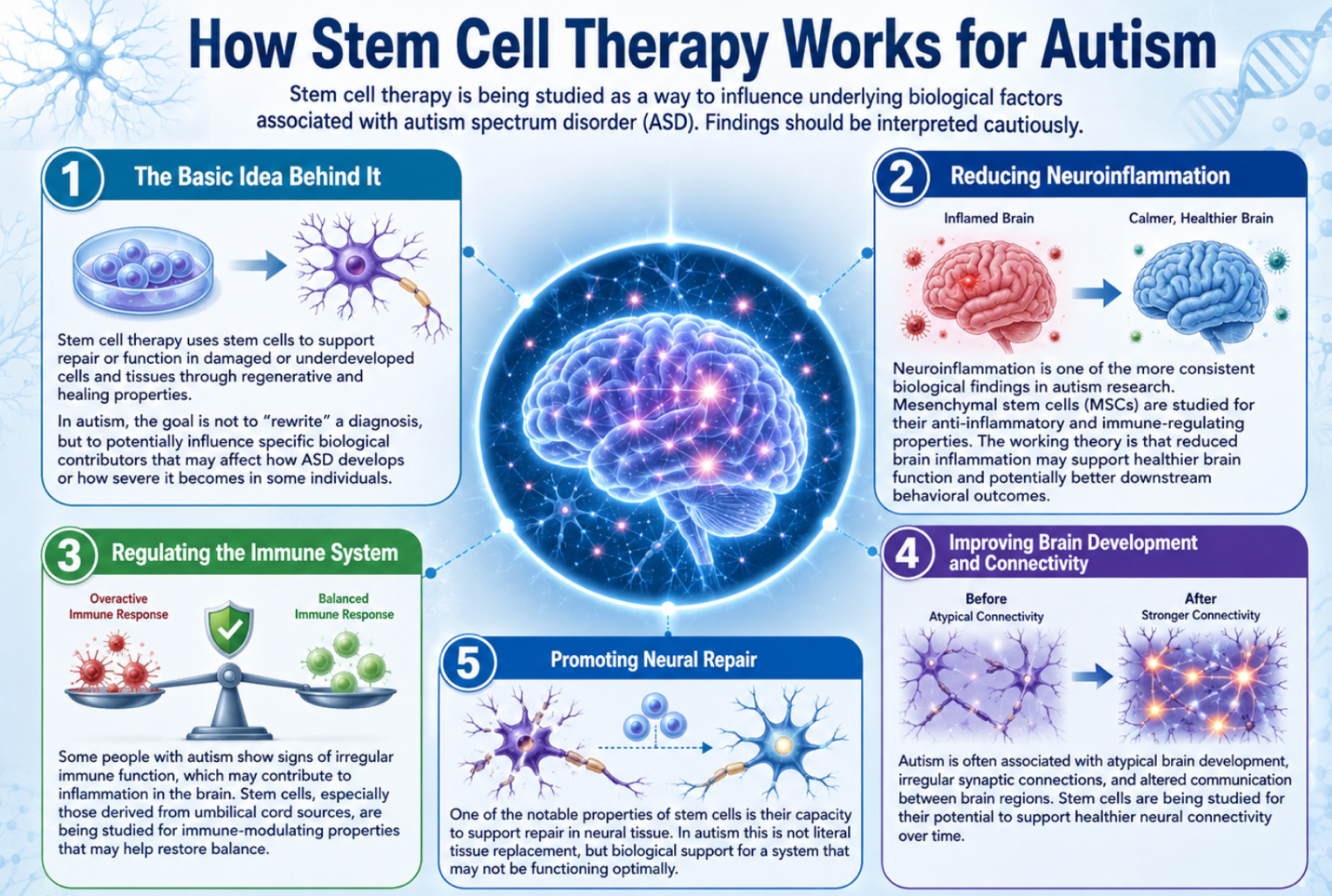
How Stem Cell Therapy Works for Autism
1.The Basic Idea Behind It
Stem cell therapy uses stem cells to repair or support damaged or underdeveloped cells and tissue, drawing on their natural regenerative and healing properties. Applied to autism, the hope isn’t that stem cells rewrite a diagnosis it’s that they might address specific biological contributors that appear to influence how ASD develops or how severe it becomes for a given individual.
2.Reducing Neuroinflammation
Neuroinflammation shows up often in individuals with autism, and it’s one of the more consistent biological findings across the research. Mesenchymal Stem Cells (MSCs) have demonstrated real ability to reduce inflammation and regulate immune response. The underlying theory is straightforward: less brain inflammation may support better brain function and, downstream, better behavioral outcomes.
3.Regulating the Immune System
A lot of people with autism show signs of a compromised or irregular immune system, which can itself drive inflammation in the brain. Stem cells particularly those derived from umbilical cord blood carry immune-modulating properties that researchers believe could help restore some balance here, potentially easing certain symptoms tied to immune dysregulation.
4.Improving Brain Development and Connectivity
Autism is frequently associated with atypical brain development, including irregular synaptic connections and disrupted communication between brain regions. Stem cells are being studied for their potential to support more typical neural connectivity, which researchers hope could ease some behavioral and cognitive challenges over time.
5.Promoting Neural Repair
One of the more distinctive properties of stem cells is their capacity to help regenerate damaged neural tissue. In autism, where atypical brain development may already be contributing to cognitive and behavioral difficulties, this repair capacity is part of what makes stem cells worth studying not as tissue replacement in a literal sense, but as biological support for a system that isn’t functioning optimally.
Why Researchers Turned to Stem Cells for Autism
The rationale isn’t complicated, even if the biology behind it is. It comes down to three connected ideas:
Autism may involve immune dysfunction or neuroinflammation in at least a meaningful subset of cases.
Mesenchymal stem cells (MSCs) carry genuine anti-inflammatory and immunomodulatory properties, which is well established in broader stem cell research.
These properties might translate into better brain function by reducing inflammation or supporting improved communication between neurons.
That’s a narrower, more defensible claim than saying stem cells fix autism and it’s the version of the story that holds up when you actually look at the clinical literature.
What the Clinical Evidence Actually Shows
A Look at the Systematic Reviews
A 2021 systematic review and meta-analysis published in Stem Cell Reviews and Reports pooled data from 11 trials covering 461 patients, assessing cognitive and behavioral outcomes. The review reported measurable improvements on the Autism Behavior Checklist (ABC) and the Childhood Autism Rating Scale (CARS) in the intervention groups. It’s worth being precise about what that means: this was a pooled analysis of mostly small, heterogeneous trials sample sizes in the individual studies ranged from roughly a dozen to under twenty patients and the confidence intervals on some outcome measures were wide. That’s not a reason to dismiss the findings, but it is a reason to treat them as an early signal rather than confirmed proof.
A Closer Look at One Individual Trial
A 2020 open-label clinical trial conducted at Vinmec International Hospital in Hanoi, and published in STEM CELLS Translational Medicine, examined autologous bone marrow mononuclear cell transplantation combined with structured educational intervention in 30 children with ASD. Over an 18-month follow-up period, researchers reported improvements in social communication, language, and daily living skills. The study’s authors and independent commentary afterward were consistent on one point: these results are genuinely encouraging, but they come from a single-arm, open-label design without a placebo comparison group, which limits how confidently the improvement can be attributed to the cell therapy itself versus the educational intervention or natural developmental progress.
Reading These Results Honestly
Put together, what the evidence supports today is this: stem cell therapy for autism shows real, reproducible safety signals and some encouraging efficacy signals on standardized behavioral scales. What it doesn’t yet show is large-scale, placebo-controlled confirmation that would justify treating it as an established, guaranteed intervention. Reviews in this space consistently use words like promising and emerging for a reason that’s genuinely where the science sits right now.
The Cell Types Behind This Research
Mesenchymal stem cells, particularly those sourced from umbilical cord tissue and umbilical cord blood, remain the most researched and most commonly used cell type in autism-focused studies. Their appeal comes down to a combination of anti-inflammatory activity, immune-modulating properties, and a strong safety track record across a wide range of clinical applications not just autism specifically.
Why Thailand Has Become a Hub for This Research
Stem cell therapy in Thailand has grown into a genuine center for regenerative medicine research and clinical application, built around GMP-certified processing laboratories, physicians trained in both regenerative medicine and pediatrics, and active collaboration with research institutions studying UC-MSC and related cell therapies in ASD populations specifically. That combination clinical infrastructure paired with ongoing research is a meaningful part of why families researching options internationally increasingly consider Thailand a serious option rather than a fallback.
Regenerative Support at Vegastemcell
An Individualized Treatment Pathway
Vegastemcell’s approach to autism stem cell treatment in Thailand begins with a full medical evaluation specific to the child in question, followed by physician-supervised administration of UC-MSC therapy and structured post-treatment follow-up to track progress over time not a fixed package applied identically to every patient.
Quality Standards Families Can Verify
Cells used are umbilical cord–derived, ethically sourced from consenting donors following healthy births, and laboratory-tested for purity, viability, and sterility before use. That’s the baseline standard a family should be able to confirm with any provider, not just take on faith.
Frequently Asked Questions
Does stem cell therapy cure autism?
No. The research supports it as a way of addressing certain biological factors inflammation, immune imbalance, neural connectivity associated with autism, not as a cure. It’s studied and used alongside established behavioral and developmental care, not as a replacement for it.
What does the clinical evidence actually show?
A 2021 meta-analysis of 11 trials and 461 patients found measurable improvements on standardized behavioral scales (ABC and CARS). A 2020 trial in 30 children reported improvements in social communication, language, and daily living skills over 18 months. Both are genuinely encouraging, but neither represents large-scale, placebo-controlled proof of efficacy.
What type of stem cells are used in autism research?
Mesenchymal stem cells, particularly those derived from umbilical cord tissue and cord blood, are the most studied and most commonly used cell type in this field.
Is stem cell therapy for autism safe?
Across the published research, safety signals have been consistently favorable, with side effects generally described as mild and temporary. Long-term data is still accumulating, which is why physician oversight throughout treatment matters.
Why do families consider stem cell therapy in Thailand specifically?
Stem cell therapy in Thailand combines certified laboratories, specialized regenerative medicine physicians, and active research ties a combination that’s made it a credible destination for families exploring UC-MSC therapy for ASD internationally.
Where This Leaves Families
Stem cell therapy is being investigated as a potential complementary approach for autism spectrum disorder because of the genuine regenerative and immunomodulatory properties of the cells involved. Researchers continue exploring how these properties might address immune dysfunction, inflammation, and neural development issues associated with ASD and the early clinical data, while limited, points in an encouraging direction rather than a discouraging one. If you’re trying to understand whether stem cell therapy in Thailand could have a role in your family’s approach to autism care, book a consultation with Vegastemcell for a personalized assessment grounded in your child’s actual medical picture.
For more infomation you can reach me directly on WhatsApp or Email. Here’s our official link:
WhatsApp :+66982509599
Email : vegastemcell@gmail.com
References
Sun, J.M., et al. (2021). Stem Cell Therapy in the Treatment of Patients With Autism Spectrum Disorder: A Systematic Review and Meta-analysis. Stem Cell Reviews and Reports. https://link.springer.com/article/10.1007/s12015-021-10257-0 (11 trials, 461 patients; ABC and CARS scale improvements reported, with wide confidence intervals reflecting small individual study sizes.)
Nguyen Thanh, L., Nguyen, H.P., Ngo, M.D., et al. (2021). Outcomes of Bone Marrow Mononuclear Cell Transplantation Combined With Interventional Education for Autism Spectrum Disorder. Stem Cells Translational Medicine, 10(1), 14–26. https://doi.org/10.1002/sctm.20-0102 — full text: https://www.ncbi.nlm.nih.gov/pmc/articles/PMC7780798/ (Open-label trial, 30 children, Vinmec International Hospital, Hanoi; 18-month follow-up.)
A Systematic Review and Meta-Analysis of Stem Cell Therapy in Children With Autism Spectrum Disorders. PMC. https://www.ncbi.nlm.nih.gov/pmc/articles/PMC9114801/ (A more conservative, later meta-analysis of 5 controlled studies — reports a significant CARS improvement but a non-significant Clinical Global Impression result, illustrating why outcome measure choice affects how positive the evidence looks.)
Hematopoietic Stem Cell Therapy in Improving Clinical Outcomes for Children with Autism Spectrum Disorder: A Systematic Review and Meta-Analysis. Regenerative Engineering and Translational Medicine. https://link.springer.com/article/10.1007/s40883-024-00355-z
Finlay-Morreale, H. (2021). Invasive Therapy for Children With Autism Is Not Justified. Stem Cells Translational Medicine, 10(6), 826. https://pubmed.ncbi.nlm.nih.gov/34010521/ (A published critical response to reference #2 above — worth reading precisely because it disagrees. It raises concerns about invasiveness and risk-benefit balance in pediatric trials, which is a legitimate part of this scientific conversation.)
Immunomodulatory Mechanisms and Therapeutic Potential of Mesenchymal Stem Cells. Stem Cell Reviews and Reports. https://link.springer.com/article/10.1007/s12015-023-10539-9