Our Services
Others
- DFPP
- Shockwave
- IV Drip

Venous leg ulcers (VLUs) are the most common type of chronic leg wound, affecting an estimated 2% of the general population at some point, and at least 2 million people every year in the United States alone. Unlike a diabetic foot ulcer or a pressure sore, a venous ulcer has a very specific root cause failing valves in the leg veins which means the most effective treatments need to address that mechanism directly, not just the open wound itself. This guide focuses specifically on venous leg ulcers: why they form, why compression therapy alone often isn’t enough, and what current stem cell research actually shows for this particular wound type.
Most chronic wounds share overlapping risk factors, but VLUs have a genuinely distinct mechanism behind them: chronic venous insufficiency.
Veins in the legs rely on one-way valves to push blood back up toward the heart against gravity. When those valves weaken or fail, blood pools in the lower leg instead a condition called venous reflux. Duplex ultrasound studies consistently confirm superficial or deep venous reflux in patients with VLUs, and it’s the underlying driver in the overwhelming majority of cases.
Persistent venous pressure damages the surrounding skin and soft tissue over time, eventually breaking down into an open ulcer typically around the ankle, where venous pressure is highest. This differs meaningfully from a diabetic ulcer (driven by nerve damage and microvascular disease) or a pressure ulcer (driven by sustained mechanical pressure), even though all three can look similar once the wound has formed.
Even after a venous ulcer closes, the underlying venous insufficiency hasn’t gone anywhere. Without addressing that root mechanism, recurrence rates for venous ulcers remain a well-documented, ongoing challenge a distinct problem from other chronic wound types where recurrence is driven more by systemic disease progression.
Compression therapy typically multilayer bandaging remains the backbone of standard VLU treatment, alongside routine wound care. It works by counteracting the venous pressure directly, and for many patients, it’s genuinely effective. But a meaningful subset of patients don’t respond adequately even after 12 weeks or more of consistent, guideline-standard compression and wound care a group researchers specifically classify as having treatment-refractory or recalcitrant venous ulcers. As one clinical review put it plainly: medical and surgical therapies exist for VLUs, but a definitive cure does not. This is the specific patient population where stem cell therapy has drawn the most clinical research interest.
This is worth walking through carefully, because VLU research has produced some of the more concrete human clinical trial data in the chronic wound space.
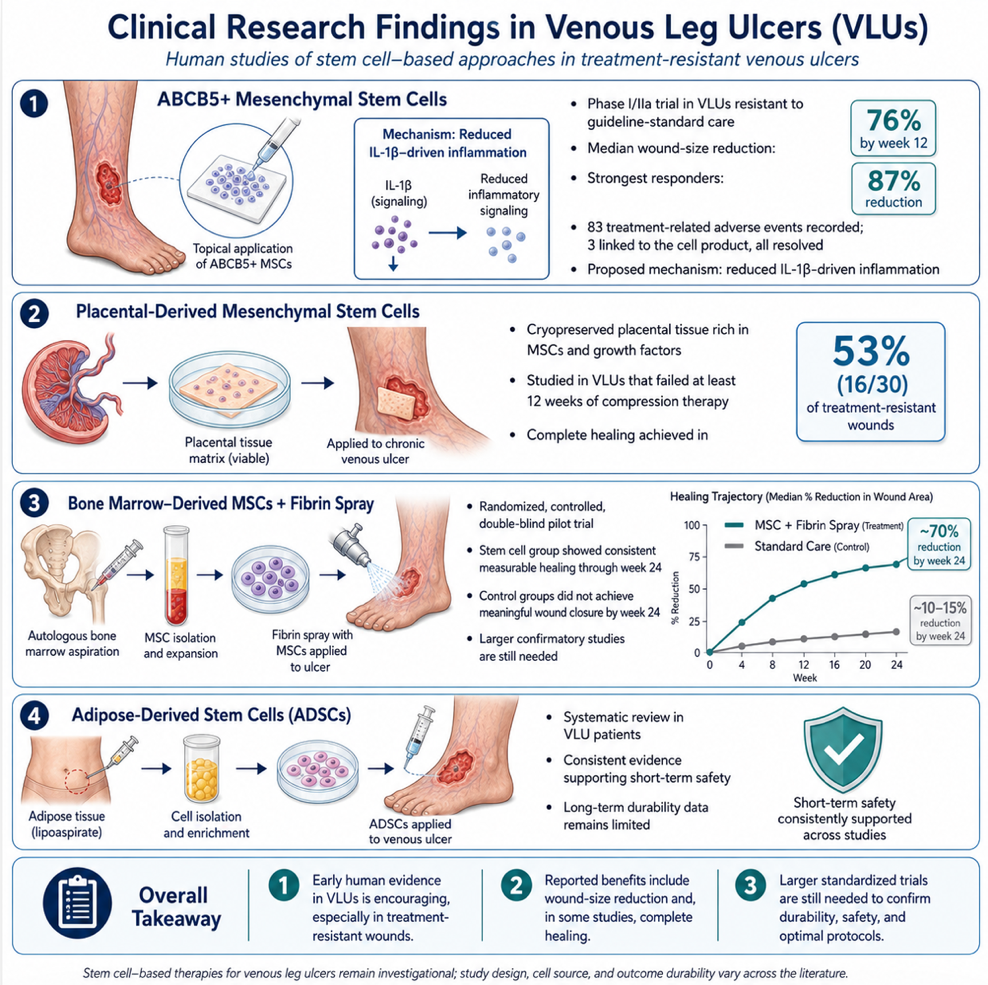
A phase I/IIa clinical trial tested ABCB5+ mesenchymal stem cells applied topically, in addition to standard care specifically in patients whose venous ulcers had already proven resistant to guideline-standard treatment. The results were notable: wound size dropped by a median of 76% by week 12 across the full study group, and by 87% among the strongest responders. Of 83 treatment-related adverse events recorded, only three were judged related to the cell product itself, and all resolved without lasting effects. The proposed mechanism is specific to venous ulcer biology: ABCB5+ MSCs appear to dampen the sustained IL-1β–driven inflammation that keeps these wounds locked open.
A separate study using a human viable wound matrix made from cryopreserved placental tissue rich in MSCs and active growth factors was tested specifically in VLUs that had already failed at least 12 weeks of standard compression therapy. Complete ulcer healing was achieved in 53% (16 of 30) of these previously treatment-resistant wounds.
A randomized, controlled, double-blind pilot trial combined autologous bone marrow-derived MSCs with a fibrin spray delivery system. Neither control group achieved meaningful wound closure by week 24, while the stem cell group showed consistent, measurable healing throughout the trial a statistically significant difference in healing rate. The researchers were careful to note that while the results were promising, larger studies are still needed to confirm the finding.
A systematic review specifically examining adipose-derived stem cells in VLU patients found consistent evidence supporting safety, though the review authors noted that data on long-term durability of results remains more limited than data on short-term safety and initial response.
A phase II clinical trial currently underway in China is specifically evaluating umbilical cord–derived mesenchymal stem cells (UC-MSCs) for refractory skin ulcers, including venous leg ulcers, with results expected as the study progresses.
Chronic venous ulcers stay open partly because of a specific, sustained inflammatory signal. MSC-based therapy appears to interrupt that signal directly, rather than just providing general anti-inflammatory support.
Unlike a diabetic ulcer, where poor blood supply is the core problem, a venous ulcer actually has a circulation excess problem blood pooling rather than blood shortage. Even so, stem cell-released growth factors like VEGF support the formation of new, functional microvessels that help clear the local tissue congestion and support repair.
Placental and umbilical cord–sourced MSC products carry a naturally rich supply of active growth factors, which is part of why these specific sources have drawn research attention for VLUs particularly.
No and this is genuinely important. In every major clinical trial referenced here, stem cell therapy was studied as an addition to standard care, not a replacement for it. Compression therapy addresses the actual venous pressure driving the ulcer in the first place; stem cell therapy is being studied specifically for the subset of patients whose wounds don’t close even with that foundational treatment in place. Continuing to manage the underlying venous insufficiency remains essential regardless of what other therapy is added.
Based on how this research is actually structured, stem cell therapy for venous leg ulcers is typically most relevant for patients whose ulcers:
As always, candidacy requires a full vascular and medical evaluation. You can review the conditions we treat on our stem cell therapy page or see real patient outcomes on our results page.
How is a venous leg ulcer different from a diabetic foot ulcer? A venous ulcer stems from failing vein valves and blood pooling (venous reflux); a diabetic ulcer stems primarily from nerve damage and small-vessel disease. They can look similar but require different underlying management.
Does stem cell therapy fix the vein problem causing the ulcer? No, current research targets the wound’s inflammatory and healing environment, not the underlying valve dysfunction. Compression therapy and, in some cases, vein-specific procedures remain necessary to address venous reflux itself.
How long before a venous ulcer is considered “treatment-refractory”? Most clinical trials use 12 weeks of consistent standard therapy without adequate healing as the threshold for considering additional interventions like stem cell therapy.
Is stem cell therapy for venous ulcers proven, or still experimental? It’s an active, promising area of clinical research phase I/II and phase I/IIa human trials have shown meaningful wound size reduction with a favorable safety profile but it isn’t yet an established, first-line standard of care. Larger confirmatory trials are still underway.
This article is for informational purposes only and does not constitute medical advice. Stem cell therapy candidacy for venous leg ulcers should be determined by a qualified physician following a full medical and vascular evaluation, and does not replace standard compression therapy. Book a consultation with our clinical team to discuss your specific case.