Our Services
Others
- DFPP
- Shockwave
- IV Drip

Every child on the Autism Spectrum Disorder the world a little differently some face mild social friction, others navigate much steeper challenges with communication, sensory processing, or daily learning. That range is part of what makes Autism Spectrum Disorder (ASD) so hard to treat with one single approach. It’s also part of why families keep searching for something more than symptom management, and why stem cell therapy for autism keeps coming up in that search.
Standard care behavioral therapy, speech and occupational support, structured education remains the backbone of autism treatment, and for good reason: it works. But these approaches largely help children cope with and adapt around their symptoms rather than addressing what may be driving them biologically. That’s the gap stem cell therapy in Thailand is stepping into, with a growing number of clinical programs built specifically around Umbilical Cord–derived Mesenchymal Stem Cells (UC-MSCs).
What Makes UC-MSCs Different From Other Stem Cells
Unspecialized Cells With Specialized Potential
Stem cells are unique in their ability to self-renew and differentiate into many specialized cell types including neurons and the glial cells that support brain function. Mesenchymal stem cells sourced from umbilical cord tissue are particularly well studied for neurological and immune-related conditions, largely because of their strong safety profile and ethical sourcing: cords are collected from consenting donors after healthy deliveries, with no embryonic tissue involved.
Restoring Balance, Not Claiming a Cure
In the context of ASD, UC-MSC therapy aims to restore a kind of internal balance calming inflammation, regulating immune activity, and supporting neural repair rather than promising to eliminate autism itself. The goal is a more balanced biological environment, one that may support cognitive and social development alongside the therapies already in place.
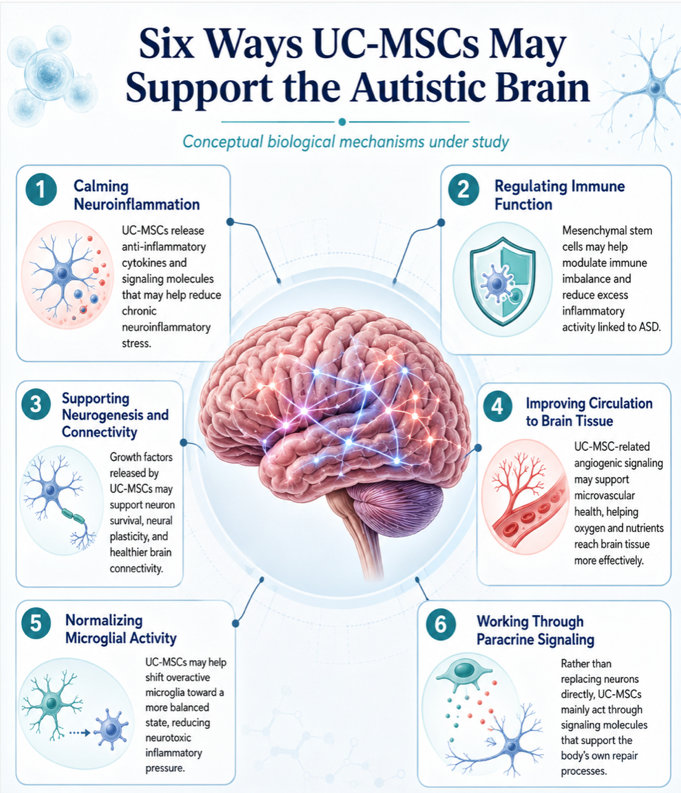
Six Ways UC-MSCs May Support the Autistic Brain
Calming Neuroinflammation
Chronic inflammation in the brain can interfere with neural signaling and development. UC-MSC stem cell therapy secrete anti-inflammatory molecules and cytokines that help quiet an overactive immune response, supporting a neural environment more conducive to learning and communication.
Regulating Immune Function
Immune imbalance including elevated inflammatory markers shows up frequently in children with ASD. Mesenchymal stem cell therapy for ASD helps modulate that immune activity, reducing excess inflammation while supporting healthier immune responses, which may lower systemic inflammation with downstream benefits for brain function.
Supporting Neurogenesis and Connectivity
UC-MSC stem cell therapy release growth factors that support the survival and growth of neurons and glial cells, potentially stimulating new neural pathways or strengthening existing ones a process linked to improved brain plasticity.
Improving Circulation to Brain Tissue
One mechanism that doesn’t get discussed enough: UC-MSC stem cell therapy promote angiogenesis, the formation of new blood vessels. Better circulation means better oxygen and nutrient delivery to brain tissue, which may help optimize metabolism and repair processes at the cellular level.
Normalizing Microglial Activity
Microglia the brain’s resident immune cells can become chronically overactive in ASD, driving sustained inflammation. UC-MSC stem cell therapy help bring microglial activity back toward a normal range, reducing neurotoxic effects and supporting more balanced brain function overall.
Working Through Paracrine Signaling
Rather than replacing neurons directly, UC-MSC stem cell therapy largely work through paracrine signaling releasing molecules that activate the body’s own repair systems. This approach reduces oxidative stress and supports natural healing capacity, working with the body’s existing biology instead of trying to override it.
Why Families Are Drawn to This Approach
It Targets Biology, Not Just Behavior
Rather than focusing purely on behavioral coping strategies, regenerative medicine for autism goes after the neuroinflammation and immune dysregulation that may underlie many ASD symptoms in the first place.
It’s Minimally Invasive
Allogeneic UC-MSC stem cell therapy eliminate the need for surgical cell harvesting, keeping the procedure relatively simple with a favorable safety profile.
It Works Alongside Existing Therapies
Umbilical cord stem cell treatment for autism isn’t designed to replace behavioral or educational programs it’s built to be integrated with them, supporting the biological side of development while established therapies handle the rest.
Why Thailand Leads in Regenerative Autism Care
Thailand has built a genuinely strong regenerative medicine ecosystem, combining medical innovation with structured oversight. A few things set it apart:
Clinical expertise physicians specializing in regenerative neurology and pediatrics collaborate closely with researchers to refine autism-specific protocols.
Research collaboration — local universities and medical centers participate in observational studies and pilot clinical work exploring stem cell–based interventions in ASD.
Regulatory oversight — clinics operate under Thai regulatory bodies and institutional review boards, which monitor safety, ethical conduct, and transparency across treatment programs.
That combination of infrastructure and oversight is a big part of why stem cell therapy in Thailand has become a trusted option for families rather than a fringe one.
Regenerative Support at Veg Medical Services
The Treatment Pathway
Vega Medical Services’s protocol for autism stem cell treatment in Thailand runs through a physician-supervised pathway: an initial medical evaluation, UC-MSC administration under clinical supervision, and structured follow-up to track progress over time.
Quality and Safety Standards
Cells are umbilical cord–derived, sourced from consenting donors after healthy births, and laboratory-tested for purity, viability, and sterility before ever reaching a patient. It’s this combination of ethical sourcing and rigorous lab standards that makes the protocol something families can actually trust.
Frequently Asked Questions
Does UC-MSC therapy cure autism?
No. It’s designed to support the biological environment associated with ASD inflammation, immune balance, neural connectivity alongside the behavioral and developmental therapies that remain central to autism care.
What results have families reported?
Early reports describe improvements in attention, speech, emotional regulation, and social responsiveness in some children, though individual outcomes vary and continued research is ongoing.
Is this treatment safe?
UC-MSC therapy uses allogeneic (donor-derived) cells, which avoids surgical harvesting and keeps the procedure minimally invasive. Cells are lab-tested before use, and treatment is delivered under physician supervision.
Can this be combined with behavioral therapy?
Yes, it’s specifically designed to complement, not replace, behavioral and educational programs already in place.
Why do so many families choose Thailand specifically?
Thailand pairs strong clinical infrastructure with active research collaboration and regulatory oversight, making stem cell therapy in Thailand one of the more established and accessible options globally for families exploring UC-MSC therapy.
Taking the Next Step
Autism care doesn’t have a single answer, and no family should feel like they’re choosing between “standard therapy” and “hope.” UC-MSC therapy is designed to sit alongside the care already working for your child, not replace it. If you’d like to understand whether stem cell therapy in Thailand could be part of your family’s path forward, book a consultation with Vegastemcell for a personalized evaluation.
This article is for general informational purposes and is not medical advice. UC-MSC therapy for autism is a developing area of research with individually variable results, and is intended to complement — not replace — established behavioral and developmental care. Please consult a qualified physician before making treatment decisions.